
托法替布对类风湿关节炎和银屑病关节炎患者残留疼痛的影响。
The effect of tofacitinib on residual pain in patients with rheumatoid arthritis and psoriatic arthritis.
机构信息
Department of Rheumatology, Hôpital Cochin, Université de Paris, Paris, France
Botnar Research Centre, Nuffield Department of Orthopaedics, Rheumatology and Musculoskeletal Sciences, University of Oxford, Oxford, UK.
出版信息
RMD Open. 2022 Sep;8(2). doi: 10.1136/rmdopen-2022-002478.
OBJECTIVE
Post hoc analysis of pooled data from nine randomised controlled trials to assess the effect of tofacitinib (oral Janus kinase inhibitor for treatment of rheumatoid arthritis (RA) and psoriatic arthritis (PsA)) on residual pain in patients with RA or PsA with abrogated inflammation.
METHODS
Patients who received ≥1 dose of tofacitinib 5 mg twice daily, adalimumab or placebo with/without background conventional synthetic disease-modifying antirheumatic drugs and had abrogated inflammation (swollen joint count (SJC)=0 and C reactive protein (CRP)<6 mg/L) after 3 months' therapy were included. Assessments included Patient's Assessment of Arthritis Pain at month 3 (Visual Analogue Scale [VAS] 0-100 mm). Scores were summarised descriptively; treatment comparisons assessed by Bayesian network meta-analyses (BNMA).
RESULTS
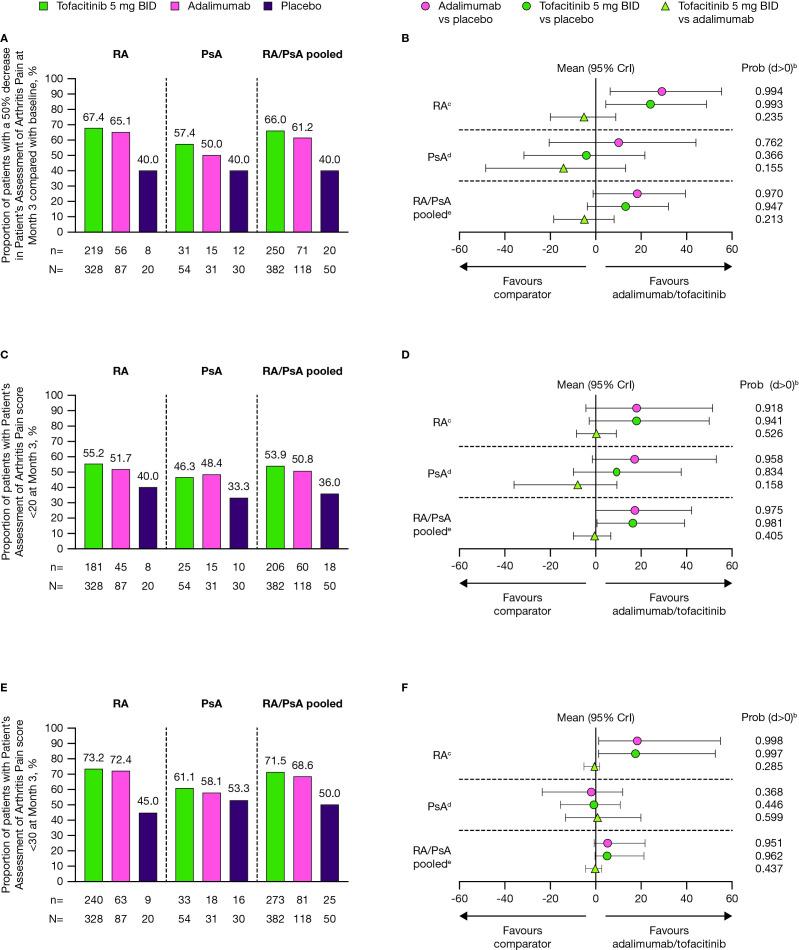
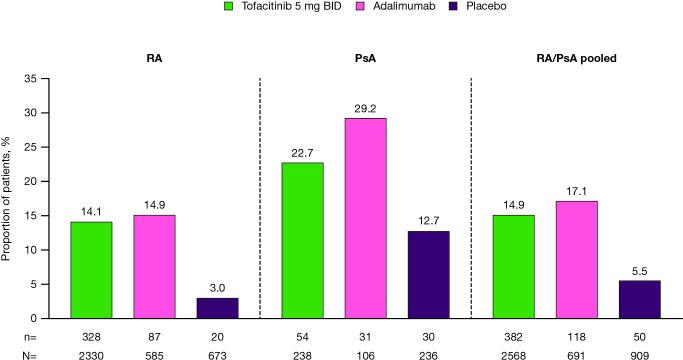
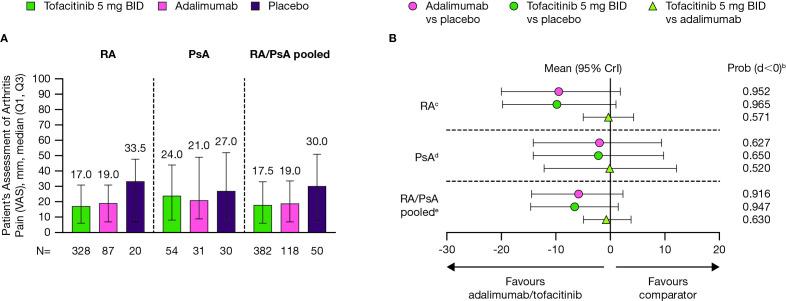
From the total population with RA/PsA, 14.9% (382 of 2568), 17.1% (118 of 691) and 5.5% (50 of 909) of patients receiving tofacitinib, adalimumab and placebo, respectively, had abrogated inflammation after 3 months' therapy. Patients with RA/PsA with abrogated inflammation receiving tofacitinib/adalimumab had higher baseline CRP versus placebo; patients with RA receiving tofacitinib/adalimumab had lower SJC and longer disease duration versus placebo. Median residual pain (VAS) at month 3 was 17.0, 19.0 and 33.5 in patients with RA treated with tofacitinib, adalimumab or placebo, and 24.0, 21.0 and 27.0 in patients with PsA, respectively. Residual pain reductions with tofacitinib/adalimumab versus placebo were less prominent in patients with PsA versus patients with RA, with no significant differences between tofacitinib/adalimumab, per BNMA.
CONCLUSION
Patients with RA/PsA with abrogated inflammation receiving tofacitinib/adalimumab had greater residual pain reduction versus placebo at month 3. Results were similar between tofacitinib and adalimumab.
TRIAL REGISTRATION NUMBER
ClinicalTrials.gov registry (NCT00960440; NCT00847613; NCT00814307; NCT00856544; NCT00853385; NCT01039688; NCT02187055; NCT01877668; NCT01882439).
目的
对 9 项随机对照试验的汇总数据进行事后分析,以评估托法替尼(治疗类风湿关节炎(RA)和银屑病关节炎(PsA)的口服 Janus 激酶抑制剂)对炎症消退的 RA 或 PsA 患者残留疼痛的影响。
方法
纳入接受托法替尼 5mg,每日两次,阿达木单抗或安慰剂治疗,且在治疗 3 个月后炎症消退(肿胀关节计数(SJC)=0 和 C 反应蛋白(CRP)<6mg/L)的患者。评估包括患者在第 3 个月时的关节炎疼痛评估(视觉模拟量表[VAS]0-100mm)。评分采用描述性方法总结;通过贝叶斯网络荟萃分析(BNMA)评估治疗比较。
结果
在 RA/PsA 总人群中,分别有 14.9%(2568 例中的 382 例)、17.1%(691 例中的 118 例)和 5.5%(909 例中的 50 例)的患者接受托法替尼、阿达木单抗和安慰剂治疗后炎症消退。炎症消退的 RA/PsA 患者接受托法替尼/阿达木单抗治疗时 CRP 水平高于安慰剂;接受托法替尼/阿达木单抗治疗的 RA 患者 SJC 较低,疾病持续时间较长。RA 患者在第 3 个月时的中位残留疼痛(VAS)分别为托法替尼、阿达木单抗和安慰剂组的 17.0、19.0 和 33.5,而 PsA 患者分别为 24.0、21.0 和 27.0。与安慰剂相比,托法替尼/阿达木单抗在 RA 患者中减轻的残留疼痛程度大于在 PsA 患者中,且 BNMA 分析无显著差异。
结论
炎症消退的 RA/PsA 患者接受托法替尼/阿达木单抗治疗后第 3 个月的残留疼痛减轻程度大于安慰剂。托法替尼与阿达木单抗的结果相似。
试验注册
ClinicalTrials.gov 注册(NCT00960440;NCT00847613;NCT00814307;NCT00856544;NCT00853385;NCT01039688;NCT02187055;NCT01877668;NCT01882439)。
 Zotero 插件