
III期非小细胞肺癌的治疗新趋势
Evolving Therapeutic Scenario of Stage III Non-Small-Cell Lung Cancer.
作者信息
Baudoux Nathalie, Friedlaender Alex, Addeo Alfredo
机构信息
Oncology Department, Geneva University Hospitals, Geneva, Switzerland.
Oncology Service, Clinique Générale Beaulieu, Geneva, Switzerland.
出版信息
Clin Med Insights Oncol. 2023 Feb 14;17:11795549231152948. doi: 10.1177/11795549231152948. eCollection 2023.
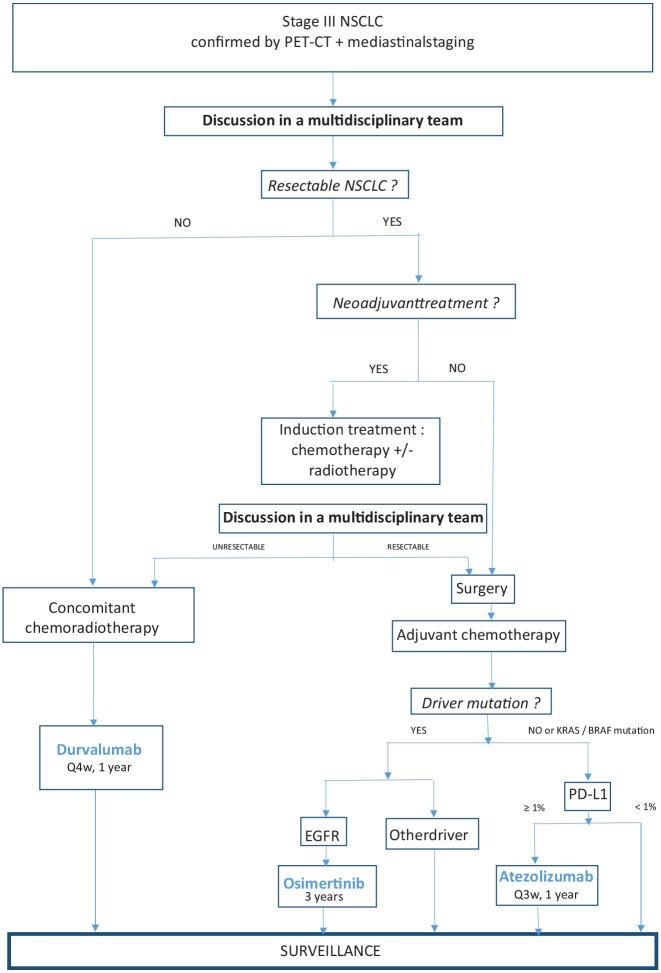
Lung cancer remains the leading cause of cancer-related death with an incidence that continues to increase in both sexes and all ages. However, 80% to 90% of lung cancers are non-small cell lung cancer (NSCLC) and the remaining 10% to 20% are small cell lung cancer. Adenocarcinoma is the most common histologic subtype of lung cancer worldwide. More frequently, lung cancer diagnosis is made in advanced stages. Stage III NSCLC refers to locoregionally advanced disease without metastases and represents about 30% NSCLC cases. Despite the absence of metastases at diagnosis, the outcome is generally poor. Stage III comprises a heterogeneous group and optimal management requires the input of a multidisciplinary team. All modalities of oncologic treatment are involved: surgery, chemotherapy, radiotherapy, and more recently, immunotherapy and targeted therapy. We will discuss the different therapeutic options in stage III NSCLC, both in operable and inoperable scenarios, and the role of immunotherapy and targeted therapy.
肺癌仍然是癌症相关死亡的主要原因,其发病率在各性别和各年龄段中持续上升。然而,80%至90%的肺癌是非小细胞肺癌(NSCLC),其余10%至20%是小细胞肺癌。腺癌是全球范围内最常见的肺癌组织学亚型。肺癌更常于晚期被诊断出来。III期NSCLC指的是无转移的局部区域晚期疾病,约占NSCLC病例的30%。尽管在诊断时没有转移,但其总体预后通常较差。III期包含一组异质性疾病,最佳治疗需要多学科团队的参与。肿瘤治疗的所有方式都涉及其中:手术、化疗、放疗,以及最近的免疫疗法和靶向疗法。我们将讨论III期NSCLC在可手术和不可手术情况下的不同治疗选择,以及免疫疗法和靶向疗法的作用。
 Zotero 插件