
人工智能在城市中国社区为基础的糖尿病视网膜病变远程医疗筛查中的应用:基于真实世界数据的成本效果和成本效益分析。
Artificial Intelligence in Community-Based Diabetic Retinopathy Telemedicine Screening in Urban China: Cost-effectiveness and Cost-Utility Analyses With Real-world Data.
机构信息
Department of Eye Disease Prevention and Control, Shanghai Eye Disease Prevention and Treatment Center/Shanghai Eye Hospital, Shanghai, China.
Shanghai Key Laboratory of Ocular Fundus Diseases, Shanghai General Hospital, Shanghai Engineering Center for Visual Science and Photomedicine, Shanghai, China.
出版信息
JMIR Public Health Surveill. 2023 Feb 23;9:e41624. doi: 10.2196/41624.
BACKGROUND
Community-based telemedicine screening for diabetic retinopathy (DR) has been highly recommended worldwide. However, evidence from low- and middle-income countries (LMICs) on the choice between artificial intelligence (AI)-based and manual grading-based telemedicine screening is inadequate for policy making.
OBJECTIVE
The aim of this study was to test whether the AI model is more worthwhile than manual grading in community-based telemedicine screening for DR in the context of labor costs in urban China.
METHODS
We conducted cost-effectiveness and cost-utility analyses by using decision-analytic Markov models with 30 one-year cycles from a societal perspective to compare the cost, effectiveness, and utility of 2 scenarios in telemedicine screening for DR: manual grading and an AI model. Sensitivity analyses were performed. Real-world data were obtained mainly from the Shanghai Digital Eye Disease Screening Program. The main outcomes were the incremental cost-effectiveness ratio (ICER) and the incremental cost-utility ratio (ICUR). The ICUR thresholds were set as 1 and 3 times the local gross domestic product per capita.
RESULTS
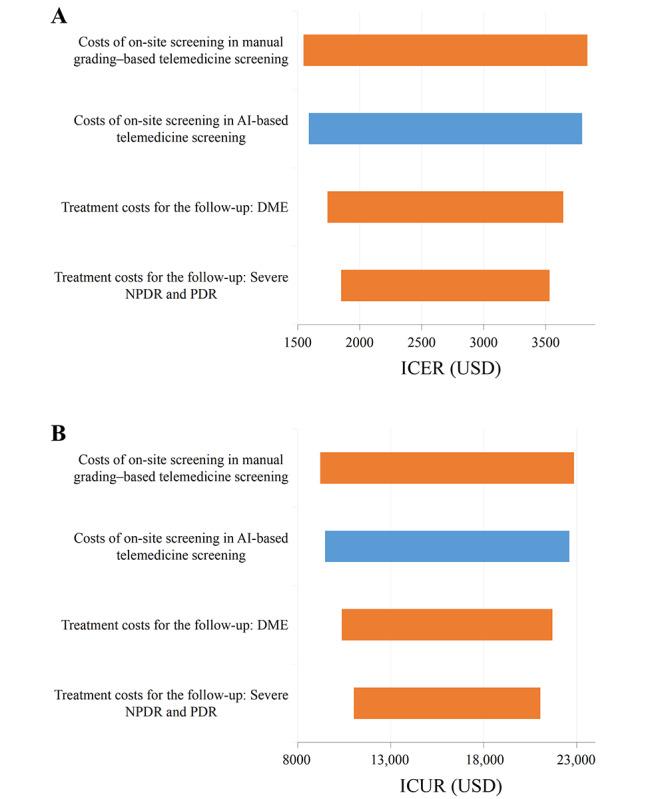
The total expected costs for a 65-year-old resident were US $3182.50 and US $3265.40, while the total expected years without blindness were 9.80 years and 9.83 years, and the utilities were 6.748 quality-adjusted life years (QALYs) and 6.753 QALYs in the AI model and manual grading, respectively. The ICER for the AI-assisted model was US $2553.39 per year without blindness, and the ICUR was US $15,216.96 per QALY, which indicated that AI-assisted model was not cost-effective. The sensitivity analysis suggested that if there is an increase in compliance with referrals after the adoption of AI by 7.5%, an increase in on-site screening costs in manual grading by 50%, or a decrease in on-site screening costs in the AI model by 50%, then the AI model could be the dominant strategy.
CONCLUSIONS
Our study may provide a reference for policy making in planning community-based telemedicine screening for DR in LMICs. Our findings indicate that unless the referral compliance of patients with suspected DR increases, the adoption of the AI model may not improve the value of telemedicine screening compared to that of manual grading in LMICs. The main reason is that in the context of the low labor costs in LMICs, the direct health care costs saved by replacing manual grading with AI are less, and the screening effectiveness (QALYs and years without blindness) decreases. Our study suggests that the magnitude of the value generated by this technology replacement depends primarily on 2 aspects. The first is the extent of direct health care costs reduced by AI, and the second is the change in health care service utilization caused by AI. Therefore, our research can also provide analytical ideas for other health care sectors in their decision to use AI.
背景
基于社区的糖尿病视网膜病变(DR)远程医疗筛查在世界范围内得到了高度推荐。然而,来自中低收入国家(LMICs)的证据不足以制定政策,无法证明人工智能(AI)和手动分级为基础的远程医疗筛查之间的选择。
目的
本研究旨在测试在城市中国的劳动力成本背景下,基于 AI 的模型是否比手动分级更适合社区为基础的 DR 远程医疗筛查。
方法
我们从社会角度使用具有 30 个一年周期的决策分析马尔可夫模型进行成本效益和成本效用分析,以比较 DR 远程医疗筛查的两种方案(手动分级和 AI 模型)的成本、效果和效用。进行了敏感性分析。真实世界的数据主要来自上海数字眼病筛查计划。主要结果是增量成本效益比(ICER)和增量成本效用比(ICUR)。ICUR 阈值设定为当地人均国内生产总值的 1 倍和 3 倍。
结果
一位 65 岁居民的总预期成本为 3182.50 美元和 3265.40 美元,而无失明的总预期年限为 9.80 年和 9.83 年,效用分别为 6.748 个质量调整生命年(QALY)和 6.753 个 QALY。AI 辅助模型的 ICER 为每年 2553.39 美元,无失明,ICUR 为 15216.96 美元/QALY,表明 AI 辅助模型不具有成本效益。敏感性分析表明,如果采用 AI 后患者的转诊依从性增加 7.5%,手动分级的现场筛查成本增加 50%,或者 AI 模型的现场筛查成本降低 50%,则 AI 模型可能是一种主导策略。
结论
我们的研究可以为中低收入国家规划基于社区的 DR 远程医疗筛查的政策制定提供参考。我们的研究结果表明,除非疑似 DR 患者的转诊依从性增加,否则在中低收入国家,采用人工智能模型可能不会提高远程医疗筛查的价值,而不是手动分级。主要原因是在中低收入国家劳动力成本较低的情况下,通过用人工智能替代手动分级节省的直接医疗保健成本较少,并且筛查效果(QALYs 和无失明年数)降低。我们的研究表明,这种技术替代产生的价值的大小主要取决于两个方面。第一个是人工智能降低的直接医疗保健成本的程度,第二个是人工智能引起的医疗服务利用的变化。因此,我们的研究还可以为其他医疗保健部门在决定使用人工智能时提供分析思路。


 Zotero 插件