
用于光热治疗的3D打印聚乳酸上沉积的氧化石墨烯的热行为:实验-数值分析
Thermal Behavior of Graphene Oxide Deposited on 3D-Printed Polylactic Acid for Photothermal Therapy: An Experimental-Numerical Analysis.
作者信息
Vence Jesús, Gil Christian, González-Rodríguez Laura, López-Álvarez Miriam
机构信息
CINTECX, Universidade de Vigo, Campus Universitario Lagoas-Marcosende, 36310 Vigo, Spain.
出版信息
J Funct Biomater. 2023 Jan 31;14(2):80. doi: 10.3390/jfb14020080.
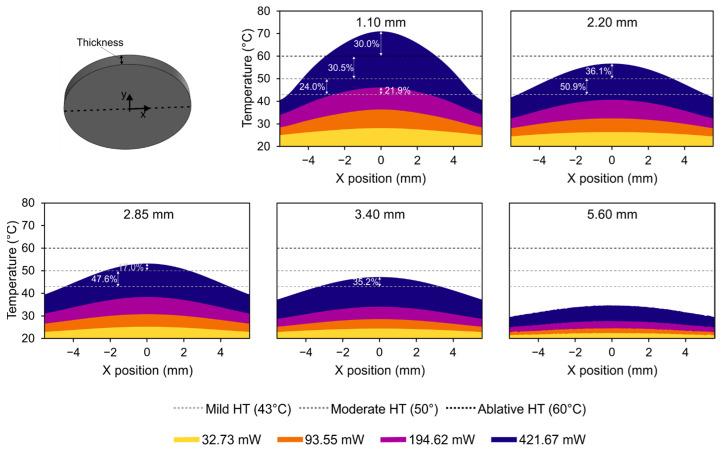
The present work evaluates the thermal behavior of graphene oxide (GO) when deposited on 3D-printed polylactic acid (PLA), in order to develop a medical device for photothermal therapy applications. An experimental-numerical analysis was performed to assess the photothermal conversion capacity, based on the power emitted by a NIR (785 nm) laser, and the subsequent temperature distribution on the GO-PLA material. The influence of the deposited mass of GO and the PLA thickness was studied through 40 different scenarios. The results estimated a value of photothermal conversion efficiency of up to 32.6%, achieved for the lower laser power density that was tested (0.335 mW/mm²), and a high mass value of deposited GO (1.024 × 10 mg/mm²). In fact, an optimal mass of GO in the range of 1.024-2.048 × 10 mg/mm is proposed, in terms of absorption capacity, since a higher mass of GO would not increase the conversion efficiency. Moreover, the study allowed for an estimation of the thermal conductivity of this specific biomaterial (0.064 W/m·K), and proved that a proper combination of GO mass, PLA thickness, and laser power can induce ablative (>60 °C, in a concentrated area), moderate (50 °C), and mild (43 °C) hyperthermia on the bottom face of the biomaterial.
本研究评估了氧化石墨烯(GO)沉积在3D打印聚乳酸(PLA)上时的热行为,以便开发一种用于光热治疗应用的医疗设备。基于近红外(785 nm)激光发射的功率以及GO-PLA材料上随后的温度分布,进行了实验-数值分析,以评估光热转换能力。通过40种不同的情况研究了GO沉积质量和PLA厚度的影响。结果估计,在测试的较低激光功率密度(0.335 mW/mm²)和较高的GO沉积质量(1.024×10 mg/mm²)下,光热转换效率高达32.6%。事实上,就吸收能力而言,建议GO的最佳质量范围为1.024-2.048×10 mg/mm,因为更高质量的GO不会提高转换效率。此外,该研究还估计了这种特定生物材料的热导率(0.064 W/m·K),并证明GO质量、PLA厚度和激光功率的适当组合可以在生物材料的底面诱导烧蚀性(>60°C,在集中区域)、中度(50°C)和轻度(43°C)热疗。



 Zotero 插件