
MRTX-500 二期临床试验:Sitravatinib 联合纳武利尤单抗治疗接受过免疫检查点抑制剂治疗或化疗后进展的非鳞状非小细胞肺癌患者。
MRTX-500 Phase 2 Trial: Sitravatinib With Nivolumab in Patients With Nonsquamous NSCLC Progressing On or After Checkpoint Inhibitor Therapy or Chemotherapy.
机构信息
Comprehensive Cancer Center, Pelotonia Institute for Immuno-Oncology, The Ohio State University, Columbus, Ohio.
Department of Cellular Therapeutics, Beverly Hills Cancer Center, Beverly Hills, California; Current Affiliation: Valkyrie Clinical Trials, Los Angeles, California.
出版信息
J Thorac Oncol. 2023 Jul;18(7):907-921. doi: 10.1016/j.jtho.2023.02.016. Epub 2023 Feb 24.
INTRODUCTION
Sitravatinib, a receptor tyrosine kinase inhibitor targeting TYRO3, AXL, MERTK receptors, and vascular epithelial growth factor receptor 2, can shift the tumor microenvironment toward an immunostimulatory state. Combining sitravatinib with checkpoint inhibitors (CPIs) may augment antitumor activity.
METHODS
The phase 2 MRTX-500 study evaluated sitravatinib (120 mg daily) with nivolumab (every 2 or 4 wk) in patients with advanced nonsquamous NSCLC who progressed on or after previous CPI (CPI-experienced) or chemotherapy (CPI-naive). CPI-experienced patients had a previous clinical benefit (PCB) (complete response, partial response, or stable disease for at least 12 weeks then disease progression) or no PCB (NPCB) from CPI. The primary end point was objective response rate (ORR); secondary objectives included safety and secondary efficacy end points.
RESULTS
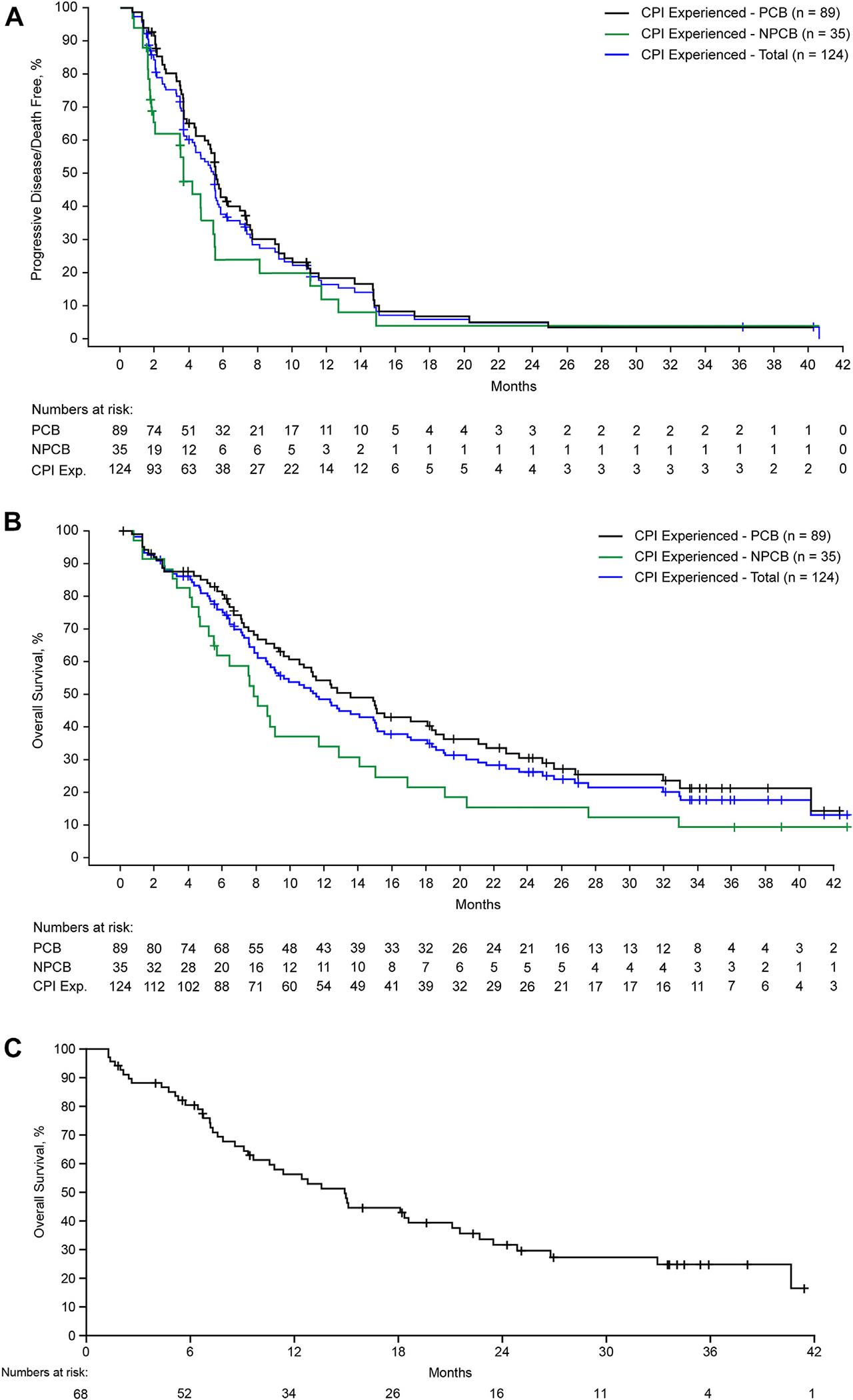
Overall, 124 CPI-experienced (NPCB, n = 35; PCB, n = 89) and 32 CPI-naive patients were treated. Investigator-assessed ORR was 11.4% in patients with NPCB, 16.9% with PCB, and 25.0% in CPI-naive. The median progression-free survival was 3.7, 5.6, and 7.1 months with NPCB, PCB, and CPI-naive, respectively; the median overall survival was 7.9 and 13.6 months with NPCB and PCB, respectively (not reached in CPI-naive patients; median follow-up 20.4 mo). Overall, (N = 156), any grade treatment-related adverse events (TRAEs) occurred in 93.6%; grade 3/4 in 58.3%. One grade 5 TRAE occurred in a CPI-naive patient. TRAEs led to treatment discontinuation in 14.1% and dose reduction or interruption in 42.9%. Biomarker analyses supported an immunostimulatory mechanism of action.
CONCLUSIONS
Sitravatinib with nivolumab had a manageable safety profile. Although ORR was not met, this combination exhibited antitumor activity and encouraged survival in CPI-experienced patients with nonsquamous NSCLC.
介绍
Sitravatinib 是一种受体酪氨酸激酶抑制剂,可靶向 TYRO3、AXL、MERTK 受体和血管内皮生长因子受体 2,可将肿瘤微环境转向免疫刺激状态。将 Sitravatinib 与检查点抑制剂(CPIs)联合使用可能会增强抗肿瘤活性。
方法
MRTX-500 期研究评估了 Sitravatinib(每日 120mg)与 nivolumab(每 2 或 4 周)联合用于晚期非鳞状 NSCLC 患者,这些患者在先前接受 CPI(CPI 经验)或化疗(CPI 初治)后进展。CPI 经验丰富的患者有先前的临床获益(PCB)(完全缓解、部分缓解或稳定疾病至少 12 周,然后疾病进展)或无 PCB(NPCB)。主要终点是客观缓解率(ORR);次要终点包括安全性和次要疗效终点。
结果
共有 124 名 CPI 经验丰富(NPCB,n=35;PCB,n=89)和 32 名 CPI 初治患者接受了治疗。研究者评估的 ORR 为 NPCB 患者 11.4%,PCB 患者 16.9%,CPI 初治患者 25.0%。NPCB、PCB 和 CPI 初治患者的中位无进展生存期分别为 3.7、5.6 和 7.1 个月;中位总生存期分别为 NPCB 患者 7.9 个月和 PCB 患者 13.6 个月(CPI 初治患者未达到;中位随访时间 20.4 个月)。总体而言,(N=156),任何等级的治疗相关不良事件(TRAEs)发生率为 93.6%;3/4 级为 58.3%。1 例 CPI 初治患者发生 1 例 5 级 TRAE。TRAEs 导致 14.1%的患者停止治疗,42.9%的患者减少或中断剂量。生物标志物分析支持免疫刺激作用机制。
结论
Sitravatinib 联合 nivolumab 具有可管理的安全性。尽管未达到 ORR,但该联合方案在非鳞状 NSCLC 的 CPI 经验丰富的患者中显示出抗肿瘤活性并延长了生存时间。


 Zotero 插件