
抗耐药抗菌治疗策略。
Resistance-resistant antibacterial treatment strategies.
作者信息
Batchelder Jonathan I, Hare Patricia J, Mok Wendy W K
机构信息
Department of Molecular Biology and Biophysics, UConn Health, Farmington, CT, United States.
School of Dental Medicine, University of Connecticut, Farmington, CT, United States.
出版信息
Front Antibiot. 2023;2. doi: 10.3389/frabi.2023.1093156. Epub 2023 Jan 30.
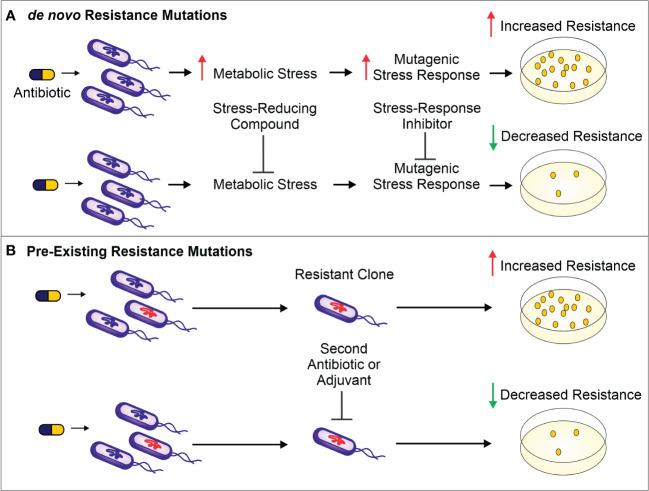
Antibiotic resistance is a major danger to public health that threatens to claim the lives of millions of people per year within the next few decades. Years of necessary administration and excessive application of antibiotics have selected for strains that are resistant to many of our currently available treatments. Due to the high costs and difficulty of developing new antibiotics, the emergence of resistant bacteria is outpacing the introduction of new drugs to fight them. To overcome this problem, many researchers are focusing on developing antibacterial therapeutic strategies that are "resistance-resistant"-regimens that slow or stall resistance development in the targeted pathogens. In this mini review, we outline major examples of novel resistance-resistant therapeutic strategies. We discuss the use of compounds that reduce mutagenesis and thereby decrease the likelihood of resistance emergence. Then, we examine the effectiveness of antibiotic cycling and evolutionary steering, in which a bacterial population is forced by one antibiotic toward susceptibility to another antibiotic. We also consider combination therapies that aim to sabotage defensive mechanisms and eliminate potentially resistant pathogens by combining two antibiotics or combining an antibiotic with other therapeutics, such as antibodies or phages. Finally, we highlight promising future directions in this field, including the potential of applying machine learning and personalized medicine to fight antibiotic resistance emergence and out-maneuver adaptive pathogens.
抗生素耐药性是对公众健康的一大威胁,在未来几十年内可能每年导致数百万人死亡。多年来必要的抗生素使用以及过度使用,已筛选出对我们目前许多可用治疗方法具有耐药性的菌株。由于开发新抗生素成本高昂且难度大,耐药菌的出现速度超过了对抗它们的新药推出速度。为克服这一问题,许多研究人员专注于开发“抗耐药性”的抗菌治疗策略,即减缓或阻止目标病原体耐药性发展的治疗方案。在本综述中,我们概述了新型抗耐药性治疗策略的主要实例。我们讨论了使用可减少诱变从而降低耐药性出现可能性的化合物。然后,我们研究了抗生素循环和进化导向的有效性,即在一种抗生素作用下使细菌群体对另一种抗生素敏感。我们还考虑了联合疗法,旨在通过联合两种抗生素或将抗生素与其他治疗方法(如抗体或噬菌体)联合使用来破坏防御机制并消除潜在的耐药病原体。最后,我们强调了该领域有前景的未来方向,包括应用机器学习和个性化医学来对抗抗生素耐药性出现及战胜适应性病原体的潜力。

 Zotero 插件