
绵羊品种和瘤胃分数对细菌和古菌群落组成的影响。
Breed and ruminal fraction effects on bacterial and archaeal community composition in sheep.
机构信息
Animal and Bioscience Research Department, Animal and Grassland Research and Innovation Centre, Teagasc, Athenry, Co. Galway, H65 R718, Ireland.
Genetics and Biotechnology Laboratory, Agriculture & Bioeconomy Research Centre (ABC), Ryan Institute, University of Galway, University Road, Galway, H91 REW4, Ireland.
出版信息
Sci Rep. 2023 Feb 27;13(1):3336. doi: 10.1038/s41598-023-28909-1.
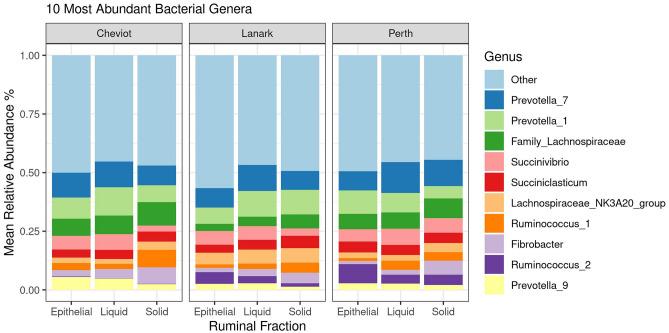
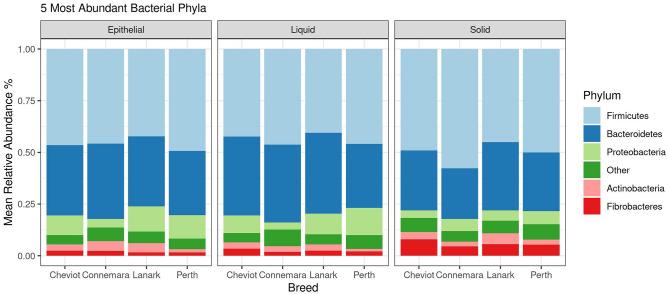
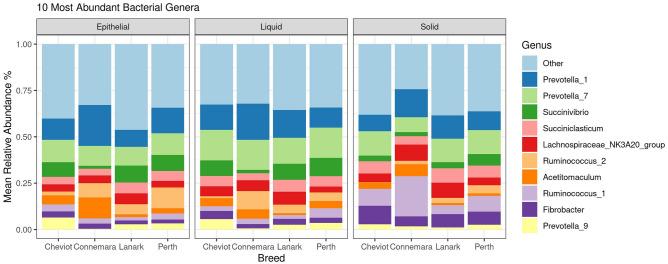
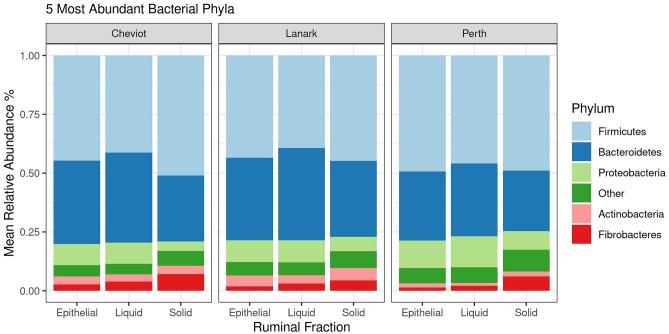
While the breed of cattle can impact on the composition and structure of microbial communities in the rumen, breed-specific effects on rumen microbial communities have rarely been examined in sheep. In addition, rumen microbial composition can differ between ruminal fractions, and be associated with ruminant feed efficiency and methane emissions. In this study, 16S rRNA amplicon sequencing was used to investigate the effects of breed and ruminal fraction on bacterial and archaeal communities in sheep. Solid, liquid and epithelial rumen samples were obtained from a total of 36 lambs, across 4 different sheep breeds (Cheviot (n = 10), Connemara (n = 6), Lanark (n = 10) and Perth (n = 10)), undergoing detailed measurements of feed efficiency, who were offered a nut based cereal diet ad-libitum supplemented with grass silage. Our results demonstrate that the feed conversion ratio (FCR) was lowest for the Cheviot (most efficient), and highest for the Connemara breed (least efficient). In the solid fraction, bacterial community richness was lowest in the Cheviot breed, while Sharpea azabuensis was most abundant in the Perth breed. Lanark, Cheviot and Perth breeds exhibited a significantly higher abundance of epithelial associated Succiniclasticum compared to the Connemara breed. When comparing ruminal fractions, Campylobacter, Family XIII, Mogibacterium, and Lachnospiraceae UCG-008 were most abundant in the epithelial fraction. Our findings indicate that breed can impact the abundance of specific bacterial taxa in sheep while having little effect on the overall composition of the microbial community. This finding has implications for genetic selection breeding programs aimed at improving feed conversion efficiency of sheep. Furthermore, the variations in the distribution of bacterial species identified between ruminal fractions, notably between solid and epithelial fractions, reveals a rumen fraction bias, which has implications for sheep rumen sampling techniques.
虽然牛的品种会影响瘤胃微生物群落的组成和结构,但在绵羊中,很少有研究关注品种特异性对瘤胃微生物群落的影响。此外,瘤胃微生物组成在瘤胃不同部位可能存在差异,并与反刍动物的饲料效率和甲烷排放有关。在这项研究中,使用 16S rRNA 扩增子测序技术研究了品种和瘤胃部位对绵羊细菌和古菌群落的影响。从 4 个不同绵羊品种(谢菲尔德(Cheviot)(n = 10)、康尼马拉(Connemara)(n = 6)、拉纳克(Lanark)(n = 10)和珀斯(Perth)(n = 10))的 36 只羔羊中获得了固体、液体和上皮瘤胃液样本,这些羔羊接受了详细的饲料效率测量,他们自由采食基于坚果的谷物日粮,并补充了草青贮料。我们的研究结果表明,谢菲尔德(Cheviot)品种的饲料转化率(FCR)最低(最有效),而康尼马拉(Connemara)品种的饲料转化率(FCR)最高(最无效)。在固体部位,谢菲尔德(Cheviot)品种的细菌群落丰富度最低,而珀斯(Perth)品种的 Sharpea azabuensis 最为丰富。与康尼马拉(Connemara)品种相比,拉纳克(Lanark)、谢菲尔德(Cheviot)和珀斯(Perth)品种的上皮相关 Succiniclasticum 丰度显著更高。在比较瘤胃液部位时,Campylobacter、Family XIII、Mogibacterium 和 Lachnospiraceae UCG-008 在上皮部位最为丰富。我们的研究结果表明,品种可以影响绵羊中特定细菌类群的丰度,而对微生物群落的整体组成影响不大。这一发现对旨在提高绵羊饲料转化率的遗传选择育种计划具有重要意义。此外,在瘤胃液部位之间,特别是在固体和上皮部位之间,确定的细菌物种分布的变化揭示了瘤胃部位的偏差,这对绵羊瘤胃液采样技术具有重要意义。
 Zotero 插件