
认知行为疗法治疗失眠症(CBT-I)可缓解老年人失眠症的缓解:一项随机临床试验的次要结局分析。
Remission of insomnia in older adults treated with cognitive behavioral therapy for insomnia (CBT-I) reduces p16 gene expression in peripheral blood: secondary outcome analysis from a randomized clinical trial.
机构信息
Cousins Center for Psychoneuroimmunology, University of California, Los Angeles, Los Angeles, CA, USA.
Jane & Terry Semel Institute for Neuroscience and Human Behavior, Department of Psychiatry & Biobehavioral Sciences, UCLA David Geffen School of Medicine, University of California, 300 UCLA Medical Plaza, Suite 3330, Los Angeles, CA, 90095, USA.
出版信息
Geroscience. 2023 Aug;45(4):2325-2335. doi: 10.1007/s11357-023-00741-5. Epub 2023 Feb 28.
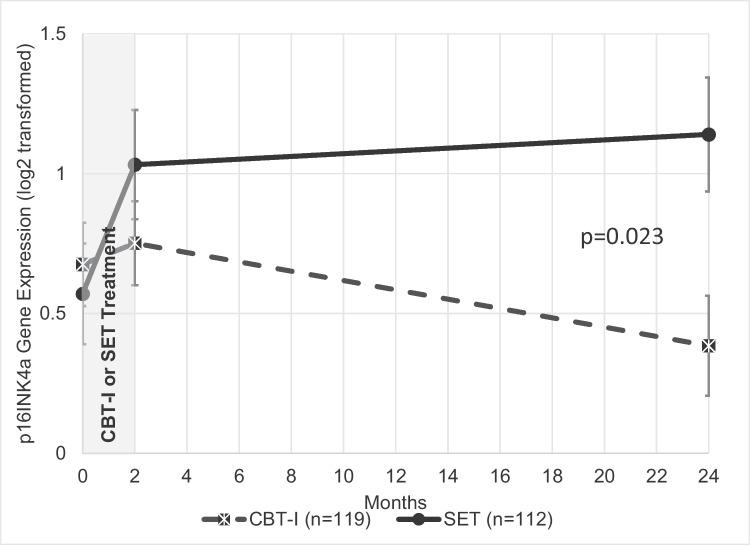
Late life insomnia may increase risk for accelerated biological aging. Intervening to treat insomnia may provide protection from biological aging by reducing the prevalence of senescent cells in the immune system, as indicated by gene expression of a marker of cellular senescence, p16. In the present study, we determine whether treatment of insomnia in older adults with cognitive behavioral therapy for insomnia (CBT-I) would reduce p16 gene expression in peripheral blood mononuclear cells (PBMC), compared to a sleep education therapy (SET), an active comparator condition. Secondly, we investigate the relationship between sustained insomnia remission and reduced expression of p16. Participants 60 + years old with insomnia were enrolled in a randomized controlled trial and assigned to CBT-I or SET. Analyses of 231 older adults (CBT-I = 119; SET = 112) examine baseline, post (2 months), and 24 months gene expression of p16. Compared to baseline, expression of p16 increased in the SET group over 24 months (P = 0.03), but showed no change in the CBT-I group. Those who received CBT-I and experienced sustained remission of insomnia had a significant decline in p16 expression by 24 months compared to baseline (P = 0.02). Individuals not sustaining remission of insomnia exhibited overall increase expression of p16 by 24 months (P = 0.03). In older adults with insomnia, p16 increases over 24 months, while CBT-I treatment of insomnia mitigates the increase in p16. Further, sustained remission of insomnia using CBT-I leads to a decrease in p16. These results suggest that behavioral interventions that are effective at treating insomnia might reduce the population of senescent cells in circulating blood.
晚年失眠可能会增加生物衰老的风险。通过减少免疫系统中衰老细胞的流行,干预治疗失眠可能会提供对生物衰老的保护,这可以通过细胞衰老的标志物 p16 的基因表达来指示。在本研究中,我们确定了在老年成年人中使用认知行为疗法治疗失眠(CBT-I)是否会比睡眠教育疗法(SET)降低外周血单核细胞(PBMC)中的 p16 基因表达,后者是一种积极的对照条件。其次,我们研究了持续失眠缓解与 p16 表达降低之间的关系。患有失眠症的 60 岁以上的参与者被纳入一项随机对照试验,并被分配到 CBT-I 或 SET 组。对 231 名年龄较大的成年人(CBT-I=119;SET=112)的分析检查了基线、治疗后(2 个月)和 24 个月时 p16 的基因表达。与基线相比,SET 组在 24 个月时 p16 的表达增加(P=0.03),而 CBT-I 组则没有变化。接受 CBT-I 治疗且失眠持续缓解的患者与基线相比,24 个月时 p16 表达显著下降(P=0.02)。失眠症未持续缓解的患者在 24 个月时整体上 p16 表达增加(P=0.03)。在患有失眠症的老年人中,p16 在 24 个月内增加,而 CBT-I 治疗失眠症可减轻 p16 的增加。此外,使用 CBT-I 持续缓解失眠症会导致 p16 减少。这些结果表明,有效治疗失眠症的行为干预措施可能会减少循环血液中衰老细胞的数量。


 Zotero 插件