
2005 年至 2019 年美国退伍军人事务部的州级大麻合法化与大麻使用障碍。
State Cannabis Legalization and Cannabis Use Disorder in the US Veterans Health Administration, 2005 to 2019.
机构信息
Columbia University and New York State Psychiatric Institute, New York.
Mental Health Data Science, New York State Psychiatric Institute, New York.
出版信息
JAMA Psychiatry. 2023 Apr 1;80(4):380-388. doi: 10.1001/jamapsychiatry.2023.0019.
IMPORTANCE
Cannabis use disorder (CUD) is increasing among US adults. Few national studies have addressed the role of medical cannabis laws (MCLs) and recreational cannabis laws (RCLs) in these increases, particularly in patient populations with high rates of CUD risk factors.
OBJECTIVE
To quantify the role of MCL and RCL enactment in the increases in diagnosed CUD prevalence among Veterans Health Administration (VHA) patients from 2005 to 2019.
DESIGN, SETTING, AND PARTICIPANTS: Staggered-adoption difference-in-difference analyses were used to estimate the role of MCL and RCL in the increases in prevalence of CUD diagnoses, fitting a linear binomial regression model with fixed effects for state, categorical year, time-varying cannabis law status, state-level sociodemographic covariates, and patient age group, sex, and race and ethnicity. Patients aged 18 to 75 years with 1 or more VHA primary care, emergency department, or mental health visit and no hospice/palliative care within a given calendar year were included. Time-varying yearly state control covariates were state/year rates from American Community Survey data: percentage male, Black, Hispanic, White, 18 years or older, unemployed, income below poverty threshold, and yearly median household income. Analysis took place between February to December 2022.
MAIN OUTCOMES AND MEASURES
As preplanned, International Classification of Diseases, Clinical Modification, ninth and tenth revisions, CUD diagnoses from electronic health records were analyzed.
RESULTS
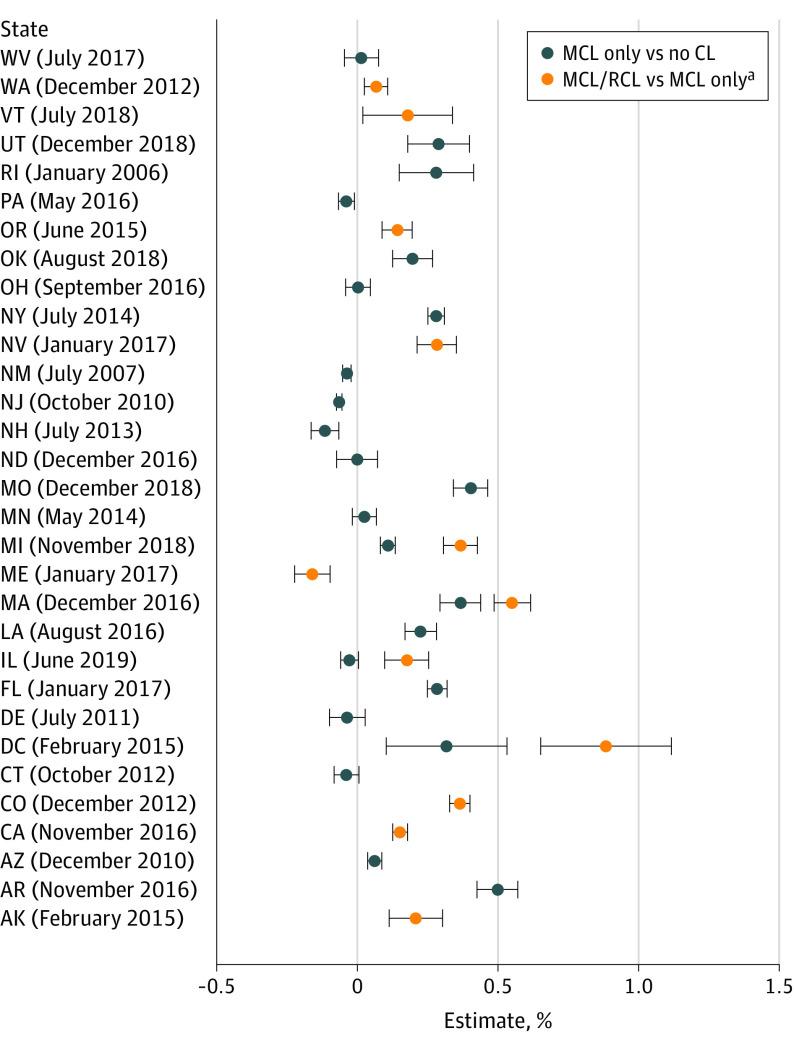
The number of individuals analyzed ranged from 3 234 382 in 2005 to 4 579 994 in 2019. Patients were largely male (94.1% in 2005 and 89.0% in 2019) and White (75.0% in 2005 and 66.6% in 2019), with a mean (SD) age of 57.0 [14.4] years. From 2005 to 2019, adjusted CUD prevalences increased from 1.38% to 2.25% in states with no cannabis laws (no CLs), 1.38% to 2.54% in MCL-only enacting states, and 1.39% to 2.56% in RCL-enacting states. Difference-in-difference results indicated that MCL-only enactment was associated with a 0.05% (0.05-0.06) absolute increase in CUD prevalence, ie, that 4.7% of the total increase in CUD prevalence in MCL-only enacting states could be attributed to MCLs, while RCL enactment was associated with a 1.12% (95% CI, 0.10-0.13) absolute increase in CUD prevalence, ie, that 9.8% of the total increase in CUD prevalence in RCL-enacting states could be attributed to RCLs. The role of RCL in the increases in CUD prevalence was greatest in patients aged 65 to 75 years, with an absolute increase of 0.15% (95% CI, 0.13-0.17) in CUD prevalence associated with RCLs, ie, 18.6% of the total increase in CUD prevalence in that age group.
CONCLUSIONS AND RELEVANCE
In this study of VHA patients, MCL and RCL enactment played a significant role in the overall increases in CUD prevalence, particularly in older patients. However, consistent with general population studies, effect sizes were relatively small, suggesting that cumulatively, laws affected cannabis attitudes diffusely across the country or that other factors played a larger role in the overall increases in adult CUD. Results underscore the need to screen for cannabis use and CUD and to treat CUD when it is present.
重要性
在美国成年人中,大麻使用障碍(CUD)的发病率正在上升。很少有全国性研究探讨医用大麻法(MCL)和娱乐大麻法(RCL)在这些增加中的作用,特别是在 CUD 风险因素发生率较高的患者群体中。
目的
量化 MCL 和 RCL 颁布在退伍军人健康管理局(VHA)患者中诊断为 CUD 的患病率从 2005 年到 2019 年增加的作用。
设计、地点和参与者:采用交错采用差异差异分析来估计 MCL 和 RCL 在 CUD 诊断患病率增加中的作用,为状态、分类年、时间变化的大麻法律状态、州级社会人口统计学协变量以及患者年龄组、性别和种族和族裔拟合一个具有固定效应的线性二项回归模型。纳入年龄在 18 至 75 岁之间、在给定日历年内有 1 次或更多次 VHA 初级保健、急诊或心理健康就诊且无临终关怀/姑息治疗的患者。时间变化的每年州控制协变量为美国社区调查数据中的州/年比率:男性百分比、黑人、西班牙裔、白人、18 岁或以上、失业、收入低于贫困线和每年中位数家庭收入。分析于 2022 年 2 月至 12 月进行。
主要结果和措施
按照预先计划,从电子健康记录中分析了国际疾病分类,临床修订版,第九和第十版,CUD 诊断。
结果
2005 年分析的人数范围为 3234382 人,2019 年为 4579994 人。患者主要为男性(2005 年为 94.1%,2019 年为 89.0%)和白人(2005 年为 75.0%,2019 年为 66.6%),平均(SD)年龄为 57.0[14.4]岁。从 2005 年到 2019 年,在没有大麻法(无 CL)的州,调整后的 CUD 患病率从 1.38%增加到 2.25%,在 MCL 仅颁布的州从 1.38%增加到 2.54%,在 RCL 颁布的州从 1.39%增加到 2.56%。差异差异结果表明,MCL 仅颁布与 CUD 患病率增加 0.05%(0.05-0.06)绝对相关,即 MCL 仅颁布州 CUD 患病率总增加的 4.7%可归因于 MCL,而 RCL 颁布与 CUD 患病率增加 1.12%(95%CI,0.10-0.13)绝对相关,即 RCL 颁布州 CUD 患病率总增加的 9.8%可归因于 RCL。RCL 在 65 至 75 岁患者中 CUD 患病率增加中的作用最大,与 RCL 相关的 CUD 患病率绝对增加 0.15%(95%CI,0.13-0.17),即该年龄组 CUD 患病率总增加的 18.6%。
结论和相关性
在这项对 VHA 患者的研究中,MCL 和 RCL 的颁布在 CUD 患病率的总体增加中发挥了重要作用,特别是在老年患者中。然而,与一般人群研究一致,效应大小相对较小,表明法律总体上在全国范围内或多或少地影响了大麻的态度,或者其他因素在成年人 CUD 的总体增加中发挥了更大的作用。研究结果强调了筛查大麻使用和 CUD 的必要性,并在存在 CUD 时进行治疗。

 Zotero 插件