
从注意力缺陷多动障碍到散发性阿尔茨海默病——Wnt/mTOR通路假说
From attention-deficit hyperactivity disorder to sporadic Alzheimer's disease-Wnt/mTOR pathways hypothesis.
作者信息
Grünblatt Edna, Homolak Jan, Babic Perhoc Ana, Davor Virag, Knezovic Ana, Osmanovic Barilar Jelena, Riederer Peter, Walitza Susanne, Tackenberg Christian, Salkovic-Petrisic Melita
机构信息
Department of Child and Adolescent Psychiatry and Psychotherapy, Psychiatric University Hospital Zurich (PUK), University of Zurich, Zurich, Switzerland.
Neuroscience Center Zurich, University of Zurich and the Swiss Federal Institute of Technology (ETH) Zurich, Zurich, Switzerland.
出版信息
Front Neurosci. 2023 Feb 16;17:1104985. doi: 10.3389/fnins.2023.1104985. eCollection 2023.
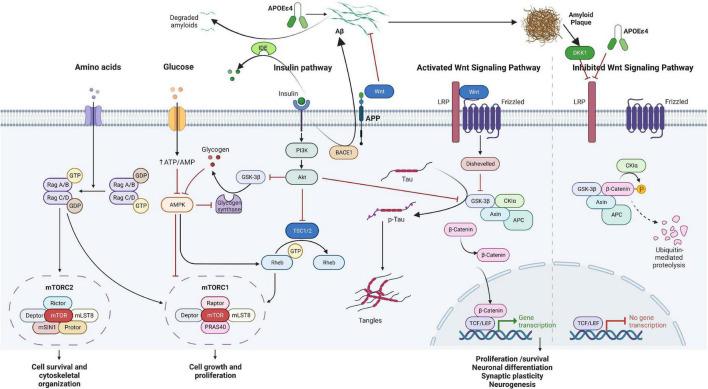
Alzheimer's disease (AD) is the most common neurodegenerative disorder with the majority of patients classified as sporadic AD (sAD), in which etiopathogenesis remains unresolved. Though sAD is argued to be a polygenic disorder, apolipoprotein E (APOE) ε4, was found three decades ago to pose the strongest genetic risk for sAD. Currently, the only clinically approved disease-modifying drugs for AD are aducanumab (Aduhelm) and lecanemab (Leqembi). All other AD treatment options are purely symptomatic with modest benefits. Similarly, attention-deficit hyperactivity disorder (ADHD), is one of the most common neurodevelopmental mental disorders in children and adolescents, acknowledged to persist in adulthood in over 60% of the patients. Moreover, for ADHD whose etiopathogenesis is not completely understood, a large proportion of patients respond well to treatment (first-line psychostimulants, e.g., methylphenidate/MPH), however, no disease-modifying therapy exists. Interestingly, cognitive impairments, executive, and memory deficits seem to be common in ADHD, but also in early stages of mild cognitive impairment (MCI), and dementia, including sAD. Therefore, one of many hypotheses is that ADHD and sAD might have similar origins or that they intercalate with one another, as shown recently that ADHD may be considered a risk factor for sAD. Intriguingly, several overlaps have been shown between the two disorders, e.g., inflammatory activation, oxidative stress, glucose and insulin pathways, wingless-INT/mammalian target of rapamycin (Wnt/mTOR) signaling, and altered lipid metabolism. Indeed, Wnt/mTOR activities were found to be modified by MPH in several ADHD studies. Wnt/mTOR was also found to play a role in sAD and in animal models of the disorder. Moreover, MPH treatment in the MCI phase was shown to be successful for apathy including some improvement in cognition, according to a recent meta-analysis. In several AD animal models, ADHD-like behavioral phenotypes have been observed indicating a possible interconnection between ADHD and AD. In this concept paper, we will discuss the various evidence in human and animal models supporting the hypothesis in which ADHD might increase the risk for sAD, with common involvement of the Wnt/mTOR-pathway leading to lifespan alteration at the neuronal levels.
阿尔茨海默病(AD)是最常见的神经退行性疾病,大多数患者被归类为散发性AD(sAD),其发病机制仍未明确。尽管sAD被认为是一种多基因疾病,但载脂蛋白E(APOE)ε4在三十年前就被发现是sAD最强的遗传风险因素。目前,唯一获得临床批准的用于AD的疾病修饰药物是阿杜卡单抗(Aduhelm)和仑卡奈单抗(Leqembi)。所有其他AD治疗选择都只是对症治疗,效果有限。同样,注意力缺陷多动障碍(ADHD)是儿童和青少年中最常见的神经发育性精神障碍之一,超过60%的患者在成年后仍会持续存在该症状。此外,对于病因尚未完全明确的ADHD,很大一部分患者对治疗(一线精神兴奋剂,如哌甲酯/MPH)反应良好,然而,目前尚无疾病修饰疗法。有趣的是,认知障碍、执行功能和记忆缺陷在ADHD中似乎很常见,在轻度认知障碍(MCI)和痴呆(包括sAD)的早期阶段也很常见。因此,众多假说之一是ADHD和sAD可能有相似的起源,或者它们相互关联,最近的研究表明ADHD可能被视为sAD的一个风险因素。有趣的是,这两种疾病之间已显示出一些重叠之处,例如炎症激活、氧化应激、葡萄糖和胰岛素途径、无翅型MMTV整合位点/雷帕霉素哺乳动物靶蛋白(Wnt/mTOR)信号通路以及脂质代谢改变。事实上,在几项ADHD研究中发现MPH可改变Wnt/mTOR的活性。Wnt/mTOR也被发现与sAD及其动物模型有关。此外,根据最近的一项荟萃分析,在MCI阶段进行MPH治疗对淡漠有效,包括在认知方面有一些改善。在几种AD动物模型中,已观察到类似ADHD的行为表型,这表明ADHD和AD之间可能存在联系。在这篇概念论文中,我们将讨论人类和动物模型中的各种证据,这些证据支持ADHD可能增加sAD风险的假说,Wnt/mTOR通路共同参与其中,导致神经元水平的寿命改变。
 Zotero 插件