
生育期女性癌症治疗相关卵巢功能障碍:管理和生育力保存选择。
Cancer Treatment-Related Ovarian Dysfunction in Women of Childbearing Potential: Management and Fertility Preservation Options.
机构信息
Baylor College of Medicine Houston, Houston, TX.
The University of Texas MD Anderson Cancer Center, Houston, TX.
出版信息
J Clin Oncol. 2023 Apr 20;41(12):2281-2292. doi: 10.1200/JCO.22.01885. Epub 2023 Mar 8.
PURPOSE
To review the complex concerns of oncofertility created through increased cancer survivorship and the long-term effects of cancer treatment in young adults.
DESIGN
Review chemotherapy-induced ovarian dysfunction, outline how fertility may be addressed before treatment initiation, and discuss barriers to oncofertility treatment and guidelines for oncologists to provide this care to their patients.
CONCLUSION
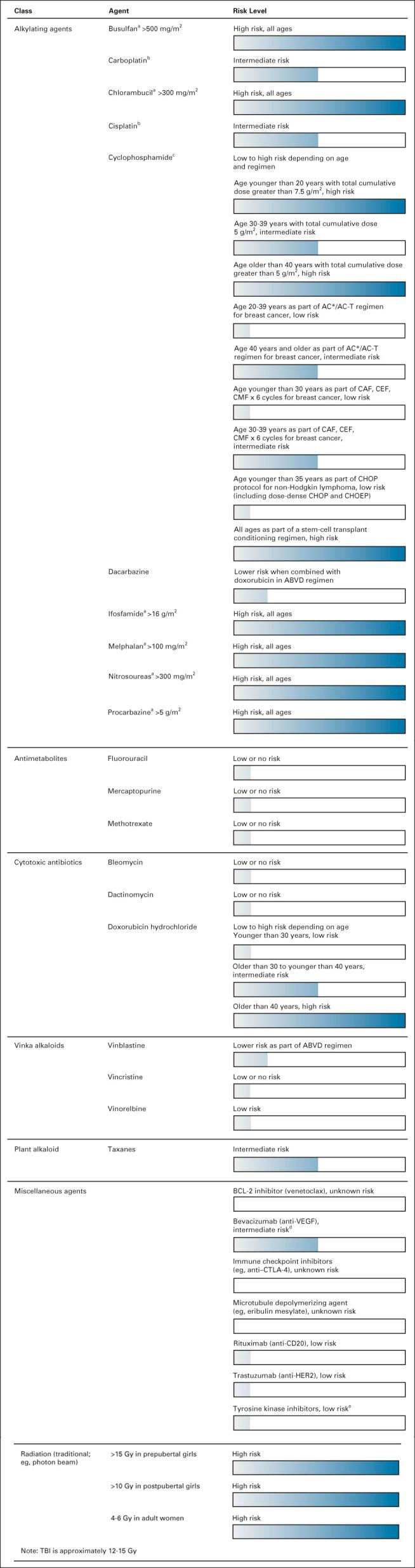
In women of childbearing potential, ovarian dysfunction resulting from cancer therapy has profound short- and long-term implications. Ovarian dysfunction can manifest as menstrual abnormalities, hot flashes, night sweats, impaired fertility, and in the long term, increased cardiovascular risk, bone mineral density loss, and cognitive deficits. The risk of ovarian dysfunction varies between drug classes, number of received lines of therapy, chemotherapy dosage, patient age, and baseline fertility status. Currently, there is no standard clinical practice to evaluate patients for their risk of developing ovarian dysfunction with systemic therapy or means to address hormonal fluctuations during treatment. This review provides a clinical guide to obtain a baseline fertility assessment and facilitate fertility preservation discussions.
目的
探讨因癌症存活率提高和年轻人癌症治疗的长期影响而产生的生育力保护相关复杂问题。
设计
综述化疗引起的卵巢功能障碍,概述在治疗开始前如何解决生育力问题,并讨论生育力保护治疗的障碍和肿瘤医生为患者提供这种治疗的指南。
结论
在有生育能力的女性中,癌症治疗引起的卵巢功能障碍具有深远的短期和长期影响。卵巢功能障碍可表现为月经异常、热潮红、盗汗、生育能力受损,长期来看还会增加心血管风险、骨密度丢失和认知功能缺陷。卵巢功能障碍的风险因药物种类、接受的治疗线数、化疗剂量、患者年龄和基线生育状况而异。目前,尚无标准的临床实践来评估患者接受系统治疗后发生卵巢功能障碍的风险,也没有办法解决治疗期间的激素波动问题。本综述提供了一个临床指南,用于进行基线生育力评估并促进生育力保护讨论。
 Zotero 插件