
2型糖尿病患者血清胰岛素样生长因子-1、晚期糖基化终末产物及其受体与结直肠癌风险的相关性
Correlation of serum IGF-1, AGEs and their receptors with the risk of colorectal cancer in patients with type 2 diabetes mellitus.
作者信息
Chen Zeng, Hong Qiao
机构信息
The Second Affiliated Hospital of Harbin Medical University, Harbin, China.
出版信息
Front Oncol. 2023 Feb 20;13:1125745. doi: 10.3389/fonc.2023.1125745. eCollection 2023.
BACKGROUND
According to epidemiological evidence, people with type 2 diabetes mellitus have a higher risk of developing colorectal cancer.
OBJECTIVE
To examine the relationship between colorectal cancer (CRC) and serum levels of IGF-1, IGF-1R, AGEs,RAGE and sRAGE in patients with type 2 diabetes.
METHODS
By using RNA-Seq data of CRC patients from The Cancer Genome Atlas (TCGA) database, we divided the patients into normal group(58 patients)and tumor group(446 patients), and analyzed the expression and prognostic value analysis of IGF-1,IGF1R and RAGE. Cox regression and the Kaplan-Meier method were used to determine the predictive value of target gene on clinical outcomes in CRC patients. In order to further combine CRC with diabetes research,one hundred forty-eight patients hospitalized in the Second Hospital of Harbin Medical University from July 2021 to July 2022 were enrolled and divided into CA and control groups. There were 106 patients in the CA group, including 75 patients with CRC and 31 patients with CRC+T2DM; the control group comprised 42 patients with T2DM. Circulating levels of IGF-1, IGF-1R, AGEs, RAGE, and sRAGE in the serum of the patients were measured using Enzyme-Linked Immunosorbnent Assay (ELISA) kits, and other clinical parameters were also measured during hospitalization. Statistical methods used were χ² test, independent samples t-test and Pearson correlation analysis were. Finally, we controlled for confounding factors and used logistic multi-factor regression analysis.
RESULTS
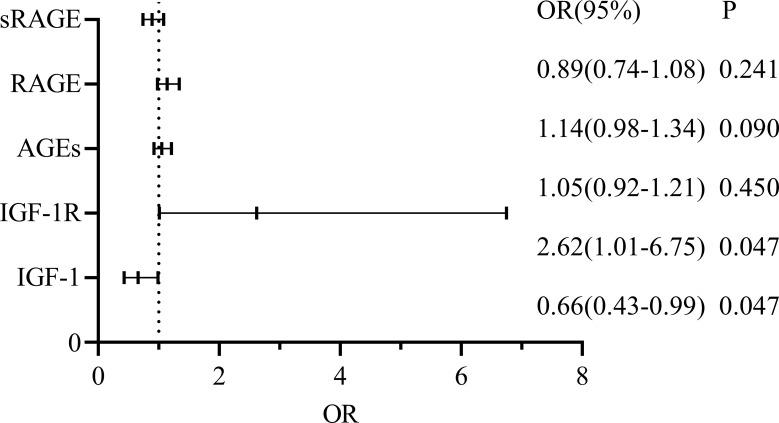
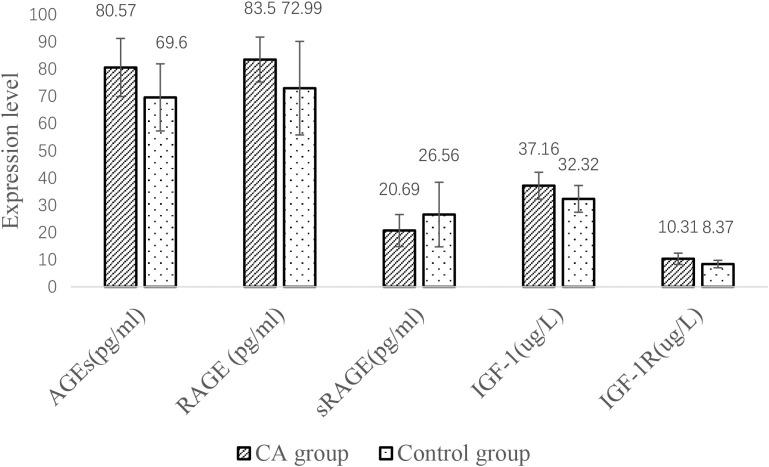
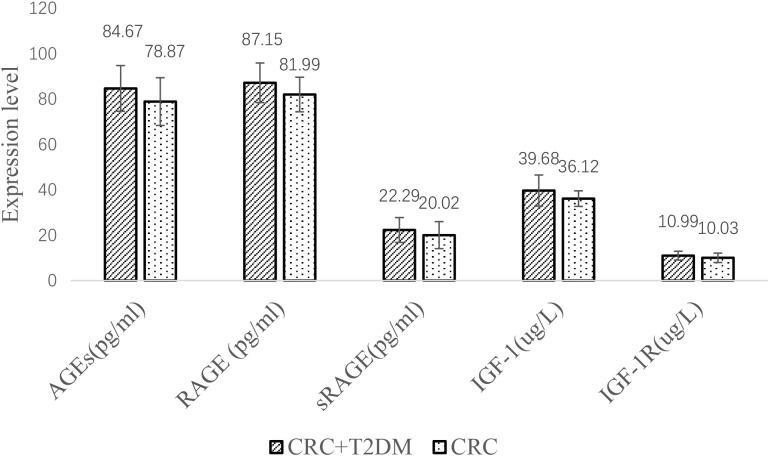
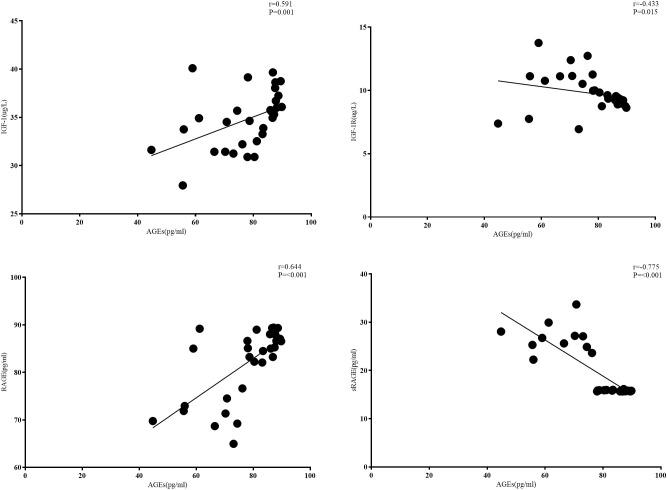
Bioinformatics analysis showed that IGF-1, IGF1R and RAGE were highly expressed in CRC patients, and the patients with high expression also showed significantly lower overall survival rate. Through Cox regression analysis, IGF-1 can be used as an independent influencing factor of CRC. In the ELISA experiment, serum AGE, RAGE, IGF-1, and IGF-1R levels were higher in the CRC and CRC+T2DM groups than in the T2DM group, but the serum sRAGE concentrations in these groups were lower than those in the T2DM group (P < 0.05). Serum AGE, RAGE, sRAGE, IGF1, and IGF1R levels were higher in the CRC+T2DM group than in the CRC group (P < 0.05). In CRC+T2DM patients, serum AGEs were correlated with age (p = 0.027), and the serum AGE levels in these groups were positively correlated with RAGE and IGF-1 levels (p < 0.001) and negatively correlated with sRAGE and IGF-1R levels (p < 0.001). After correcting for confounding factors based on logistic multiple regression analysis, the effects of age, serum IGF-1 and IGF-1R on the development of CRC in patients with T2DM were statistically significant (p<0.05).
CONCLUSION
Serum IGF-1 and IGF-1R levels independently influenced the development of CRC in patients with T2DM. Furthermore, IGF-1 and IGF-1R were correlated with AGEs in CRC patients who also had T2DM, suggesting that AGEs may influence the development of CRC in T2DM patients. These findings suggest that we may be able to lower the risk of CRC in the clinic by regulating AGEs through the regulation of blood glucose levels, which will affect IGF-1 and its receptors.
背景
根据流行病学证据,2型糖尿病患者患结直肠癌的风险更高。
目的
研究2型糖尿病患者结直肠癌(CRC)与血清胰岛素样生长因子-1(IGF-1)、胰岛素样生长因子-1受体(IGF-1R)、晚期糖基化终末产物(AGEs)、晚期糖基化终末产物受体(RAGE)和可溶性晚期糖基化终末产物受体(sRAGE)水平之间的关系。
方法
利用癌症基因组图谱(TCGA)数据库中CRC患者的RNA测序数据,将患者分为正常组(58例)和肿瘤组(446例),分析IGF-1、IGF-1R和RAGE的表达及预后价值。采用Cox回归和Kaplan-Meier法确定目标基因对CRC患者临床结局的预测价值。为了进一步将CRC与糖尿病研究相结合,选取2021年7月至2022年7月在哈尔滨医科大学附属第二医院住院的148例患者,分为CRC组和对照组。CRC组106例,其中CRC患者75例,CRC合并2型糖尿病(CRC+T2DM)患者31例;对照组包括42例2型糖尿病患者。采用酶联免疫吸附测定(ELISA)试剂盒检测患者血清中IGF-1、IGF-1R、AGEs、RAGE和sRAGE的循环水平,并在住院期间测量其他临床参数。使用的统计方法为χ²检验、独立样本t检验和Pearson相关分析。最后,我们控制了混杂因素并进行逻辑多因素回归分析。
结果
生物信息学分析显示,IGF-1、IGF-1R和RAGE在CRC患者中高表达,高表达患者的总生存率也显著较低。通过Cox回归分析,IGF-1可作为CRC的独立影响因素。在ELISA实验中,CRC组和CRC+T2DM组血清AGE、RAGE、IGF-1和IGF-1R水平高于2型糖尿病组,但这些组的血清sRAGE浓度低于2型糖尿病组(P<0.05)。CRC+T2DM组血清AGE、RAGE、sRAGE、IGF-1和IGF-1R水平高于CRC组(P<0.05)。在CRC+T2DM患者中,血清AGEs与年龄相关(p=0.027),这些组的血清AGE水平与RAGE和IGF-1水平呈正相关(p<0.001),与sRAGE和IGF-1R水平呈负相关(p<0.001)。基于逻辑多因素回归分析校正混杂因素后,年龄、血清IGF-1和IGF-1R对2型糖尿病患者CRC发生的影响具有统计学意义(p<0.05)。
结论
血清IGF-1和IGF-1R水平独立影响2型糖尿病患者CRC的发生。此外,在合并2型糖尿病的CRC患者中,IGF-1和IGF-1R与AGEs相关,提示AGEs可能影响2型糖尿病患者CRC的发生。这些发现表明,我们或许可以通过调节血糖水平来调节AGEs,进而影响IGF-1及其受体,从而在临床上降低CRC的风险。

 Zotero 插件