
成人重症监护病房中的肾脏替代治疗:国际重症监护和急诊医学学会(ISCCM)专家小组实践建议
Renal Replacement Therapy in Adult Intensive Care Unit: An ISCCM Expert Panel Practice Recommendation.
作者信息
Mishra Rajesh C, Sinha Sharmili, Govil Deepak, Chatterjee Ranajit, Gupta Vivek, Singhal Vinay, Lobo Valentine Alexander, Annigeri Rajeev A, Karanth Sunil, Lopa Ahsina Jahan, Ahmed Ahsan, Kishen Roop, Pande Rajesh, Javeri Yash, Chaudhry Dhruva, Kar Arindam
机构信息
Department of MICU, Shaibya Comprehensive Care Clinic, Ahmedabad, Gujarat, India.
Department of Critical Care Medicine, Apollo Hospitals, Bhubaneswar, Odisha, India.
出版信息
Indian J Crit Care Med. 2022 Oct;26(Suppl 2):S3-S6. doi: 10.5005/jp-journals-10071-24278.
UNLABELLED
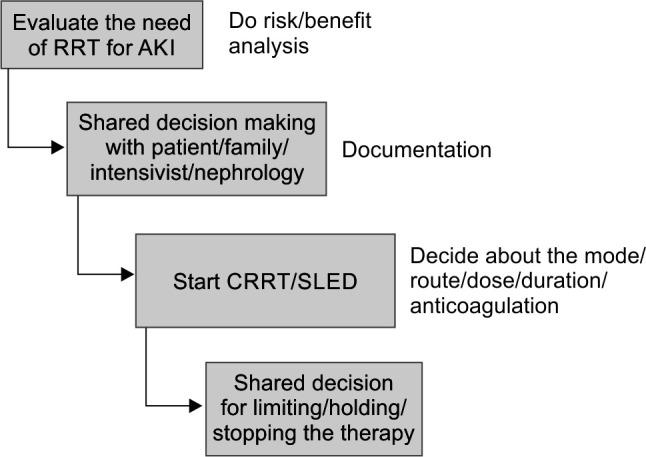
Acute kidney injury (AKI) contributes significantly to morbidity and mortality in ICU patients. The cause of AKI may be multifactorial and the management strategies focus primarily on the prevention of AKI along with optimization of hemodynamics. However, those who do not respond to medical management may require renal replacement therapy (RRT). The various options include intermittent and continuous therapies. Continuous therapy is preferred in hemodynamically unstable patients requiring moderate to high dose vasoactive drugs. A multidisciplinary approach is advocated in the management of critically ill patients with multi-organ dysfunction in ICU. However, an intensivist is a primary physician involved in life-saving interventions and key decisions. This RRT practice recommendation has been made after appropriate discussion with intensivists and nephrologists representing diversified critical care practices in Indian ICUs. The basic aim of this document is to optimize renal replacement practices (initiation and management) with the help of trained intensivists in the management of AKI patients effectively and promptly. The recommendations represent opinions and practice patterns and are not based solely on evidence or a systematic literature review. However, various existing guidelines and literature have been reviewed to support the recommendations. A trained intensivist must be involved in the management of AKI patients in ICU at all levels of care, including identifying a patient requiring RRT, writing a prescription and its modification as per the patient's metabolic need, and discontinuation of therapy on renal recovery. Nevertheless, the involvement of the nephrology team in AKI management is paramount. Appropriate documentation is strongly recommended not only to ensure quality assurance but also to help future research as well.
HOW TO CITE THIS ARTICLE
Mishra RC, Sinha S, Govil D, Chatterjee R, Gupta V, Singhal V, . Renal Replacement Therapy in Adult Intensive Care Unit: An ISCCM Expert Panel Practice Recommendation. Indian J Crit Care Med 2022;26(S2):S3-S6.
未标注
急性肾损伤(AKI)在重症监护病房(ICU)患者的发病率和死亡率中占很大比例。AKI的病因可能是多因素的,管理策略主要集中在预防AKI以及优化血流动力学。然而,那些对药物治疗无反应的患者可能需要肾脏替代治疗(RRT)。各种选择包括间歇性和连续性治疗。对于需要中到高剂量血管活性药物的血流动力学不稳定患者,连续性治疗是首选。在ICU中,对于多器官功能障碍的重症患者的管理提倡多学科方法。然而,重症医学专家是参与挽救生命的干预措施和关键决策的主要医生。这份RRT实践建议是在与代表印度ICU各种重症监护实践的重症医学专家和肾病学家进行适当讨论后制定的。本文档的基本目的是在训练有素的重症医学专家的帮助下,有效且及时地优化AKI患者管理中的肾脏替代实践(启动和管理)。这些建议代表了观点和实践模式,并非仅基于证据或系统的文献综述。然而,已对各种现有指南和文献进行了审查以支持这些建议。在ICU中,训练有素的重症医学专家必须参与AKI患者各级护理的管理,包括识别需要RRT的患者、开具处方并根据患者的代谢需求进行调整,以及在肾脏恢复时停止治疗。尽管如此,肾病团队参与AKI管理至关重要。强烈建议进行适当记录,这不仅是为了确保质量保证,也是为了帮助未来的研究。
如何引用本文
Mishra RC, Sinha S, Govil D, Chatterjee R, Gupta V, Singhal V, . 成人重症监护病房的肾脏替代治疗:ISCCM专家小组实践建议。《印度重症监护医学杂志》2022;26(S2):S3 - S6。
 Zotero 插件