
2010 年至 2018 年中国大陆法定报告呼吸道传染病的流行病学特征。
Epidemiological Characteristics of Notifiable Respiratory Infectious Diseases in Mainland China from 2010 to 2018.
机构信息
National Institute for Viral Disease Control and Prevention, Chinese Center for Disease Control and Prevention, Beijing 102206, China.
State Key Laboratory for Infectious Disease Prevention and Control, Collaborative Innovation Center for Diagnosis and Treatment of Infectious Diseases, National Institute for Communicable Disease Control and Prevention, Chinese Center for Disease Control and Prevention, Beijing 102206, China.
出版信息
Int J Environ Res Public Health. 2023 Feb 23;20(5):3946. doi: 10.3390/ijerph20053946.
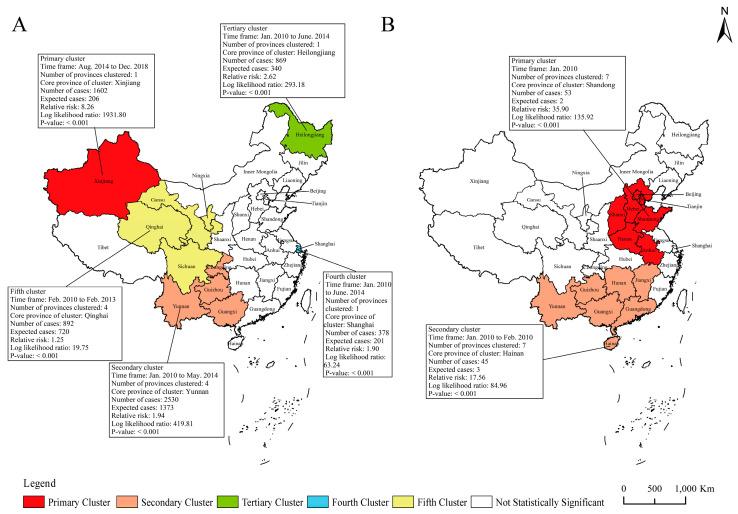
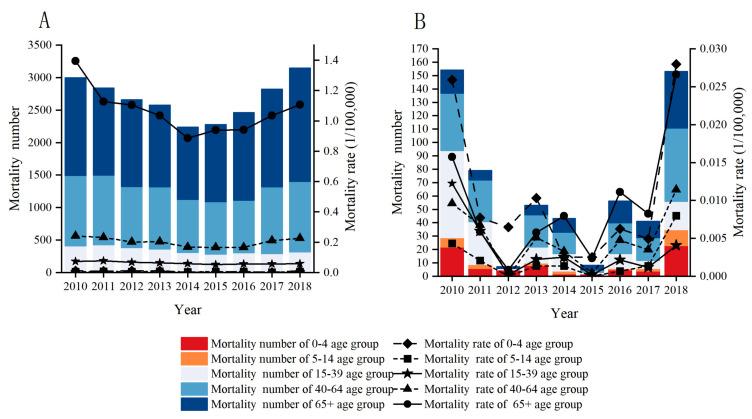
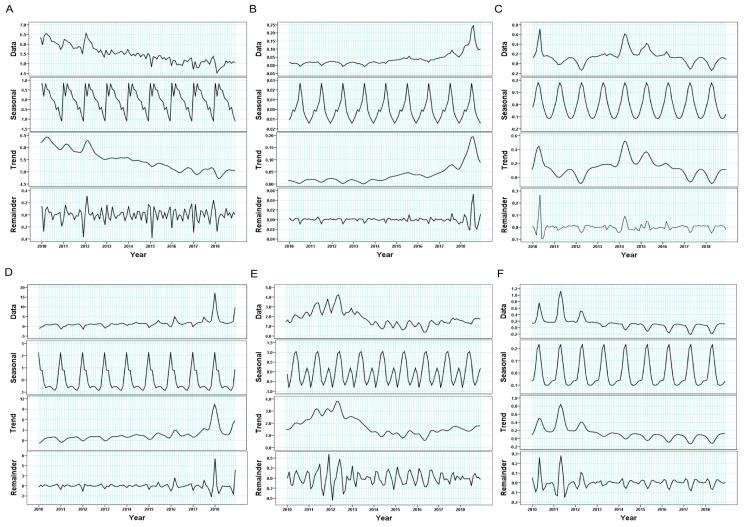
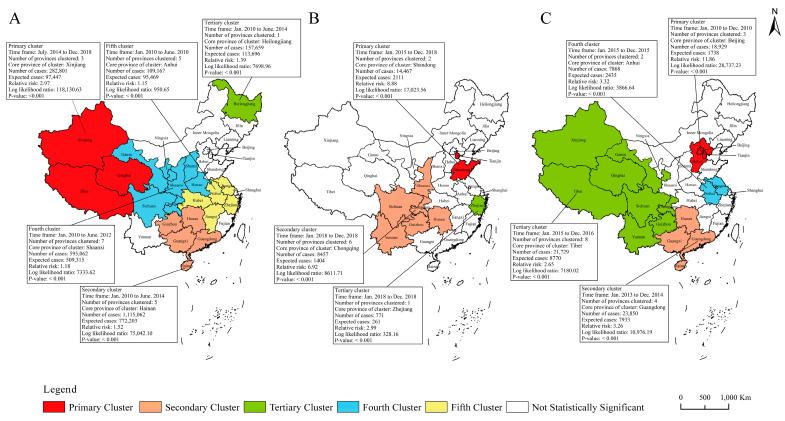
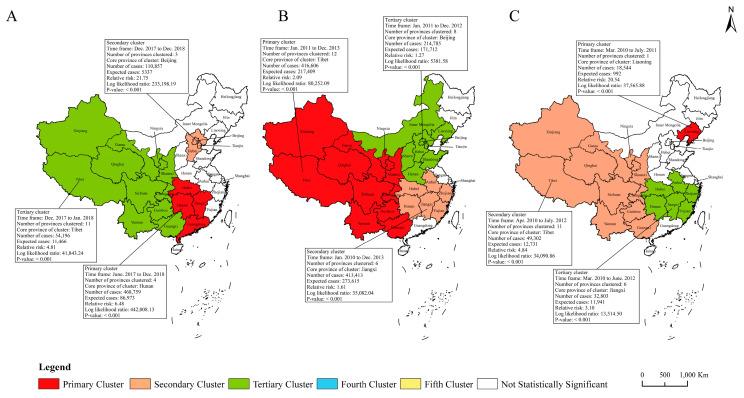
Respiratory infectious diseases (RIDs) pose threats to people's health, some of which are serious public health problems. The aim of our study was to explore epidemic situations regarding notifiable RIDs and the epidemiological characteristics of the six most common RIDs in mainland China. We first collected the surveillance data of all 12 statutory notifiable RIDs for 31 provinces in mainland China that reported between 2010 and 2018, and then the six most prevalent RIDs were selected to analyze their temporal, seasonal, spatiotemporal and population distribution characteristics. From 2010 to 2018, there were 13,985,040 notifiable cases and 25,548 deaths from RIDs in mainland China. The incidence rate of RIDs increased from 109.85/100,000 in 2010 to 140.85/100,000 in 2018. The mortality from RIDs ranged from 0.18/100,000 to 0.24/100,000. The most common RIDs in class B were pulmonary tuberculosis (PTB), pertussis, and measles, while those in class C were seasonal influenza, mumps and rubella. From 2010 to 2018, the incidence rate of PTB and rubella decreased; however, pertussis and seasonal influenza increased, with irregular changes in measles and mumps. The mortality from PTB increased from 2015 to 2018, and the mortality from seasonal influenza changed irregularly. PTB was mainly prevalent among people over 15 years old, while the other five common RIDs mostly occurred among people younger than 15 years old. The incidence of the six common RIDs mostly occurred in winter and spring, and they were spatiotemporally clustered in different areas and periods. In conclusion, PTB, seasonal influenza and mumps remain as public health problems in China, suggesting that continuous government input, more precise interventions, and a high-tech digital/intelligent surveillance and warning system are required to rapidly identify emerging events and timely response.
呼吸道传染病(RIDs)对人们的健康构成威胁,其中一些是严重的公共卫生问题。我们的研究旨在探讨中国法定报告的传染性疾病的流行情况以及中国大陆六种最常见的 RIDs 的流行病学特征。我们首先收集了中国大陆 31 个省份 2010 年至 2018 年期间所有 12 种法定报告的传染性疾病的监测数据,然后选择了六种最常见的 RIDs 来分析它们的时间、季节、时空和人群分布特征。2010 年至 2018 年,中国大陆共报告传染性疾病 1398.504 万例,死亡 2554.8 例。RIDs 的发病率从 2010 年的 109.85/100,000 上升到 2018 年的 140.85/100,000。RIDs 的死亡率范围为 0.18/100,000 至 0.24/100,000。乙类传染病中最常见的是肺结核(PTB)、百日咳和麻疹,而丙类传染病中最常见的是季节性流感、流行性腮腺炎和风疹。2010 年至 2018 年,PTB 和风疹的发病率下降,而百日咳和季节性流感增加,麻疹和流行性腮腺炎的发病率呈不规则变化。PTB 的死亡率从 2015 年到 2018 年上升,季节性流感的死亡率呈不规则变化。PTB 主要发生在 15 岁以上人群,而其他五种常见 RIDs 主要发生在 15 岁以下人群。六种常见 RIDs 的发病率主要发生在冬春季,在不同地区和时期呈时空聚集性。总之,PTB、季节性流感和流行性腮腺炎仍然是中国的公共卫生问题,这表明需要持续的政府投入、更精准的干预措施以及高科技数字化/智能化监测和预警系统,以便快速识别新出现的事件并及时做出反应。



 Zotero 插件