
中国 COVID-19 大流行期间传染病报告发病率的变化。
Changes in notifiable infectious disease incidence in China during the COVID-19 pandemic.
机构信息
Division of Infectious Disease, Key Laboratory of Surveillance and Early-warning on Infectious Disease, Chinese Center for Disease Control and Prevention, Beijing, China.
State Key Laboratory of Pathogen and Biosecurity, Beijing Institute of Microbiology and Epidemiology, Beijing, P. R. China.
出版信息
Nat Commun. 2021 Nov 26;12(1):6923. doi: 10.1038/s41467-021-27292-7.
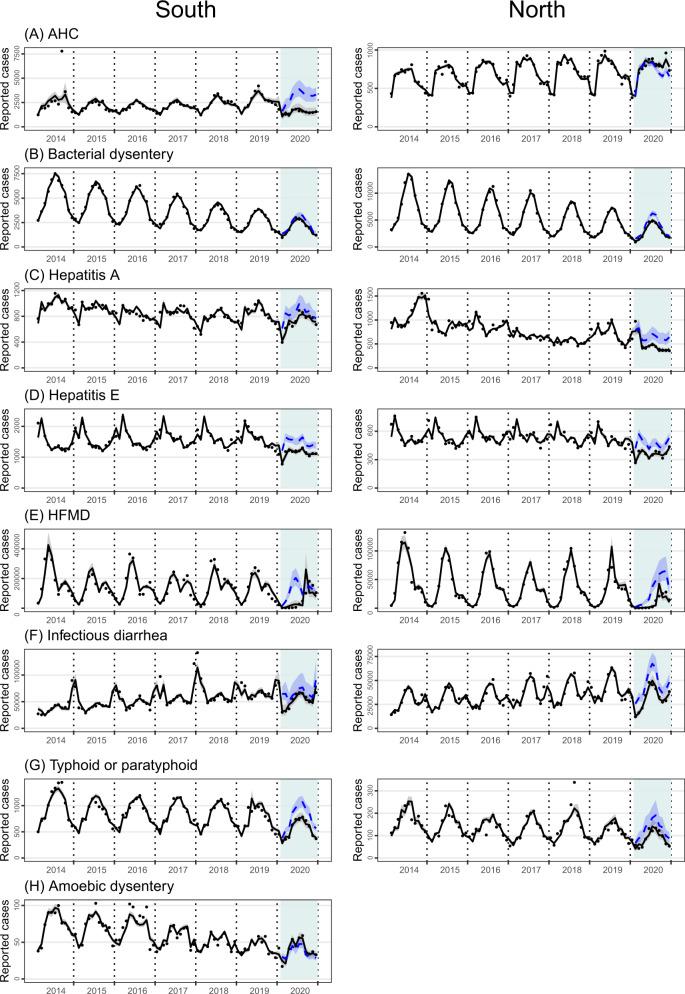
Nationwide nonpharmaceutical interventions (NPIs) have been effective at mitigating the spread of the novel coronavirus disease (COVID-19), but their broad impact on other diseases remains under-investigated. Here we report an ecological analysis comparing the incidence of 31 major notifiable infectious diseases in China in 2020 to the average level during 2014-2019, controlling for temporal phases defined by NPI intensity levels. Respiratory diseases and gastrointestinal or enteroviral diseases declined more than sexually transmitted or bloodborne diseases and vector-borne or zoonotic diseases. Early pandemic phases with more stringent NPIs were associated with greater reductions in disease incidence. Non-respiratory diseases, such as hand, foot and mouth disease, rebounded substantially towards the end of the year 2020 as the NPIs were relaxed. Statistical modeling analyses confirm that strong NPIs were associated with a broad mitigation effect on communicable diseases, but resurgence of non-respiratory diseases should be expected when the NPIs, especially restrictions of human movement and gathering, become less stringent.
全国范围的非药物干预(NPIs)已被证明在减缓新型冠状病毒病(COVID-19)的传播方面非常有效,但它们对其他疾病的广泛影响仍有待研究。在这里,我们报告了一项生态分析,比较了 2020 年中国 31 种主要传染病的发病率与 2014-2019 年期间的平均水平,同时控制了按 NPI 强度水平定义的时间阶段。呼吸道疾病和胃肠道或肠病毒病的发病率下降幅度大于性传播疾病或血源性病原体疾病以及媒介传播或动物源性疾病。疫情早期实施更严格的 NPIs 与疾病发病率的更大降幅相关。随着 NPIs 的放宽,非呼吸道疾病(如手足口病)在 2020 年年末大幅反弹。统计模型分析证实,强有力的 NPIs 与传染病的广泛缓解效应有关,但当 NPIs(尤其是对人员流动和聚集的限制)变得不那么严格时,预计非呼吸道疾病会再次出现。


 Zotero 插件