
同源重组缺陷状态预测中国高级别浆液性卵巢癌患者对铂类化疗的反应。
Homologous recombination deficiency status predicts response to platinum-based chemotherapy in Chinese patients with high-grade serous ovarian carcinoma.
机构信息
Department of Gynecologic Oncology, Fudan University Shanghai Cancer Center, 270 DongAn Rd, Shanghai, 200032, China.
Department of Oncology, Shanghai Medical College, Fudan University, Shanghai, China.
出版信息
J Ovarian Res. 2023 Mar 15;16(1):53. doi: 10.1186/s13048-023-01129-x.
BACKGROUND
Homologous Recombination Deficiency (HRD) is a predictive biomarker for ovarian cancer treated with PARP inhibitors or for breast cancer treated with first-line platinum-based chemotherapy. However, limited research is documented on platinum-based treatment prediction with HRD as a biomarker in ovarian cancer patients, especially in the Chinese population.
METHODS
We investigated the association between HRD status and the response of platinum-based chemotherapy in 240 Chinese HGSOC patients.
RESULTS
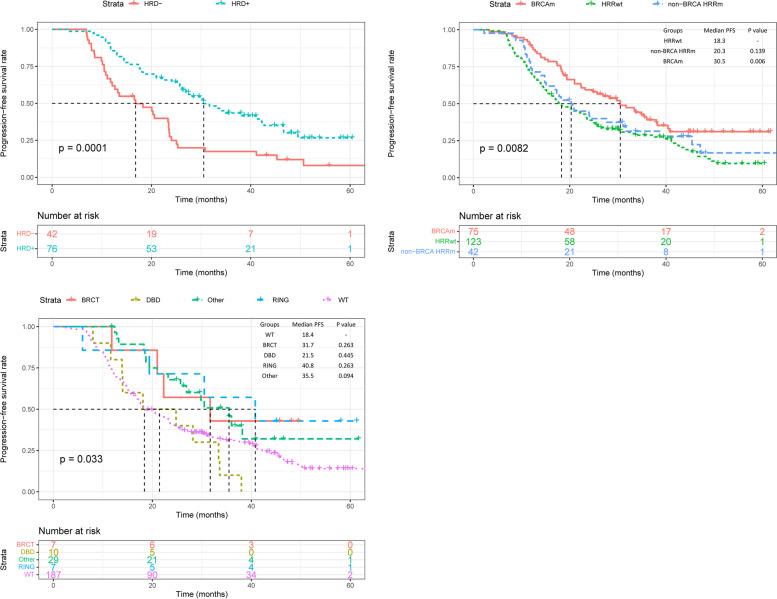
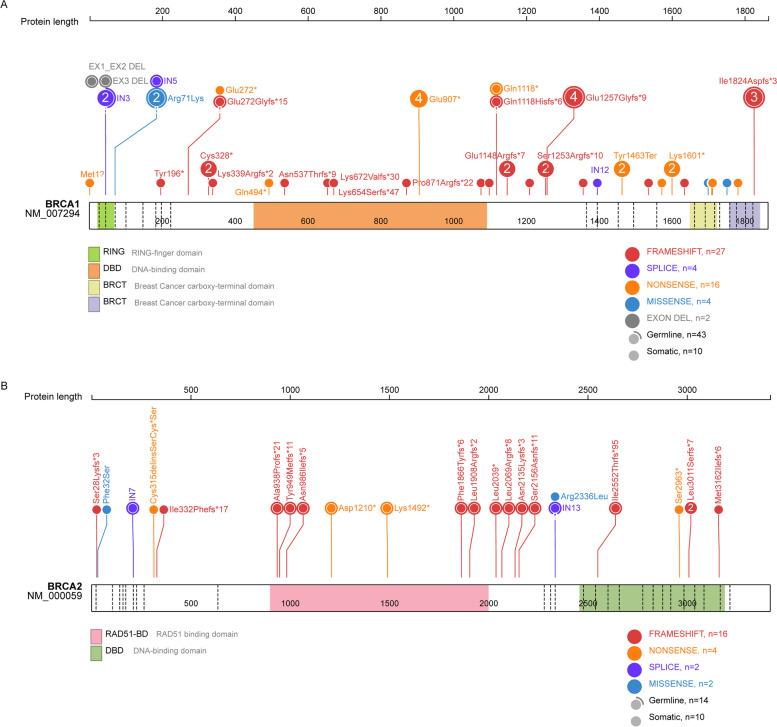
The Pt-sensitive patients showed higher HRD scores than Pt-resistant ones, but this was not significant(median: 42.6 vs. 31.6, p = 0.086). (Pt)-sensitive rate was higher in HRD + BRCAm tumors and in HRD + BRCAwt tumors (HRD + BRCAm: 97%, p = 0.004 and HRD + BRCAwt: 90%, p = 0.04) compared with 74% in the HRD-BRCAwt tumors. We also found Pt-sensitive patients tend to be enriched in patients with BRCA mutations or non-BRCA HRR pathway gene mutations (BRCA: 93.6% vs 75.4%, p < 0.001; non-BRCA HRR: 88.6% vs 75.4%, p = 0.062). Patients with HRD status positive had significantly improved PFS compared with those with HRD status negative (median PFS: 30.5 months vs. 16.8 months, Log-rank p = 0.001). Even for BRCAwt patients, positive HRD was also associated with better PFS than the HRD-negative group (median: 27.5 months vs 16.8 months, Log-rank p = 0.010). Further, we found patients with pathogenic mutations located in the DNA-binding domain (DBD) of BRCA1 had improved FPS, compared to those with mutations in other domains. (p = 0.03).
CONCLUSIONS
The HRD status can be identified as an independent significance in Chinese HGSOC patients treated with first-line platinum-based chemotherapy.
背景
同源重组缺陷(HRD)是卵巢癌患者接受 PARP 抑制剂治疗或乳腺癌患者接受一线铂类化疗的预测性生物标志物。然而,关于 HRD 作为生物标志物在卵巢癌患者中进行铂类治疗预测的研究有限,尤其是在中国人群中。
方法
我们研究了 240 名中国高级别浆液性卵巢癌(HGSOC)患者中 HRD 状态与铂类化疗反应之间的关系。
结果
铂类敏感患者的 HRD 评分高于铂类耐药患者,但无统计学意义(中位数:42.6 比 31.6,p=0.086)。HRD+BRCA 突变肿瘤和 HRD+BRCAwt 肿瘤的铂类敏感率较高(HRD+BRCA 突变:97%,p=0.004;HRD+BRCAwt:90%,p=0.04),而 HRD-BRCAwt 肿瘤的铂类敏感率为 74%。我们还发现,铂类敏感患者倾向于富集于 BRCA 突变或非 BRCA HRR 途径基因突变患者中(BRCA:93.6%比 75.4%,p<0.001;非 BRCA HRR:88.6%比 75.4%,p=0.062)。HRD 状态阳性患者的 PFS 明显长于 HRD 状态阴性患者(中位 PFS:30.5 个月比 16.8 个月,对数秩检验 p=0.001)。即使是 BRCAwt 患者,HRD 阳性也与 HRD 阴性组相比具有更好的 PFS(中位:27.5 个月比 16.8 个月,对数秩检验 p=0.010)。此外,我们发现 BRCA1 的 DNA 结合域(DBD)中存在致病性突变的患者与其他突变患者相比,FPS 有所提高。(p=0.03)。
结论
HRD 状态可作为中国 HGSOC 患者接受一线铂类化疗的独立预后因素。


 Zotero 插件