
壳寡糖可改善多囊卵巢综合征患者卵巢颗粒细胞炎症和氧化应激。
Chitosan oligosaccharide improves ovarian granulosa cells inflammation and oxidative stress in patients with polycystic ovary syndrome.
机构信息
Reproductive Health Department, Shenzhen Traditional Chinese Medicine Hospital, The Fourth Clinical Medical College of Guangzhou University of Traditional Chinese Medicine, Shenzhen, China.
Jiangxi Provincial Key Laboratory of Reproductive Physiology and Pathology, Nanchang University, Nanchang, China.
出版信息
Front Immunol. 2023 Mar 1;14:1086232. doi: 10.3389/fimmu.2023.1086232. eCollection 2023.
INTRODUCTION
Polycystic Ovary Syndrome (PCOS) is the most common reproductive endocrine disorder among women of reproductive age, which is one of the main causes of anovulatory infertility. Even though the rapidly developed assisted reproductive technology (ART) could effectively solve fertility problems, some PCOS patients still have not obtained satisfactory clinical outcomes. The poor quality of oocytes caused by the abnormal follicular development of PCOS may directly contribute to the failure of ART treatment. Ovarian granulosa cells (GCs) are the most closely related cells to oocytes, and changes in their functional status have a direct impact on oocyte formation. Previous studies have shown that changes in the ovarian microenvironment, like oxidative stress and inflammation, may cause PCOS-related aberrant follicular development by impairing the physiological state of the GCs. Therefore, optimizing the ovarian microenvironment is a feasible method for enhancing the development potential of PCOS oocytes.
METHODS
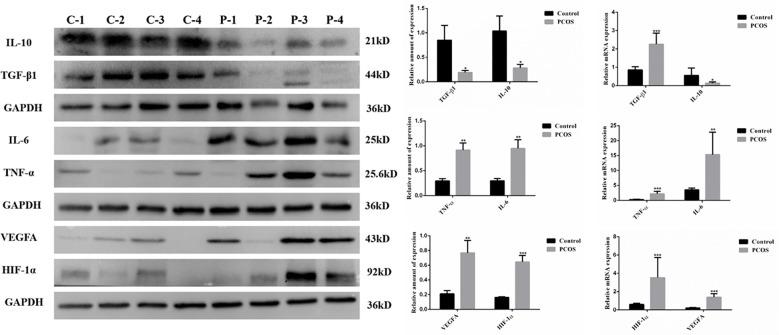
In this study, we first detected the expression of inflammatory-related factors (TGF-β1, IL-10, TNFα, IL-6) and oxidative stress-related factors (HIF-1α and VEGFA), as well as the proliferation ability and apoptosis level of GCs, which were collected from control patients (non-PCOS) and PCOS patients, respectively. Subsequently, human ovarian granulosa cell line (KGN) cells were used to verify the anti-inflammatory and anti-oxidative stress effects of chitosan oligosaccharide (COS) on GCs, as well as to investigate the optimal culture time and concentration of COS. The optimal culture conditions were then used to culture GCs from PCOS patients and control patients.
RESULTS
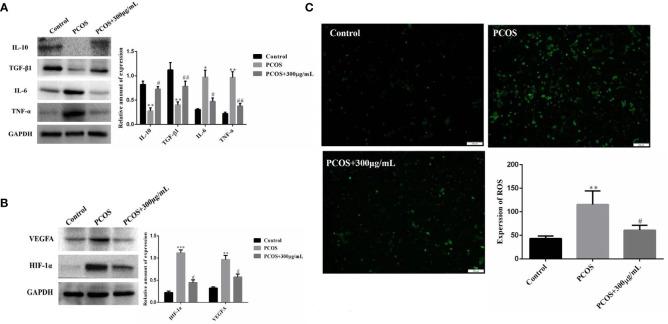
The results showed that GCs from PCOS patients exhibited obvious inflammation and oxidative stress and significantly reduced proliferation and increased apoptosis. Furthermore, COS can increase the expression of anti-inflammatory factors (TGF-β1 and IL-10) and decrease the expression of pro-inflammatory factors (TNFα and IL-6), as well as promote the proliferation of GCs. Moreover, we found that COS can reduce the level of reactive oxygen species in GCs under oxidative stress by inhibiting the expression of HIF-1α and VEGFA and by suppressing the apoptosis of GCs induced by oxidative stress.
CONCLUSION
We find that inflammation and oxidative stress exist in the GCs of PCOS patients, and COS can reduce these factors, thereby improving the function of GCs.
简介
多囊卵巢综合征(PCOS)是育龄妇女中最常见的生殖内分泌疾病,也是排卵障碍性不孕的主要原因之一。尽管快速发展的辅助生殖技术(ART)可以有效地解决生育问题,但一些 PCOS 患者的临床结局仍不令人满意。PCOS 导致的卵泡发育异常引起的卵母细胞质量差,可能直接导致 ART 治疗失败。卵巢颗粒细胞(GCs)是与卵母细胞最密切相关的细胞,其功能状态的变化直接影响卵母细胞的形成。先前的研究表明,卵巢微环境的改变,如氧化应激和炎症,可能通过损害 GCs 的生理状态导致与 PCOS 相关的异常卵泡发育。因此,优化卵巢微环境是增强 PCOS 卵母细胞发育潜能的一种可行方法。
方法
本研究首先检测了来自对照组(非 PCOS)和 PCOS 患者的 GCs 中炎症相关因子(TGF-β1、IL-10、TNFα、IL-6)和氧化应激相关因子(HIF-1α 和 VEGFA)的表达,以及 GCs 的增殖能力和凋亡水平。随后,用人卵巢颗粒细胞系(KGN)细胞验证壳聚糖寡糖(COS)对 GCs 的抗炎和抗氧化应激作用,并探讨 COS 的最佳培养时间和浓度。然后在最佳培养条件下培养 PCOS 患者和对照组患者的 GCs。
结果
结果表明,PCOS 患者的 GCs 表现出明显的炎症和氧化应激,增殖能力明显降低,凋亡明显增加。此外,COS 可以增加抗炎因子(TGF-β1 和 IL-10)的表达,降低促炎因子(TNFα 和 IL-6)的表达,促进 GCs 的增殖。而且,我们发现 COS 可以通过抑制 HIF-1α 和 VEGFA 的表达和抑制氧化应激诱导的 GCs 凋亡来降低 GCs 中的活性氧水平。
结论
我们发现 PCOS 患者的 GCs 存在炎症和氧化应激,COS 可以降低这些因子,从而改善 GCs 的功能。



 Zotero 插件