
医疗和非医疗设备的臭氧消毒:设计与实施考量评估
Ozone Decontamination of Medical and Nonmedical Devices: An Assessment of Design and Implementation Considerations.
作者信息
Epelle Emmanuel I, Macfarlane Andrew, Cusack Michael, Burns Anthony, Okolie Jude A, Vichare Parag, Rolland Luc, Yaseen Mohammed
机构信息
School of Computing, Engineering & Physical Sciences, University of the West of Scotland, Paisley PA1 2BE, United Kingdom.
ACS Clothing, 6 Dovecote Road Central Point Logistics Park, Centralpark ML1 4GP, United Kingdom.
出版信息
Ind Eng Chem Res. 2023 Mar 1;62(10):4191-4209. doi: 10.1021/acs.iecr.2c03754. eCollection 2023 Mar 15.
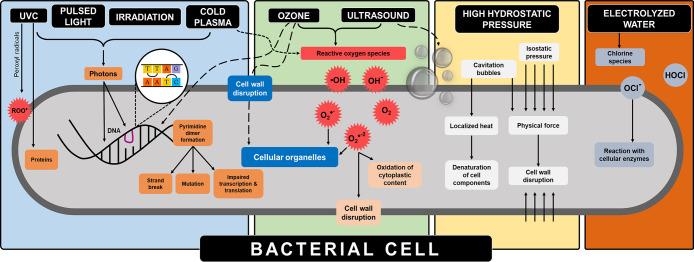
The control of infectious diseases can be improved via carefully designed decontamination equipment and systems. Research interest in ozone (a powerful antimicrobial agent) has significantly increased over the past decade. The COVID-19 pandemic has also instigated the development of new ozone-based technologies for the decontamination of personal protective equipment, surfaces, materials, and indoor environments. As this interest continues to grow, it is necessary to consider key factors affecting the applicability of lab-based findings to large-scale systems utilizing ozone. In this review, we present recent developments on the critical factors affecting the successful deployments of industrial ozone technologies. Some of these include the medium of application (air or water), material compatibility, efficient circulation and extraction, measurement and control, automation, scalability, and process economics. We also provide a comparative assessment of ozone relative to other decontamination methods/sterilization technologies and further substantiate the necessity for increased developments in gaseous and aqueous ozonation. Modeling methodologies, which can be applied for the design and implementation of ozone contacting systems, are also presented in this review. Key knowledge gaps and open research problems/opportunities are extensively covered including our recommendations for the development of novel solutions with industrial importance.
通过精心设计的去污设备和系统,可以改善传染病的控制。在过去十年中,对臭氧(一种强大的抗菌剂)的研究兴趣显著增加。新冠疫情也推动了基于臭氧的新技术的发展,用于个人防护装备、表面、材料和室内环境的去污。随着这种兴趣的持续增长,有必要考虑影响基于实验室的研究结果应用于利用臭氧的大规模系统的关键因素。在本综述中,我们介绍了影响工业臭氧技术成功应用的关键因素的最新进展。其中一些因素包括应用介质(空气或水)、材料兼容性、高效循环和提取、测量与控制、自动化、可扩展性以及工艺经济性。我们还对臭氧与其他去污方法/灭菌技术进行了比较评估,并进一步证实了加强气态和水相臭氧处理发展的必要性。本综述还介绍了可用于臭氧接触系统设计和实施的建模方法。文中广泛涵盖了关键知识空白和开放研究问题/机遇,包括我们对具有工业重要性的新型解决方案开发的建议。



 Zotero 插件