
邮寄家用基于人乳头瘤病毒的宫颈癌筛查自我采样试剂盒的经济评价。
Economic Evaluation of Mailed Home-Based Human Papillomavirus Self-sampling Kits for Cervical Cancer Screening.
机构信息
Center for Health Research, Kaiser Permanente Northwest, Portland, Oregon.
Department of Epidemiology, University of Washington School of Public Health, Seattle.
出版信息
JAMA Netw Open. 2023 Mar 1;6(3):e234052. doi: 10.1001/jamanetworkopen.2023.4052.
IMPORTANCE
Human papillomavirus (HPV) self-sampling addresses barriers to cervical cancer screening, and mailed self-sampling kits have been reported to increase screening uptake. International research suggests mailed kits are cost-effective in certain settings. However, the cost-effectiveness of mailing HPV self-sampling kits for increasing screening uptake has not been evaluated in the US.
OBJECTIVE
To conduct an economic evaluation of a mailed HPV self-sampling intervention among underscreened women enrolled in an integrated US health care system.
DESIGN, SETTING, AND PARTICIPANTS: This economic evaluation involved a cost-effectiveness analysis of results from a randomized clinical trial of 19 851 women aged 30 to 64 years enrolled in a health plan from Kaiser Permanente Washington (KPWA), a US-based integrated health care system. Women were identified through electronic medical records, and eligible participants were enrolled in a health plan for at least 3 years and 5 months, had a primary care clinician, had not received a Papanicolaou test for at least 3 years and 5 months, and had not received a hysterectomy. Enrollment occurred from February 25, 2014, to August 29, 2016, with follow-up through February 25, 2018. The current economic evaluation was conducted between August 2, 2021, and July 30, 2022. Intervention delivery costs were calculated from both the KPWA and Medicare perspectives and were based on either wellness visit or Papanicolaou test-only visit costs.
INTERVENTION
Participants in the control group received usual care, which comprised patient reminders and ad hoc outreach for screening. Participants in the intervention group received usual care plus a mailed HPV self-sampling kit.
MAIN OUTCOME AND MEASURES
The primary economic outcome was the incremental cost-effectiveness ratio (ICER) for increased screening uptake, defined as the incremental difference in cost (intervention group minus control group) divided by the difference in the number of participants completing screening (intervention group minus control group) within 6 months of randomization.
RESULTS
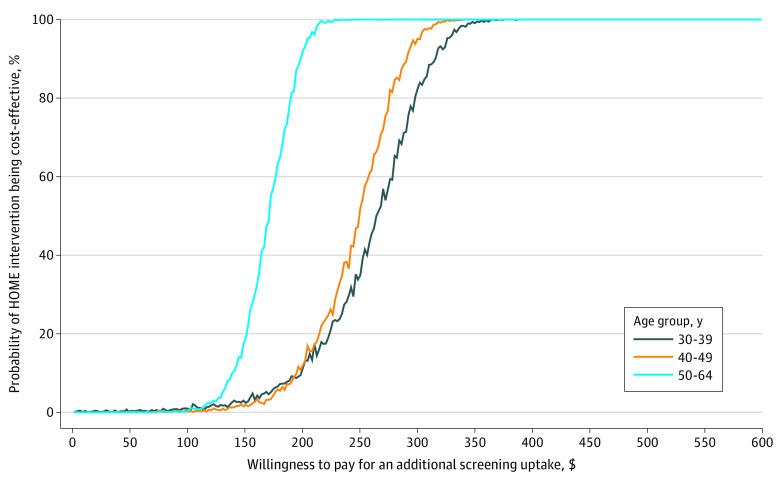
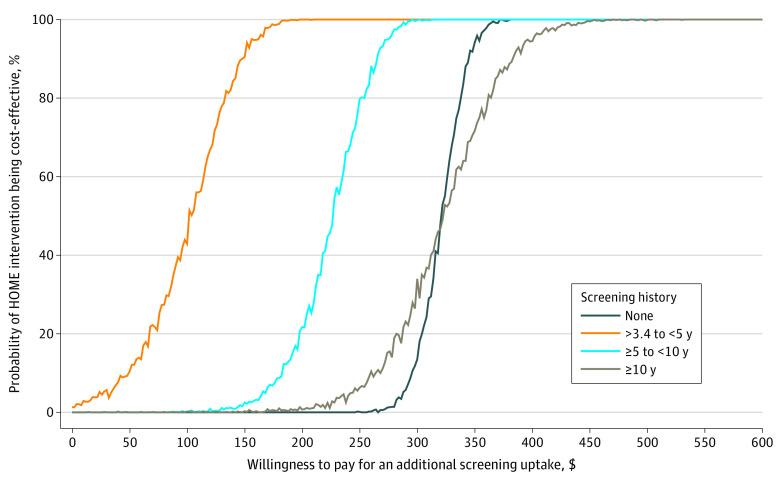
Among 19 851 women (mean [SD] age, 50.1 [9.5] years; 76.7% White), 9960 were randomized to the intervention group, and 9891 were randomized to the control group. Baseline ICERs ranged from $85.84 (95% CI, $85.68-$85.99) using KPWA wellness visits as the cost basis to $146.29 (95% CI, $146.20-$146.38) using Medicare Papanicolaou test-only visits as the cost source. Subgroups of participants aged 50 to 64 years and participants most recently overdue for screening achieved cost-effectiveness at lower levels of willingness to pay for an additional completed screening than other subgroups.
CONCLUSIONS AND RELEVANCE
In this economic evaluation, mailing HPV self-sampling kits to women overdue for cervical cancer screening was cost-effective for increased screening uptake relative to usual care. These results support mailing HPV kits as an efficient outreach strategy for increasing screening rates among eligible women in US health care systems.
重要性
人乳头瘤病毒(HPV)自我采样解决了宫颈癌筛查的障碍,邮寄自我采样试剂盒已被报道可提高筛查率。国际研究表明,在某些情况下,邮寄试剂盒具有成本效益。然而,邮寄 HPV 自我采样试剂盒以提高筛查率的成本效益尚未在美国进行评估。
目的
对参加美国综合医疗保健系统的未充分筛查女性进行邮寄 HPV 自我采样干预的经济评估。
设计、地点和参与者:这是一项经济评估,涉及对 Kaiser Permanente Washington (KPWA) 一项针对 19851 名年龄在 30 至 64 岁之间的女性的随机临床试验结果进行成本效益分析,这些女性是通过电子病历确定的,符合条件的参与者至少参加了 KPWA 健康计划 3 年零 5 个月,有初级保健医生,至少 3 年零 5 个月未接受巴氏涂片检查,且未接受过子宫切除术。登记于 2014 年 2 月 25 日至 2016 年 8 月 29 日进行,随访至 2018 年 2 月 25 日。目前的经济评估于 2021 年 8 月 2 日至 2022 年 7 月 30 日进行。干预交付成本是根据 KPWA 和医疗保险的观点计算的,并且基于健康检查或巴氏涂片检查仅访问成本。
干预措施
对照组参与者接受常规护理,包括患者提醒和筛查的临时外展。干预组参与者在接受常规护理的基础上增加了邮寄 HPV 自我采样试剂盒。
主要结果和测量
主要的经济结果是增加筛查率的增量成本效益比(ICER),定义为随机分组后 6 个月内完成筛查的参与者人数(干预组减去对照组)的增量差异除以成本(干预组减去对照组)的差异。
结果
在 19851 名女性(平均[SD]年龄,50.1[9.5]岁;76.7%为白人)中,9960 名被随机分配到干预组,9891 名被随机分配到对照组。基于 KPWA 健康检查的基线 ICER 范围为 85.84 美元(95%CI,85.68-85.99),使用医疗保险巴氏涂片检查仅访问作为成本来源为 146.29 美元(95%CI,146.20-146.38)。50 至 64 岁的参与者亚组和最近错过筛查的参与者在更低的支付意愿水平上实现了成本效益,以获得额外的完成筛查。
结论和相关性
在这项经济评估中,与常规护理相比,向宫颈癌筛查延误的女性邮寄 HPV 自我采样试剂盒在提高筛查率方面具有成本效益。这些结果支持邮寄 HPV 试剂盒作为提高美国医疗保健系统中合格女性筛查率的有效外展策略。
 Zotero 插件