
基于外骨骼的训练可提高不完全性脊髓损伤患者的独立行走能力:一项随机对照试验的结果。
Exoskeleton-based training improves walking independence in incomplete spinal cord injury patients: results from a randomized controlled trial.
机构信息
Biomechanics and Technical Aids Department, National Hospital for Paraplegics, SESCAM, Finca la Peraleda s/n, 45071, Toledo, Spain.
Physical Medicine and Rehabilitation Department, National Hospital for Paraplegics, SESCAM, Toledo, Spain.
出版信息
J Neuroeng Rehabil. 2023 Mar 24;20(1):36. doi: 10.1186/s12984-023-01158-z.
BACKGROUND
In recent years, ambulatory lower limb exoskeletons are being gradually introduced into the clinical practice to complement walking rehabilitation programs. However, the clinical evidence of the outcomes attained with these devices is still limited and nonconclusive. Furthermore, the user-to-robot adaptation mechanisms responsible for functional improvement are still not adequately unveiled. This study aimed to (1) assess the safety and feasibility of using the HANK exoskeleton for walking rehabilitation, and (2) investigate the effects on walking function after a training program with it.
METHODS
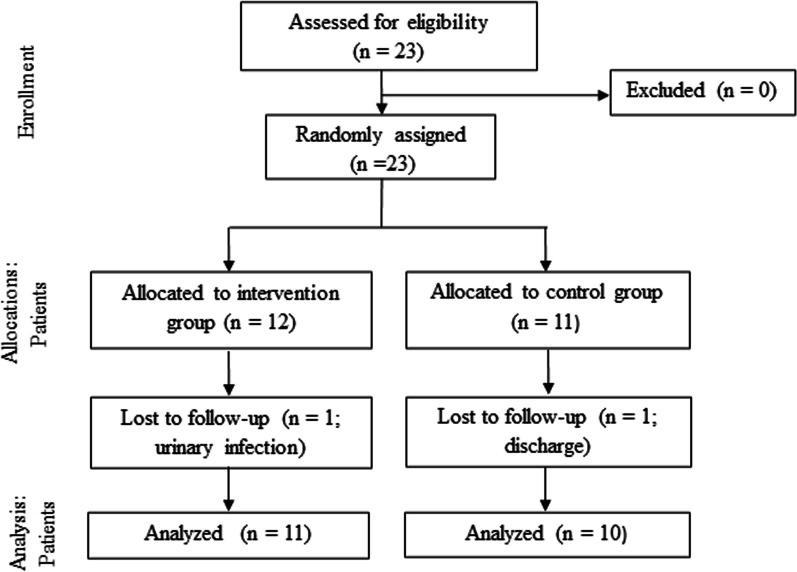
A randomized controlled trial was conducted including a cohort of 23 patients with less than 1 year since injury, neurological level of injury (C2-L4) and severity (American Spinal Cord Injury Association Impairment Scale [AIS] C or D). The intervention was comprised of 15 one-hour gait training sessions with lower limb exoskeleton HANK. Safety was assessed through monitoring of adverse events, and pain and fatigue through a Visual Analogue Scale. LEMS, WISCI-II, and SCIM-III scales were assessed, along with the 10MWT, 6MWT, and the TUG walking tests (see text for acronyms).
RESULTS
No major adverse events were reported. Participants in the intervention group (IG) reported 1.8 cm (SD 1.0) for pain and 3.8 (SD 1.7) for fatigue using the VAS. Statistically significant differences were observed for the WISCI-II for both the "group" factor (F = 16.75, p < 0.001) and "group-time" interactions (F = 8.87; p < 0.01). A post-hoc analysis revealed a statistically significant increase of 3.54 points (SD 2.65, p < 0.0001) after intervention for the IG but not in the CG (0.7 points, SD 1.49, p = 0.285). No statistical differences were observed between groups for the remaining variables.
CONCLUSIONS
The use of HANK exoskeleton in clinical settings is safe and well-tolerated by the patients. Patients receiving treatment with the exoskeleton improved their walking independence as measured by the WISCI-II after the treatment.
背景
近年来,下肢可移动外骨骼逐渐被引入临床实践,以补充步行康复计划。然而,这些设备所取得的临床效果证据仍然有限且不明确。此外,负责功能改善的用户与机器人适应机制仍未被充分揭示。本研究旨在:(1)评估 HANK 外骨骼用于步行康复的安全性和可行性;(2)调查使用该外骨骼进行训练后的步行功能效果。
方法
本研究为随机对照试验,纳入 23 名患者,受伤时间不到 1 年,神经损伤水平为 C2-L4,损伤严重程度为美国脊髓损伤协会损伤评分(AIS)C 或 D 级。干预措施包括 15 次下肢外骨骼 HANK 每小时 1 小时的步行训练。通过监测不良事件评估安全性,通过视觉模拟量表(VAS)评估疼痛和疲劳。评估了 LEMS、WISCI-II 和 SCIM-III 量表,以及 10MWT、6MWT 和 TUG 步行测试(见缩写)。
结果
未报告重大不良事件。干预组(IG)的参与者使用 VAS 报告疼痛为 1.8 厘米(SD 1.0),疲劳为 3.8(SD 1.7)。WISCI-II 评分在“组”因素(F=16.75,p<0.001)和“组-时间”交互作用(F=8.87;p<0.01)方面均存在统计学显著差异。事后分析显示,干预后 IG 显著增加 3.54 分(SD 2.65,p<0.0001),而 CG 则没有增加(0.7 分,SD 1.49,p=0.285)。两组间其余变量无统计学差异。
结论
HANK 外骨骼在临床环境中使用是安全的,患者能够耐受。接受外骨骼治疗的患者在 WISCI-II 上的步行独立性在治疗后得到改善。

 Zotero 插件