
美国 1992-2019 年按组织学类型和种族/族裔划分的卵巢癌发病率趋势。
Trends of Ovarian Cancer Incidence by Histotype and Race/Ethnicity in the United States 1992-2019.
机构信息
Department of Epidemiology, University of Michigan, Ann Arbor, Michigan.
Department of Integrative Oncology, BC Cancer Research Institute, Vancouver, British Columbia, Canada.
出版信息
Cancer Res Commun. 2023 Jan 3;3(1):1-8. doi: 10.1158/2767-9764.CRC-22-0410. eCollection 2023 Jan.
UNLABELLED
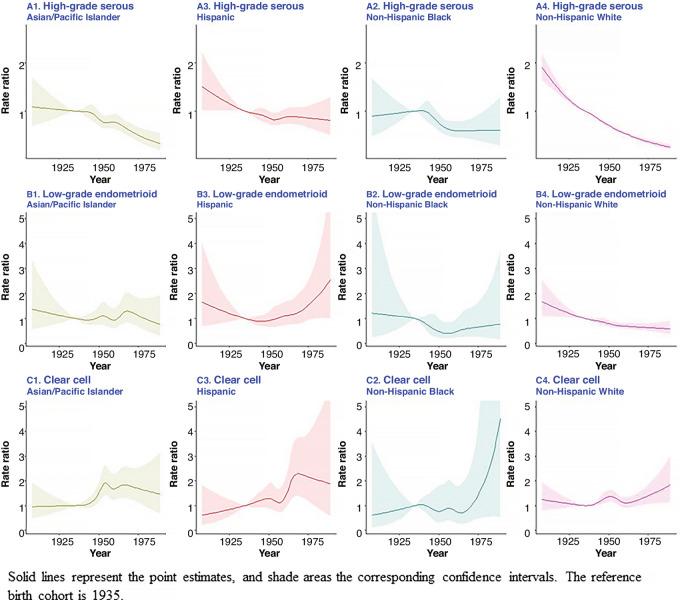
The effect of risk factors on ovarian cancer differs by histotype, and the prevalence of such risk factors varies by race/ethnicity. It is not clear how ovarian cancer incidence has changed over time by histotype and race/ethnicity. We used the Surveillance, Epidemiology, and End Results Program (SEER-12) 1992-2019 data to examine the trend of ovarian cancer incidence for three histotypes (high-grade serous = 19,691, endometrioid = 3,212, and clear cell = 3,275) and four racial/ethnic groups (Asian/Pacific Islander, Hispanic, non-Hispanic Black, and non-Hispanic White). Joinpoint and age-period-cohort analyses were conducted to analyze ovarian cancer incidence trends. High-grade serous cancer was the most common histotype, but its incidence has significantly decreased over time for all racial/ethnic groups; the decrease was largest for non-Hispanic White women (average annual percent change AAPC during 2010-2019 = -6.1; 95% confidence interval (CI), -8.0 to -4.2). Conversely, clear cell cancer was most common in the Asian/Pacific Islanders, and its incidence has increased over time, particularly among Hispanic and Asian/Pacific Islander women (AAPC during 2010-2019 = 2.8; 95% CI, 0.8 to 4.7, and AAPC = 1.5; 95% CI, 0.7 to 2.2, respectively). Endometrioid cancer incidence has decreased in non-Hispanic White but increased in Hispanic women (AAPC during 2010-2019 = -1.3; 95% CI, -1.9 to -0.8, and AAPC = 3.6; 95% CI, 1.0 to 6.3, respectively). The differential incidence trends by histotype and race/ethnicity underscore the need to monitor incidence and risk factor trends across different groups and develop targeted preventive interventions to reduce the burden of ovarian cancer and disparity by race/ethnicity.
SIGNIFICANCE
During 1992-2019, high-grade serous ovarian cancer incidence has decreased while clear cell cancer incidence has increased regardless of race/ethnicity. Endometrioid cancer incidence has decreased in non-Hispanic White but increased in Hispanic women. Differential ovarian cancer incidence trends highlight the need for targeted preventive interventions by histotype and race/ethnicity.
未加标签
危险因素对卵巢癌的影响因组织类型而异,而这些危险因素的患病率因种族/民族而异。目前尚不清楚卵巢癌的发病率随组织类型和种族/民族的变化而随时间发生了怎样的变化。我们使用监测、流行病学和最终结果计划(SEER-12)1992-2019 年的数据,研究了三种组织类型(高级别浆液性 = 19691、子宫内膜样 = 3212 和透明细胞 = 3275)和四个种族/民族群体(亚裔/太平洋岛民、西班牙裔、非西班牙裔黑人、和非西班牙裔白人)的卵巢癌发病率趋势。进行了 Joinpoint 和年龄-时期-队列分析,以分析卵巢癌发病率趋势。高级别浆液性癌是最常见的组织类型,但所有种族/民族群体的发病率都随着时间的推移而显著下降;非西班牙裔白人女性的降幅最大(2010-2019 年期间的平均年百分比变化 AAPC = -6.1;95%置信区间(CI),-8.0 至-4.2)。相反,透明细胞癌在亚裔/太平洋岛民中最为常见,其发病率随着时间的推移而增加,尤其是在西班牙裔和亚裔/太平洋岛民妇女中(2010-2019 年期间的 AAPC = 2.8;95%CI,0.8 至 4.7,和 AAPC = 1.5;95%CI,0.7 至 2.2)。非西班牙裔白种人子宫内膜样癌的发病率下降,但西班牙裔妇女的发病率上升(2010-2019 年期间的 AAPC = -1.3;95%CI,-1.9 至-0.8,和 AAPC = 3.6;95%CI,1.0 至 6.3)。不同组织类型和种族/民族的发病率趋势差异突出表明,需要监测不同群体的发病率和危险因素趋势,并制定有针对性的预防干预措施,以减少卵巢癌负担和种族/民族差异。
意义
1992-2019 年间,高级别浆液性卵巢癌的发病率下降,而无论种族/民族如何,透明细胞癌的发病率都在上升。非西班牙裔白人的子宫内膜样癌发病率下降,但西班牙裔妇女的发病率上升。卵巢癌发病率的差异趋势突出表明,需要根据组织类型和种族/民族进行有针对性的预防干预。

 Zotero 插件