
2010 年至 2015 年美国不同种族/族裔乳腺癌亚型发病率和分布的变化。
Variation in Breast Cancer Subtype Incidence and Distribution by Race/Ethnicity in the United States From 2010 to 2015.
机构信息
Department of Breast Surgical Oncology, National Cancer Center, National Clinical Research Center for Cancer, Cancer Hospital, Chinese Academy of Medical Sciences and Peking Union Medical College, Chaoyang District, Beijing, China.
Department of Radiotherapy, National Cancer Center, National Clinical Research Center for Cancer, Cancer Hospital, Chinese Academy of Medical Sciences and Peking Union Medical College, Chaoyang District, Beijing, China.
出版信息
JAMA Netw Open. 2020 Oct 1;3(10):e2020303. doi: 10.1001/jamanetworkopen.2020.20303.
IMPORTANCE
Breast cancer is the most commonly diagnosed cancer and the leading cause of death in women worldwide. Yet the racial/ethnic disparity in incidences and distributions of breast cancer remains largely unknown.
OBJECTIVE
To examine the racial/ethnic patterns associated with the incidence of the subtypes of breast cancer and distribution of patients across clinicopathological variables.
DESIGN, SETTING, AND PARTICIPANTS: This population-based cohort study analyzed data from the Surveillance, Epidemiology, and End Results (SEER) database, which collected data from 18 SEER cancer registries that identified patients with breast cancer in the US diagnosed between January 1, 2010, and December 31, 2015. The inclusion criteria were (1) female patients with primary unilateral breast cancer who underwent surgical treatment; (2) record of estrogen receptor, progesterone receptor, and ERBB2 status; (3) record of medical history and histological subtype of the specified tumor location; and (4) data on patient race/ethnicity, lateral tumor position, tumor size, tumor TNM stage, and number of tumors. Incidence and distribution rates were identified and compared for different molecular subtypes, histological grades, pathological patterns, T stages, TNM stages, and tumor sites of breast cancers for each racial/ethnic group. Patient race/ethnicity was classified as follows: non-Hispanic White, Hispanic White, Black, Asian/Pacific Islander, American Indian/Alaskan Native, and unknown. Data were analyzed from January 1, 2010, to December 31, 2015.
MAIN OUTCOMES AND MEASURES
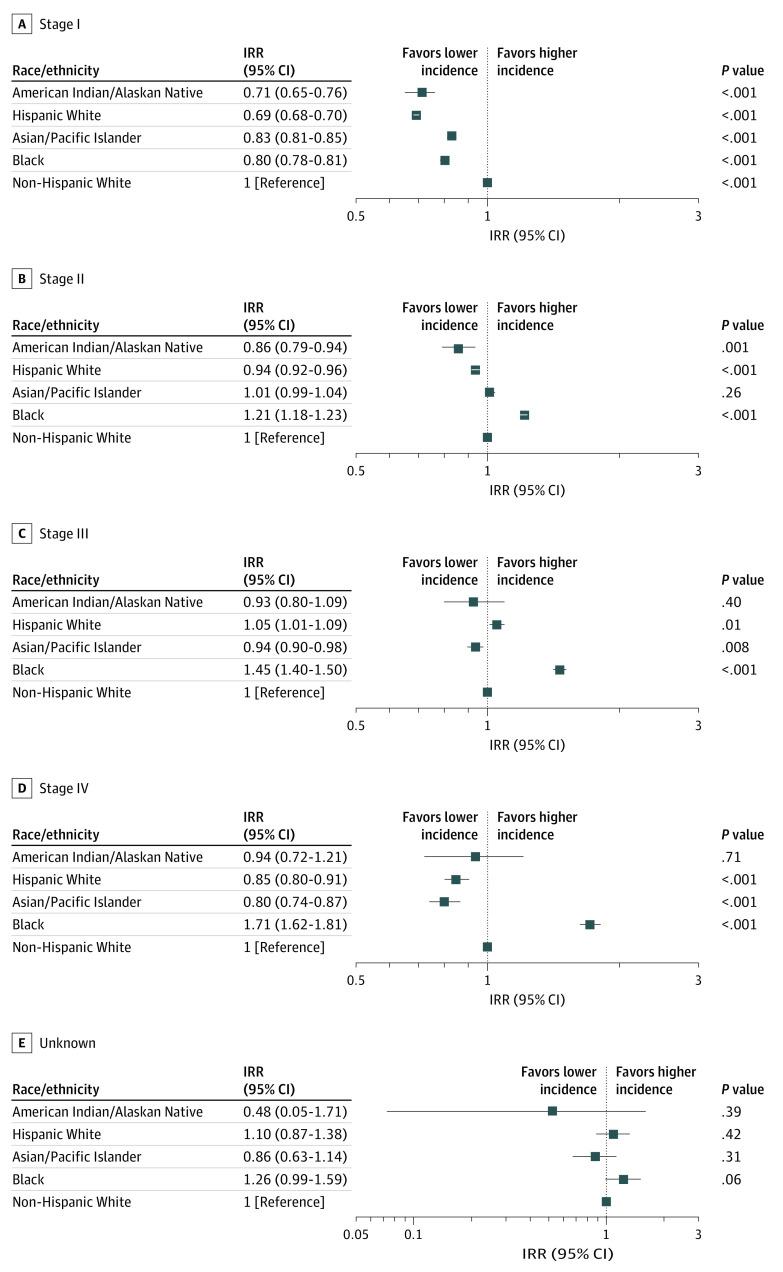
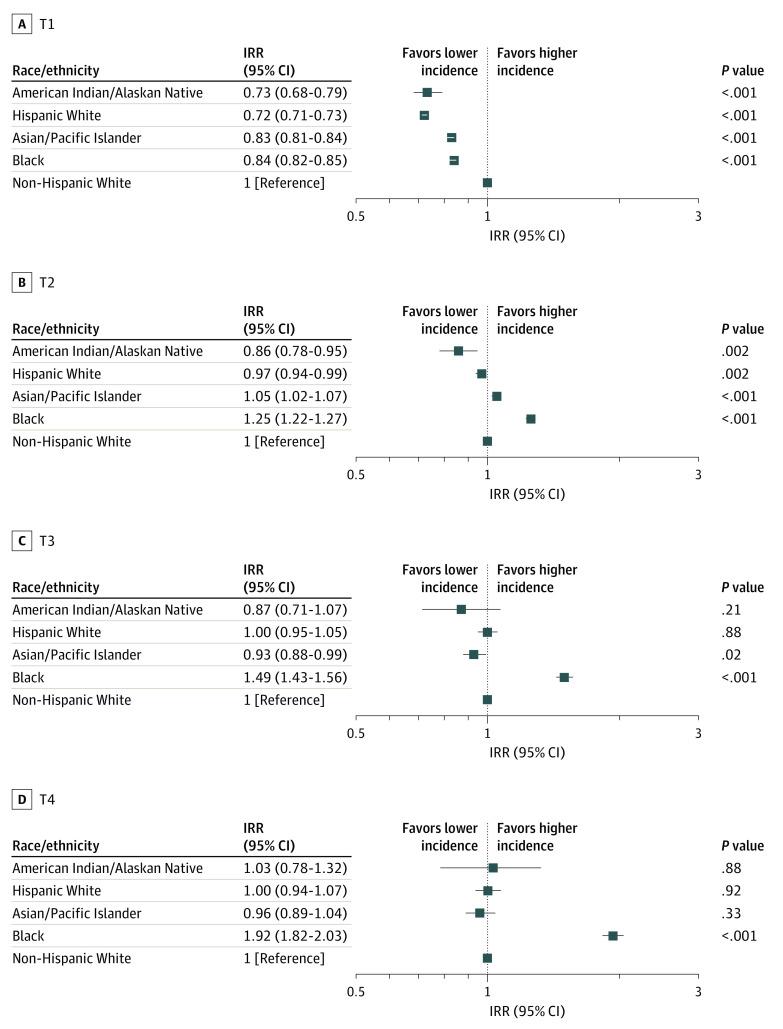
Incidence rates of 4 molecular subtypes: hormone receptor (HR)-positive and ERBB2-negative, HR-positive and ERBB2-positive, HR-negative and ERBB2-positive, and triple-negative breast cancer (TNBC). Data on distribution by histological grades (grades 1-4 and unknown), pathological patterns, T stages, TNM stages, and tumor sites was also extracted. Annual age-standardized incidence rates and incidence rate ratios (IRRs) were calculated with 95% CIs. Race/ethnicity case-to-case odds ratios were estimated using polytomous regression.
RESULTS
A total of 239 211 women with breast cancer were analyzed (median [interquartile range]) age, 60 [50-69] years). The annual incidence rate of all breast cancers was 31.3 (95% CI, 31.2- 31.5) per 100 000 people in non-Hispanic White women (the reference group), which was higher compared with the incidence among Black women (IRR, 1.04; 95% CI, 1.02-1.05; P < .001). The incidence rates were also lower in Asian/Pacific Islander (IRR, 0.90; 95% CI, 0.89-0.92; P < .001), American Indian/Alaskan native (IRR, 0.82; 95% CI, 0.81-0.83; P < .001), and Hispanic White women (IRR, 0.79; 95% CI, 0.75-0.83; P < .001). In Black patients, the incidences of the HR-positive and ERBB2-positive (IRR, 1.12; 95% CI, 1.08-1.16; P < .001), HR-negative and ERBB2-positive (IRR, 1.46; 95% CI, 1.38-1.54; P < .001), and TNBC (IRR, 2.07; 95% CI, 2.01-2.14; P < .001) subtypes were higher than those in non-Hispanic White patients, but the incidence of the HR-positive and ERBB2-negative subtype in Black women was lower (IRR, 0.86; 95% CI, 0.84-0.87; P < .001). The incidences of histological grade 1 (IRR, 0.75; 95% CI, 0.73-0.78; P < .001) and grade 2 (IRR, 0.91; 95% CI, 0.89-0.93; P < .001) were lower in Asian/Pacific Islander vs non-Hispanic White patients. Non-Hispanic White patients had a higher proportion of lobular carcinoma (9.7% [n = 15 718]) and tubular adenocarcinoma (0.6% [n = 997]) than Black (7.2% [n = 1933]; 0.3% [n = 81]), Asian/Pacific Islander (5.7% [n = 1202]; 0.3% [n = 55]), Hispanic White (7.2% [n = 1985]; 0.3% [n = 88]), and American Indian/Alaskan Native patients (7.2% [n = 101]; 0.4% [n = 5]).
CONCLUSIONS AND RELEVANCE
This cohort study found notable disparities in incidences and proportions of different molecular subtypes, histological grades, pathological patterns, T stages, TNM stages, and tumor sites associated with race/ethnicity. The findings suggest that combining epidemiologic with genomic and molecular profiling data warrants further research.
重要性
乳腺癌是全球最常见的癌症和女性死亡的主要原因。然而,乳腺癌的发病和分布在不同种族/族裔之间的差异在很大程度上仍不清楚。
目的
研究与乳腺癌亚型的发病模式以及患者在临床病理变量方面的分布相关的种族/族裔模式。
设计、设置和参与者:本基于人群的队列研究分析了来自监测、流行病学和最终结果(SEER)数据库的数据,该数据库收集了美国 18 个 SEER 癌症登记处的数据,这些登记处确定了 2010 年 1 月 1 日至 2015 年 12 月 31 日期间接受过手术治疗的单侧原发性乳腺癌女性患者。纳入标准为:(1)接受过手术治疗的女性原发性单侧乳腺癌患者;(2)记录雌激素受体、孕激素受体和 ERBB2 状态;(3)记录指定肿瘤位置的病史和组织学亚型;(4)患者种族/族裔、肿瘤侧位、肿瘤大小、肿瘤 TNM 分期和肿瘤数量的数据。为每个种族/族裔组确定并比较了不同分子亚型、组织学分级、病理模式、T 分期、TNM 分期和乳腺癌肿瘤部位的发病率和分布率。患者种族/族裔分为以下几类:非西班牙裔白人、西班牙裔白人、黑人、亚洲/太平洋岛民、美洲印第安人/阿拉斯加原住民和未知。数据从 2010 年 1 月 1 日分析至 2015 年 12 月 31 日。
主要结果和测量
四种分子亚型的发病率:激素受体(HR)阳性和 ERBB2 阴性、HR 阳性和 ERBB2 阳性、HR 阴性和 ERBB2 阳性以及三阴性乳腺癌(TNBC)。还提取了与组织学分级(1-4 级和未知)、病理模式、T 分期、TNM 分期和肿瘤部位相关的分布数据。使用 95%CI 计算了每年年龄标准化发病率和发病率比(IRR)。使用多分类回归估计了种族/族裔病例间的比值比。
结果
共分析了 239211 名乳腺癌女性患者(中位[四分位间距]年龄为 60[50-69]岁)。非西班牙裔白人女性(参考组)所有乳腺癌的年发病率为 31.3(95%CI,31.2-31.5)/100000 人,高于黑人女性的发病率(IRR,1.04;95%CI,1.02-1.05;P<0.001)。亚洲/太平洋岛民(IRR,0.90;95%CI,0.89-0.92;P<0.001)、美洲印第安人/阿拉斯加原住民(IRR,0.82;95%CI,0.81-0.83;P<0.001)和西班牙裔白人女性(IRR,0.79;95%CI,0.75-0.83;P<0.001)的发病率也较低。在黑人患者中,HR 阳性和 ERBB2 阳性(IRR,1.12;95%CI,1.08-1.16;P<0.001)、HR 阴性和 ERBB2 阳性(IRR,1.46;95%CI,1.38-1.54;P<0.001)和 TNBC(IRR,2.07;95%CI,2.01-2.14;P<0.001)亚型的发病率较高,但黑人女性的 HR 阳性和 ERBB2 阴性亚型发病率较低(IRR,0.86;95%CI,0.84-0.87;P<0.001)。亚洲/太平洋岛民的组织学分级 1(IRR,0.75;95%CI,0.73-0.78;P<0.001)和分级 2(IRR,0.91;95%CI,0.89-0.93;P<0.001)的发病率较低。非西班牙裔白人患者的小叶癌(9.7%[n=15718])和管状腺癌(0.6%[n=997])比例高于黑人(7.2%[n=1933];0.3%[n=81])、亚洲/太平洋岛民(5.7%[n=1202];0.3%[n=55])、西班牙裔白人(7.2%[n=1985];0.3%[n=88])和美洲印第安人/阿拉斯加原住民患者(7.2%[n=101];0.4%[n=5])。
结论和相关性
本队列研究发现,与种族/族裔相关的发病率和不同分子亚型、组织学分级、病理模式、T 分期、TNM 分期和肿瘤部位的比例存在显著差异。这些发现表明,将流行病学与基因组和分子分析数据相结合值得进一步研究。


 Zotero 插件