
间期乳腺癌的危险因素:来自十年乳腺钼靶筛查项目的见解
Risk factors for interval breast cancer: insights from a decade of a mammography screening program.
作者信息
Subelack Jonas, Morant Rudolf, Blum Marcel, Eichenberger Alena, Geissler Alexander, Ehlig David
机构信息
Chair of Health Economics, Policy and Management, School of Medicine, University of St.Gallen, St. Jakobstr. 21, 9000, St.Gallen, Switzerland.
Cancer League of Eastern Switzerland, St.Gallen, Switzerland.
出版信息
Breast Cancer Res Treat. 2025 May;211(1):23-33. doi: 10.1007/s10549-025-07619-4. Epub 2025 Feb 12.
PURPOSE
Breast cancer remains a major global health issue, with mammography screening programs (MSPs) being critical for early detection to improve survival. Interval breast cancers (IBC) are an important quality criterion and have been linked with increased mortality. We aimed to identify risk factors for IBC diagnoses, based on MSP data.
METHODS
In this retrospective cohort study, we merged data from the Swiss MSP "donna" with data from cancer registries from 2010 to 2019 to categorize cases as IBC or screen-detected breast cancer (SBC). We compared the incidence, tumor characteristics, and survival proportions of women with IBC versus SBC. We used a multivariable Poisson regression with robust errors to identify risk factors for IBC diagnoses.
RESULTS
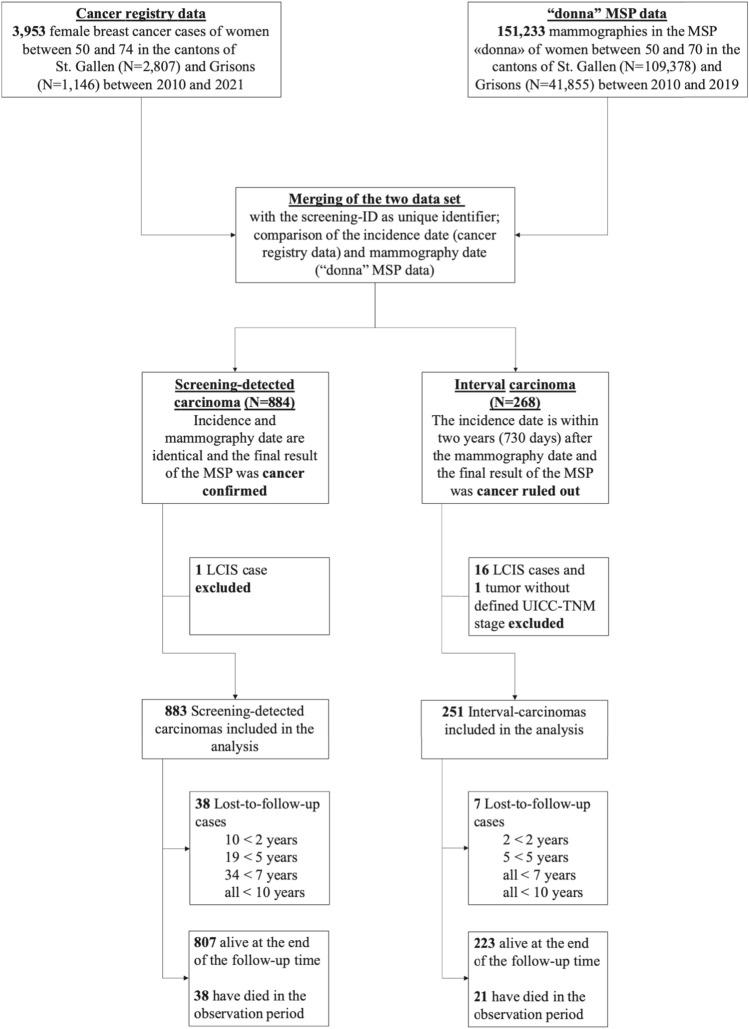
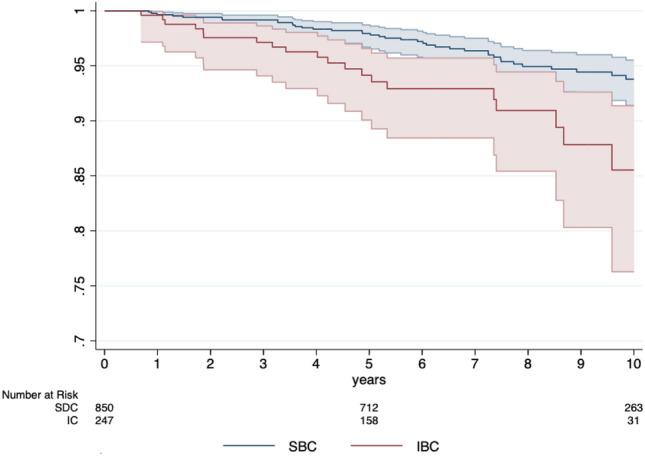
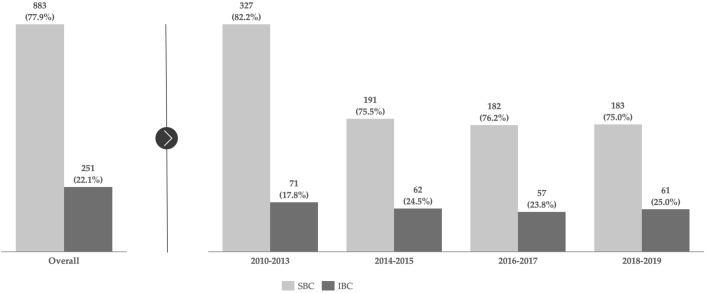
We identified 1134 breast cancer cases, specifically 251 IBC and 883 SBC. The 7-year survival proportions significantly deviated with 92.9% for women with IBC and 96.4% for women with SBC (p < 0.05). Women with IBC are diagnosed with significantly higher tumor stages (p < 0.05) and have a worse tumor biology in multiple dimensions e.g. larger tumor size or more often triple negative (p < 0.05). Higher breast density (BI-RADS d risk ratio (RR): 3.293), certain age groups (55-59 years RR: 1.345), and a family breast cancer history (RR: 1.299) were identified as significant (p < 0.05) risk factors for IBC diagnoses.
CONCLUSIONS
Women with IBC had lower overall survival proportions than women with SBC, possibly due to higher stages at diagnosis. Increased breast density and a positive family history of breast cancer could encourage MSPs to personalize their screening process (e.g. additional diagnostics).
目的
乳腺癌仍然是一个重大的全球健康问题,乳腺钼靶筛查项目(MSPs)对于早期发现以提高生存率至关重要。间期乳腺癌(IBC)是一项重要的质量标准,并且与死亡率增加有关。我们旨在基于MSP数据确定IBC诊断的风险因素。
方法
在这项回顾性队列研究中,我们将瑞士MSP“donna”的数据与2010年至2019年癌症登记处的数据合并,以将病例分类为IBC或筛查发现的乳腺癌(SBC)。我们比较了IBC与SBC女性的发病率、肿瘤特征和生存率。我们使用具有稳健误差的多变量泊松回归来确定IBC诊断的风险因素。
结果
我们确定了1134例乳腺癌病例,具体为251例IBC和883例SBC。7年生存率有显著差异,IBC女性为92.9%,SBC女性为96.4%(p < 0.05)。IBC女性被诊断出的肿瘤分期显著更高(p < 0.05),并且在多个维度上肿瘤生物学特性更差,例如肿瘤尺寸更大或更常为三阴性(p < 0.05)。更高的乳腺密度(BI-RADS d风险比(RR):3.293)、特定年龄组(55 - 59岁RR:1.345)以及家族乳腺癌病史(RR:1.299)被确定为IBC诊断的显著(p < 0.05)风险因素。
结论
IBC女性的总体生存率低于SBC女性,可能是由于诊断时分期较高。乳腺密度增加和乳腺癌家族史阳性可能促使MSPs个性化其筛查过程(例如进行额外诊断)。
 Zotero 插件