
基于感知与反应的细菌疗法的最新进展。
Recent advances in bacterial therapeutics based on sense and response.
作者信息
Feng Zhuo, Wang Yuchen, Xu Haiheng, Guo Yunfei, Xia Wen, Zhao Chenxuan, Zhao Xiaozhi, Wu Jinhui
机构信息
State Key Laboratory of Pharmaceutical Biotechnology, Chemistry and Biomedicine Innovation Center, Medical School of Nanjing University, Nanjing 210093, China.
Department of Andrology, Drum Tower Hospital, Medical School of Nanjing University, Nanjing 210093, China.
出版信息
Acta Pharm Sin B. 2023 Mar;13(3):1014-1027. doi: 10.1016/j.apsb.2022.09.015. Epub 2022 Sep 25.
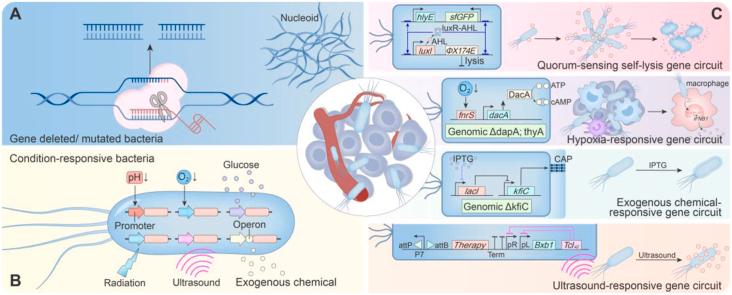
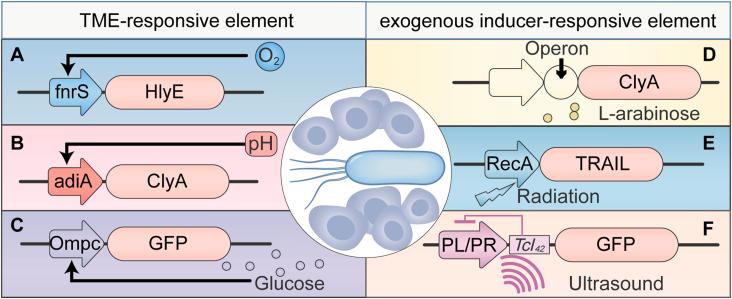
Intelligent drug delivery is a promising strategy for cancer therapies. In recent years, with the rapid development of synthetic biology, some properties of bacteria, such as gene operability, excellent tumor colonization ability, and host-independent structure, make them ideal intelligent drug carriers and have attracted extensive attention. By implanting condition-responsive elements or gene circuits into bacteria, they can synthesize or release drugs by sensing stimuli. Therefore, compared with traditional drug delivery, the usage of bacteria for drug loading has better targeting ability and controllability, and can cope with the complex delivery environment of the body to achieve the intelligent delivery of drugs. This review mainly introduces the development of bacterial-based drug delivery carriers, including mechanisms of bacterial targeting to tumor colonization, gene deletions or mutations, environment-responsive elements, and gene circuits. Meanwhile, we summarize the challenges and prospects faced by bacteria in clinical research, and hope to provide ideas for clinical translation.
智能药物递送是一种很有前景的癌症治疗策略。近年来,随着合成生物学的快速发展,细菌的一些特性,如基因可操作性、出色的肿瘤定植能力和不依赖宿主的结构,使其成为理想的智能药物载体,并引起了广泛关注。通过将条件响应元件或基因回路植入细菌中,它们可以通过感知刺激来合成或释放药物。因此,与传统药物递送相比,利用细菌进行药物装载具有更好的靶向能力和可控性,并且能够应对体内复杂的递送环境以实现药物的智能递送。本综述主要介绍了基于细菌的药物递送载体的发展,包括细菌靶向肿瘤定植的机制、基因缺失或突变、环境响应元件和基因回路。同时,我们总结了细菌在临床研究中面临的挑战和前景,希望能为临床转化提供思路。



 Zotero 插件