
基于抗原的快速检测和快速分子检测用于 SARS-CoV-2 的检测:一项针对诊断检测准确性研究的快速综述与网络荟萃分析。
Rapid antigen-based and rapid molecular tests for the detection of SARS-CoV-2: a rapid review with network meta-analysis of diagnostic test accuracy studies.
机构信息
Knowledge Translation Program, Li Ka Shing Knowledge Institute, St. Michael's Hospital, Unity Health Toronto, 209 Victoria Street, East Building, Toronto, ON, M5B 1T8, Canada.
Institute for Health Policy, Management, and Evaluation, University of Toronto, Toronto, ON, Canada.
出版信息
BMC Med. 2023 Mar 29;21(1):110. doi: 10.1186/s12916-023-02810-0.
BACKGROUND
The global spread of COVID-19 created an explosion in rapid tests with results in < 1 hour, but their relative performance characteristics are not fully understood yet. Our aim was to determine the most sensitive and specific rapid test for the diagnosis of SARS-CoV-2.
METHODS
Design: Rapid review and diagnostic test accuracy network meta-analysis (DTA-NMA).
ELIGIBILITY CRITERIA
Randomized controlled trials (RCTs) and observational studies assessing rapid antigen and/or rapid molecular test(s) to detect SARS-CoV-2 in participants of any age, suspected or not with SARS-CoV-2 infection.
INFORMATION SOURCES
Embase, MEDLINE, and Cochrane Central Register of Controlled Trials, up to September 12, 2021.
OUTCOME MEASURES
Sensitivity and specificity of rapid antigen and molecular tests suitable for detecting SARS-CoV-2. Data extraction and risk of bias assessment: Screening of literature search results was conducted by one reviewer; data abstraction was completed by one reviewer and independently verified by a second reviewer. Risk of bias was not assessed in the included studies.
DATA SYNTHESIS
Random-effects meta-analysis and DTA-NMA.
RESULTS
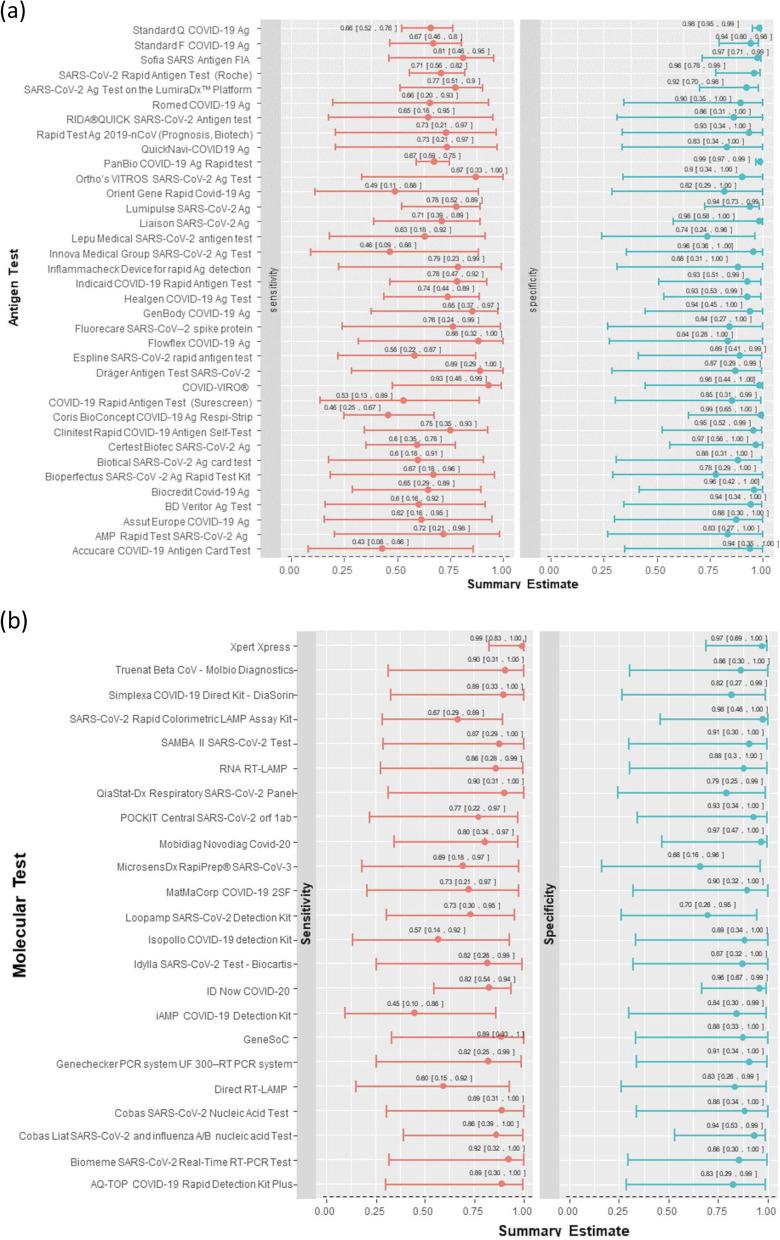
We included 93 studies (reported in 88 articles) relating to 36 rapid antigen tests in 104,961 participants and 23 rapid molecular tests in 10,449 participants. Overall, rapid antigen tests had a sensitivity of 0.75 (95% confidence interval 0.70-0.79) and specificity of 0.99 (0.98-0.99). Rapid antigen test sensitivity was higher when nasal or combined samples (e.g., combinations of nose, throat, mouth, or saliva samples) were used, but lower when nasopharyngeal samples were used, and in those classified as asymptomatic at the time of testing. Rapid molecular tests may result in fewer false negatives than rapid antigen tests (sensitivity: 0.93, 0.88-0.96; specificity: 0.98, 0.97-0.99). The tests with the highest sensitivity and specificity estimates were the Xpert Xpress rapid molecular test by Cepheid (sensitivity: 0.99, 0.83-1.00; specificity: 0.97, 0.69-1.00) among the 23 commercial rapid molecular tests and the COVID-VIRO test by AAZ-LMB (sensitivity: 0.93, 0.48-0.99; specificity: 0.98, 0.44-1.00) among the 36 rapid antigen tests we examined.
CONCLUSIONS
Rapid molecular tests were associated with both high sensitivity and specificity, while rapid antigen tests were mainly associated with high specificity, according to the minimum performance requirements by WHO and Health Canada. Our rapid review was limited to English, peer-reviewed published results of commercial tests, and study risk of bias was not assessed. A full systematic review is required.
REVIEW REGISTRATION
PROSPERO CRD42021289712.
背景
COVID-19 在全球范围内的传播导致了快速检测的爆发,其结果在 1 小时内得出,但这些检测的相对性能特征尚未完全了解。我们的目的是确定用于诊断 SARS-CoV-2 的最敏感和最特异的快速检测方法。
方法
设计:快速综述和诊断测试准确性网络荟萃分析(DTA-NMA)。
纳入标准
评估适用于任何年龄、疑似 SARS-CoV-2 感染或未感染 SARS-CoV-2 感染的参与者的快速抗原和/或快速分子检测的随机对照试验(RCT)和观察性研究。
信息来源
Embase、MEDLINE 和 Cochrane 对照试验中心注册库,截至 2021 年 9 月 12 日。
结局指标
快速抗原和分子检测检测 SARS-CoV-2 的敏感性和特异性。数据提取和偏倚风险评估:由一名评审员进行文献检索结果的筛选;数据提取由一名评审员完成,并由第二名评审员独立验证。纳入研究未评估偏倚风险。
数据综合
随机效应荟萃分析和 DTA-NMA。
结果
我们纳入了 93 项研究(在 88 篇文章中报告),涉及 104961 名参与者的 36 种快速抗原检测和 10449 名参与者的 23 种快速分子检测。总体而言,快速抗原检测的敏感性为 0.75(95%置信区间 0.70-0.79),特异性为 0.99(0.98-0.99)。当使用鼻或组合样本(例如,鼻、喉、口或唾液样本的组合)时,快速抗原检测的敏感性更高,但当使用鼻咽样本时,以及在测试时被归类为无症状的情况下,敏感性较低。快速分子检测可能比快速抗原检测产生更少的假阴性(敏感性:0.93,0.88-0.96;特异性:0.98,0.97-0.99)。在我们检查的 23 种商业快速分子检测中,灵敏度和特异性最高的检测是 Cepheid 的 Xpert Xpress 快速分子检测(灵敏度:0.99,0.83-1.00;特异性:0.97,0.69-1.00),而在 36 种快速抗原检测中,AAZ-LMB 的 COVID-VIRO 检测(灵敏度:0.93,0.48-0.99;特异性:0.98,0.44-1.00)的灵敏度和特异性最高。
结论
根据世界卫生组织和加拿大卫生部的最低性能要求,快速分子检测与高敏感性和特异性相关,而快速抗原检测主要与高特异性相关。我们的快速综述仅限于英语、同行评审的商业检测的已发表结果,并且未评估研究的偏倚风险。需要进行全面的系统综述。
审查注册
PROSPERO CRD42021289712。


 Zotero 插件