
时光倒流:一项关于补充营养保健品与改变生活方式对大脑年龄变化影响的回顾性单盲研究。
Turning Back the Clock: A Retrospective Single-Blind Study on Brain Age Change in Response to Nutraceuticals Supplementation vs. Lifestyle Modifications.
作者信息
Fingelkurts Andrew A, Fingelkurts Alexander A
机构信息
BM-Science-Brain and Mind Technologies Research Centre, 02601 Espoo, Finland.
出版信息
Brain Sci. 2023 Mar 21;13(3):520. doi: 10.3390/brainsci13030520.
BACKGROUND
There is a growing consensus that chronological age (CA) is not an accurate indicator of the aging process and that biological age (BA) instead is a better measure of an individual's risk of age-related outcomes and a more accurate predictor of mortality than actual CA. In this context, BA measures the "true" age, which is an integrated result of an individual's level of damage accumulation across all levels of biological organization, along with preserved resources. The BA is plastic and depends upon epigenetics. Brain state is an important factor contributing to health- and lifespan.
METHODS AND OBJECTIVE
Quantitative electroencephalography (qEEG)-derived brain BA (BBA) is a suitable and promising measure of brain aging. In the present study, we aimed to show that BBA can be decelerated or even reversed in humans (N = 89) by using customized programs of nutraceutical compounds or lifestyle changes (mean duration = 13 months).
RESULTS
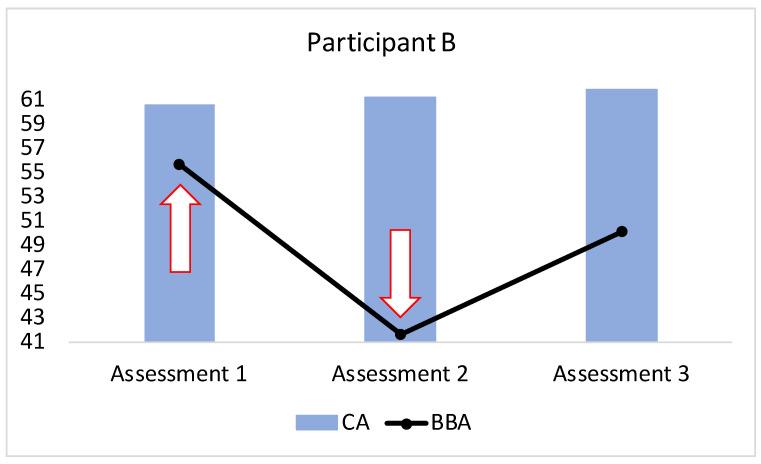
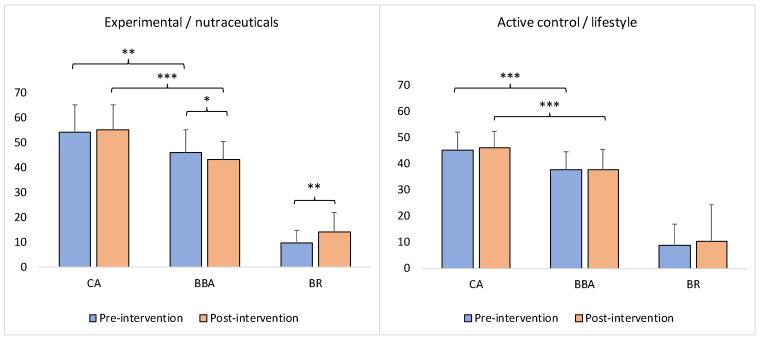
We observed that BBA was younger than CA in both groups at the end of the intervention. Furthermore, the BBA of the participants in the nutraceuticals group was 2.83 years younger at the endpoint of the intervention compared with their BBA score at the beginning of the intervention, while the BBA of the participants in the lifestyle group was only 0.02 years younger at the end of the intervention. These results were accompanied by improvements in mental-physical health comorbidities in both groups. The pre-intervention BBA score and the sex of the participants were considered confounding factors and analyzed separately.
CONCLUSIONS
Overall, the obtained results support the feasibility of the goal of this study and also provide the first robust evidence that halting and reversal of brain aging are possible in humans within a reasonable (practical) timeframe of approximately one year.
背景
越来越多的人达成共识,即实足年龄(CA)并非衰老过程的准确指标,而生物年龄(BA)才是衡量个体与年龄相关结局风险的更好指标,并且比实际的实足年龄更能准确预测死亡率。在这种情况下,生物年龄衡量的是“真实”年龄,它是个体在生物组织各个层面的损伤积累水平以及所保留资源的综合结果。生物年龄具有可塑性,且取决于表观遗传学。脑状态是影响健康和寿命的一个重要因素。
方法与目的
基于定量脑电图(qEEG)得出的脑生物年龄(BBA)是一种合适且有前景的脑衰老测量方法。在本研究中,我们旨在表明,通过使用定制的营养化合物方案或生活方式改变(平均持续时间 = 13个月),人类(N = 89)的脑生物年龄可以减缓甚至逆转。
结果
我们观察到,干预结束时两组的脑生物年龄均比实足年龄小。此外,营养补充剂组参与者在干预终点时的脑生物年龄相较于干预开始时的脑生物年龄得分年轻2.83岁,而生活方式组参与者在干预结束时的脑生物年龄仅年轻0.02岁。两组的身心健康合并症均有改善。干预前的脑生物年龄得分和参与者的性别被视为混杂因素并分别进行了分析。
结论
总体而言,所获结果支持了本研究目标的可行性,同时也首次提供了有力证据,表明在大约一年的合理(实际)时间范围内,人类有可能停止并逆转脑衰老。



 Zotero 插件