
推进基于荧光素酶的抗体免疫分析进入下一代混合和读取检测。
Advancing Luciferase-Based Antibody Immunoassays to Next-Generation Mix and Read Testing.
机构信息
Adeno-Associated Virus Biology Section, National Institute of Dental and Craniofacial Research, National Institutes of Health, Bethesda, MD 202892, USA.
Department of Perioperative Medicine, Clinical Center, National Institutes of Health, Bethesda, MD 202892, USA.
出版信息
Biosensors (Basel). 2023 Feb 21;13(3):303. doi: 10.3390/bios13030303.
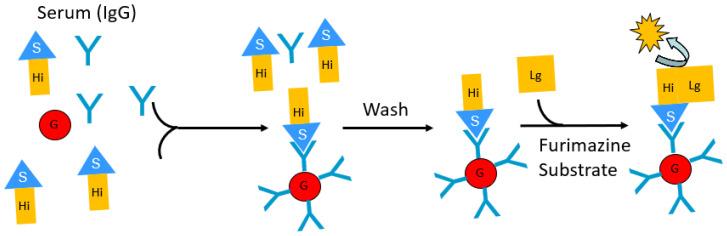
Antibody measurements play a central role in the diagnosis of many autoimmune and infectious diseases. One antibody detection technology, Luciferase Immunoprecipitation Systems (LIPS), utilizes genetically encoded recombinant luciferase antigen fusion proteins in an immunoglobulin capture format to generate robust antibody measurement with high diagnostic sensitivity and specificity. The LIPS technology has been highly useful in detecting antibodies for research diagnostics and the discovery of new autoantigens. The methodology of the assay requires immunoglobulin binding reagents such as protein A/G beads and washing steps to process the immune complex before antibody levels are measured by light production with a luminometer. Recently, simplified mix and read immunoassays based on split components of the nanoluciferase enzyme in a complementation format have been developed for antibody measurements without requiring immunoglobulin-capturing beads or washing steps. The mix and read immunoassays utilize two or three nanoluciferase fragments which when reconstituted via antigen-specific antibody binding generate a functional enzyme. At present, these split luciferase tests have been developed mainly for detecting SARS-CoV-2 antibodies. Here, we describe the traditional LIPS technology and compare it to the new split luciferase methodologies focusing on their technical features, strengths, limitations, and future opportunities for diagnostic research, and clinical applications.
抗体检测在许多自身免疫性和感染性疾病的诊断中起着核心作用。一种抗体检测技术,即荧光素酶免疫沉淀系统(LIPS),利用基因编码的重组荧光素酶抗原融合蛋白进行免疫球蛋白捕获,以产生具有高诊断灵敏度和特异性的强大抗体测量。LIPS 技术在检测研究诊断和新自身抗原的抗体方面非常有用。该测定方法需要免疫球蛋白结合试剂,如蛋白 A/G 珠,以及在使用发光计测量抗体水平之前进行免疫复合物的洗涤步骤。最近,基于互补形式的纳米荧光素酶酶的分裂成分的简化混合和读取免疫测定已被开发用于抗体测量,而不需要免疫球蛋白捕获珠或洗涤步骤。混合和读取免疫测定使用两个或三个纳米荧光素酶片段,当通过抗原特异性抗体结合重新构成时,会产生功能性酶。目前,这些分裂荧光素酶测试主要用于检测 SARS-CoV-2 抗体。在这里,我们描述了传统的 LIPS 技术,并将其与新的分裂荧光素酶方法进行了比较,重点介绍了它们的技术特点、优势、局限性以及在诊断研究和临床应用方面的未来机遇。



 Zotero 插件