
基于核壳 FeO@SiO@Au 纳米粒子放大效应的表面等离子体共振传感器用于检测 T-2 毒素。
Surface Plasmon Resonance Sensor Based on Core-Shell FeO@SiO@Au Nanoparticles Amplification Effect for Detection of T-2 Toxin.
机构信息
School of Chemical Engineering, Sichuan University of Science and Engineering, Zigong 643000, China.
State Key Laboratory of NBC Protection for Civilian, Beijing 102205, China.
出版信息
Sensors (Basel). 2023 Mar 13;23(6):3078. doi: 10.3390/s23063078.
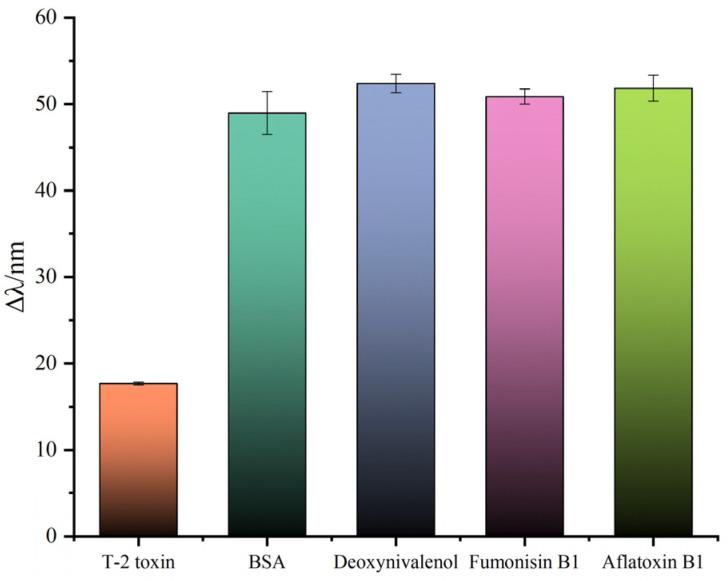
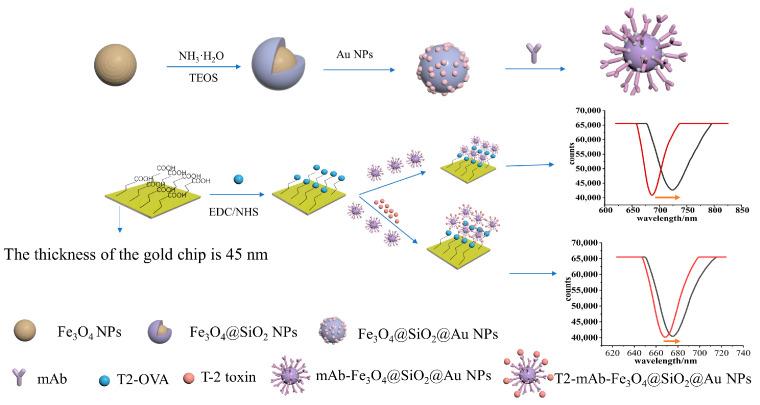
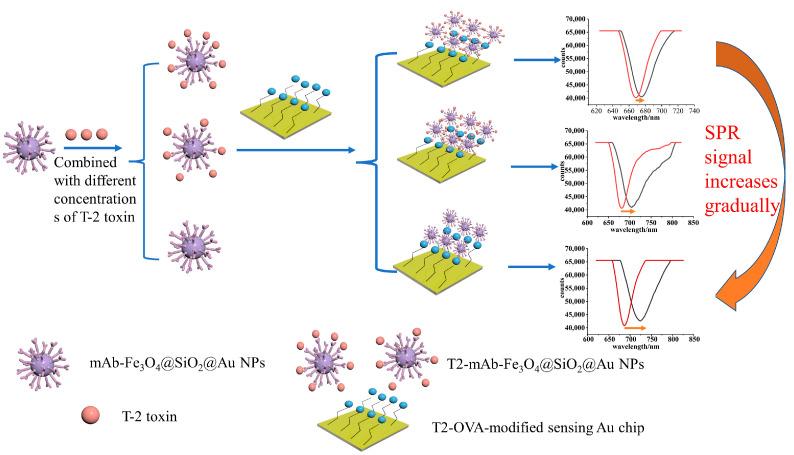
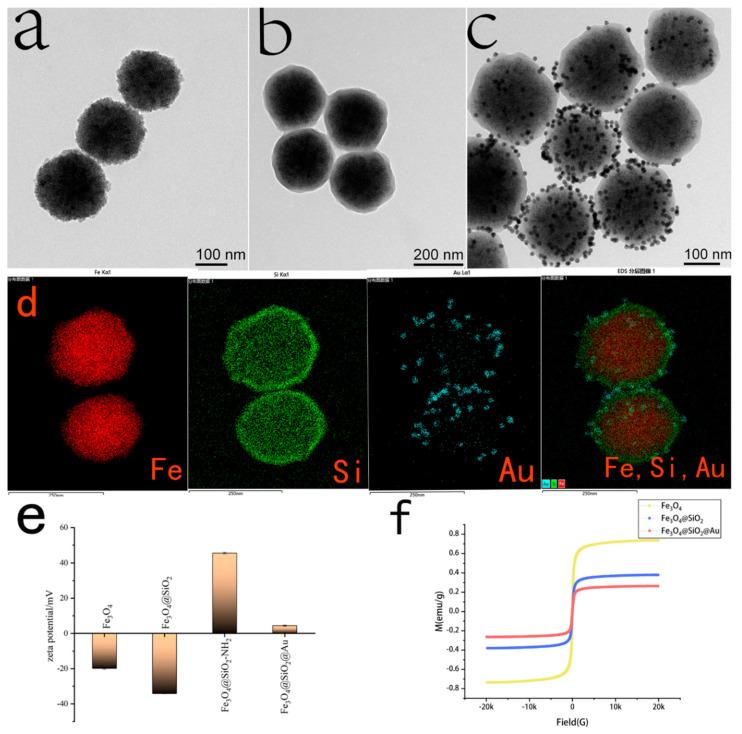
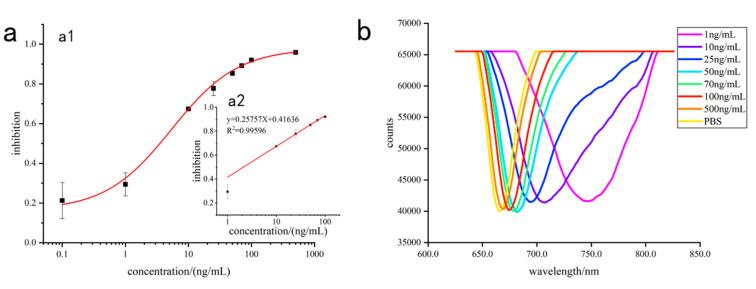
In this paper, a core-shell based on the FeO@SiO@Au nanoparticle amplification technique for a surface plasmon resonance (SPR) sensor is proposed. FeO@SiO@AuNPs were used not only to amplify SPR signals, but also to rapidly separate and enrich T-2 toxin via an external magnetic field. We detected T-2 toxin using the direct competition method in order to evaluate the amplification effect of FeO@SiO@AuNPs. A T-2 toxin-protein conjugate (T2-OVA) immobilized on the surface of 3-mercaptopropionic acid-modified sensing film competed with T-2 toxin to combine with the T-2 toxin antibody-FeO@SiO@AuNPs conjugates (mAb-FeO@SiO@AuNPs) as signal amplification elements. With the decrease in T-2 toxin concentration, the SPR signal gradually increased. In other words, the SPR response was inversely proportional to T-2 toxin. The results showed that there was a good linear relationship in the range of 1 ng/mL~100 ng/mL, and the limit of detection was 0.57 ng/mL. This work also provides a new possibility to improve the sensitivity of SPR biosensors in the detection of small molecules and in disease diagnosis.
本文提出了一种基于 FeO@SiO@Au 纳米粒子的核壳放大技术的表面等离子体共振(SPR)传感器。FeO@SiO@AuNPs 不仅用于放大 SPR 信号,还用于通过外加磁场快速分离和富集 T-2 毒素。我们使用直接竞争法检测 T-2 毒素,以评估 FeO@SiO@AuNPs 的放大效果。固定在巯基丙酸修饰的传感膜表面的 T-2 毒素蛋白结合物(T2-OVA)与 T-2 毒素竞争与 T-2 毒素抗体-FeO@SiO@AuNPs 结合物(mAb-FeO@SiO@AuNPs)结合作为信号放大元件。随着 T-2 毒素浓度的降低,SPR 信号逐渐增加。换句话说,SPR 响应与 T-2 毒素呈反比。结果表明,在 1ng/mL~100ng/mL 范围内呈良好线性关系,检出限为 0.57ng/mL。这项工作还为提高 SPR 生物传感器在小分子检测和疾病诊断中的灵敏度提供了新的可能性。


 Zotero 插件