
尼日利亚伊巴丹地区 HIV 患儿粪便中的腹泻病原体。
Diarrhoeal pathogens in the stools of children living with HIV in Ibadan, Nigeria.
机构信息
Department of Microbiology, Chrisland University, Abeokuta, Ogun State, Nigeria.
Department of Pharmaceutical Microbiology, University of Ibadan, Ibadan, Oyo State, Nigeria.
出版信息
Front Cell Infect Microbiol. 2023 Mar 13;13:1108923. doi: 10.3389/fcimb.2023.1108923. eCollection 2023.
INTRODUCTION
Diarrhoea can be debilitating in young children. Few aetiological investigations in Africans living with human immunodeficiency virus (HIV) have been performed since antiretrovirals became widely available.
METHODS
Stool specimens from children with diarrhoea living with HIV, and HIV-uninfected controls, recruited at two hospitals in Ibadan, Nigeria, were screened for parasites and occult blood, and cultured for bacteria. Following biochemical identification of at least five colonies per specimen, diarrhoeagenic Escherichia coli and Salmonella were confirmed by PCR. Data were line-listed and comparisons were made using Fisher's Exact test.
RESULTS
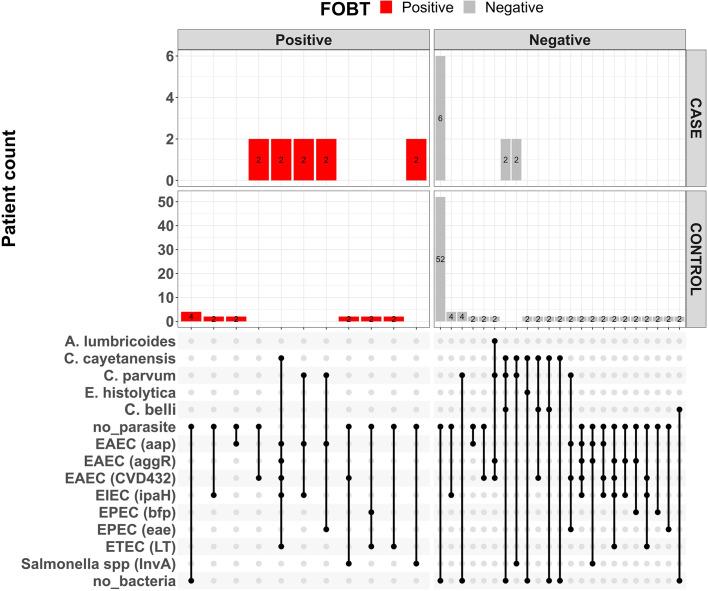
Only 10 children living with HIV could be enrolled during the 25-month study period and 55 HIV-uninfected children with diarrhoea were included for comparison. The most common pathogens overall were enteroaggregative E. coli (18/65, 27.7%), enteroinvasive E. coli (10/65, 15.4%), Cryptosporidium parvum (8/65, 12.3%) and Cyclospora cayetanensis (7/65, 10.8%). At least one pathogen was detected from seven of ten children living with HIV and 27 (49.1%) HIV-uninfected children. Parasite detection was associated with HIV positive status (p=0.03) with C. parvum specifically recovered more commonly from children living with HIV (p=0.01). Bacterial-parasite pathogen combinations were detected in specimens from four of ten children living with HIV but only 3(5.5%) HIV-uninfected children (p=0.009). Stools from five of ten children living with HIV and 7(12.7%) HIV-negative children (p = 0.014) contained occult blood.
DISCUSSION
Even though children living with HIV present infrequently to Ibadan health facilities with diarrhoea, their greater propensity for mixed and potentially invasive infections justifies prioritizing laboratory diagnosis of their stools.
简介
腹泻可能会使幼儿身体虚弱。自从抗逆转录病毒药物广泛应用以来,在感染人类免疫缺陷病毒 (HIV) 的非洲人群中进行的病因学研究很少。
方法
在尼日利亚伊巴丹的两家医院,招募了患有腹泻的 HIV 感染儿童和未感染 HIV 的对照组儿童的粪便标本,对其进行寄生虫和隐血筛查,并进行细菌培养。对每个标本至少鉴定出 5 个菌落,然后通过 PCR 确认致腹泻性大肠杆菌和沙门氏菌。对数据进行列表并使用 Fisher 精确检验进行比较。
结果
在 25 个月的研究期间,仅招募了 10 名 HIV 感染儿童,而纳入了 55 名患有腹泻的未感染 HIV 的对照组儿童进行比较。总体而言,最常见的病原体是聚集性大肠杆菌(18/65,27.7%)、侵袭性大肠杆菌(10/65,15.4%)、微小隐孢子虫(8/65,12.3%)和环孢子虫(7/65,10.8%)。在 10 名 HIV 感染儿童中,有 7 名至少有一种病原体,而在 27 名(49.1%)未感染 HIV 的儿童中,有 27 名(49.1%)至少有一种病原体。寄生虫检测与 HIV 阳性状态相关(p=0.03),特别是微小隐孢子虫更常见于 HIV 感染儿童(p=0.01)。在 10 名 HIV 感染儿童的标本中检测到细菌-寄生虫病原体组合,但仅在 3 名(5.5%)未感染 HIV 的儿童中检测到(p=0.009)。在 10 名 HIV 感染儿童中的 5 名和 7 名(12.7%)未感染 HIV 的儿童的粪便中检测到隐血(p=0.014)。
讨论
尽管感染 HIV 的儿童很少因腹泻到伊巴丹卫生机构就诊,但他们更容易发生混合性和潜在侵袭性感染,因此有理由优先对他们的粪便进行实验室诊断。
 Zotero 插件