
尼日利亚西南部肠致病性大肠杆菌的基因组流行病学
Genomic epidemiology of enteropathogenic Escherichia coli in southwestern Nigeria.
作者信息
Akinlabi Olabisi C, Dada Rotimi A, Olayinka Ademola A, Oginni-Falajiki Ibukunoluwa O, Bejide Oyeniyi S, Adewole Pelumi D, Thomson Nicholas R, Aboderin Aaron O, Okeke Iruka N
机构信息
Department of Pharmaceutical Microbiology, Faculty of Pharmacy, University of Ibadan, Ibadan, Nigeria.
Department of Pharmaceutical Microbiology and Biotechnology, Ahmadu Bello University, Zaria, Nigeria.
出版信息
PLoS Negl Trop Dis. 2025 Aug 22;19(8):e0013442. doi: 10.1371/journal.pntd.0013442. eCollection 2025 Aug.
BACKGROUND
Enteropathogenic Escherichia coli (EPEC) are etiological agents of diarrhea. We studied the genetic diversity and virulence factors of EPEC in southwestern Nigeria, where this pathotype is rarely characterized.
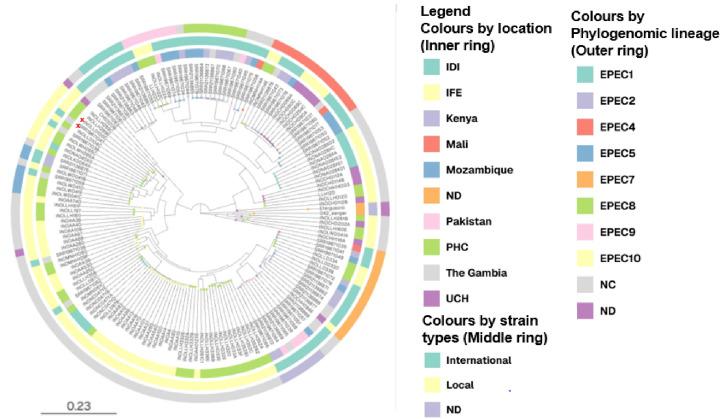
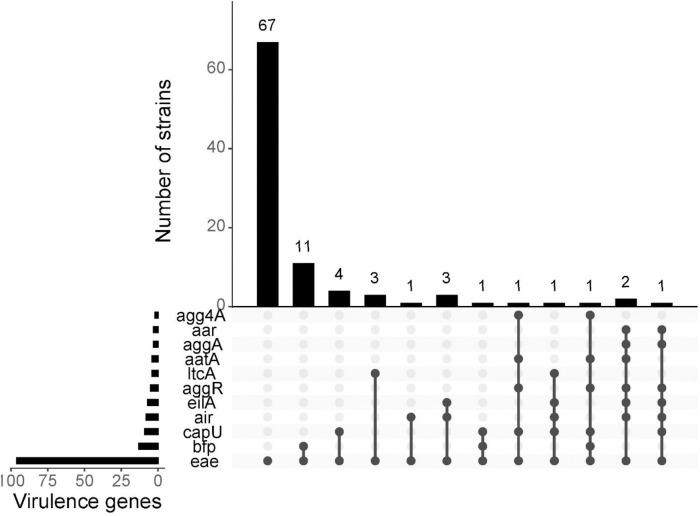
METHODOLOGY/PRINCIPAL FINDINGS: EPEC isolates (n = 96) recovered from recent southwestern Nigeria diarrhea case-control studies were whole genome-sequenced using Illumina technology. Genomes were assembled using SPAdes and quality was evaluated using QUAST. Virulencefinder, Ectyper, and ResFinder were used to identify virulence genes, serotypes, and resistance genes. Multilocus sequence typing was done by STtyping. Single nucleotide polymorphisms (SNPs) were called out of whole genome alignment using SNP-sites and a phylogenetic tree was constructed using IQtree. Thirty-nine of the 96(40.6%) EPEC isolates were from diarrhea cases diarrhea. Nine isolates from diarrhea patients and four from healthy controls were typical EPEC, harboring bundle-forming pilus (bfp) genes whilst the rest were atypical EPEC. There were 15 EPEC-EAEC hybrids. Atypical serotypes O71:H19 (16, 16.6%), O108:H21 (6, 6.3%), O157:H39 (5, 5.2%), and O165:H9 (4, 4.2%) were the most prevalent; only 8 (8.3%) isolates belonged to classical EPEC serovars. The largest, ST517 clade harbored multiple siderophore and serine protease autotransporter genes and included an O71:H19 subclade <10 SNPs apart, representing a likely outbreak involving 15 children, four with diarrhea. Likely outbreaks, of typical O119:H6(ST28) and atypical O127:H29(ST7798) were additionally identified.
CONCLUSION/SIGNIFICANCE: EPEC circulating in southwestern Nigeria are diverse and differ substantially from well-characterized lineages seen previously elsewhere. EPEC carriage and outbreaks could be commonplace but are largely undetected, hence, unreported, and require genomic surveillance for identification.
背景
肠致病性大肠杆菌(EPEC)是腹泻的病原体。我们研究了尼日利亚西南部EPEC的遗传多样性和毒力因子,该致病型在当地鲜有特征描述。
方法/主要发现:从尼日利亚西南部近期腹泻病例对照研究中分离出96株EPEC,使用Illumina技术对其进行全基因组测序。使用SPAdes组装基因组,并使用QUAST评估质量。使用Virulencefinder、Ectyper和ResFinder鉴定毒力基因、血清型和耐药基因。通过STtyping进行多位点序列分型。使用SNP-sites从全基因组比对中找出单核苷酸多态性(SNP),并使用IQtree构建系统发育树。96株EPEC分离株中有39株(40.6%)来自腹泻病例。9株腹泻患者分离株和4株健康对照分离株为典型EPEC,携带束状菌毛(bfp)基因,其余为非典型EPEC。有15株EPEC-EAEC杂交株。非典型血清型O71:H19(16株,16.6%)、O108:H21(6株,6.3%)、O157:H39(5株,5.2%)和O165:H9(4株,4.2%)最为常见;只有8株(8.3%)分离株属于经典EPEC血清型。最大的ST517分支包含多个铁载体和丝氨酸蛋白酶自转运蛋白基因,包括一个相距不到10个SNP的O71:H19亚分支,代表可能涉及15名儿童的一次暴发,其中4名儿童患有腹泻。另外还确定了可能的典型O119:H6(ST28)和非典型O127:H29(ST7798)暴发。
结论/意义:在尼日利亚西南部传播的EPEC具有多样性,与之前在其他地方发现的特征明确的谱系有很大不同。EPEC的携带和暴发可能很常见,但大多未被发现,因此未报告,需要进行基因组监测以进行识别。


 Zotero 插件