
癌症相关成纤维细胞调控肿瘤免疫微环境——癌症治疗的新靶点?
CAFs orchestrates tumor immune microenvironment-A new target in cancer therapy?
作者信息
Zhang Chunxue, Fei Yuxiang, Wang Hui, Hu Sheng, Liu Chao, Hu Rong, Du Qianming
机构信息
School of Basic Medicine and Clinical Pharmacy, China Pharmaceutical University, Nanjing, China.
Department of Pharmacy, Nanjing First Hospital, Nanjing Medical University, Nanjing, China.
出版信息
Front Pharmacol. 2023 Mar 14;14:1113378. doi: 10.3389/fphar.2023.1113378. eCollection 2023.
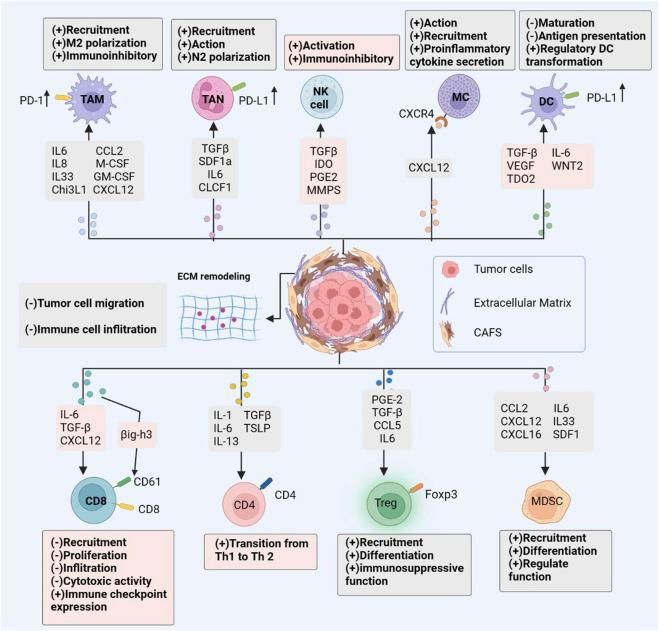
Cancer immunotherapy has opened a new landscape in cancer treatment, however, the poor specificity and resistance of most targeted therapeutics have limited their therapeutic efficacy. In recent years, the role of CAFs in immune regulation has been increasingly noted as more evidence has been uncovered regarding the link between cancer-associated fibroblasts (CAFs) and the evolutionary process of tumor progression. CAFs interact with immune cells to shape the tumor immune microenvironment (TIME) that favors malignant tumor progression, a crosstalk process that leads to the failure of cancer immunotherapies. In this review, we outline recent advances in the immunosuppressive function of CAFs, highlight the mechanisms of CAFs-immune cell interactions, and discuss current CAF-targeted therapeutic strategies for future study.
癌症免疫疗法为癌症治疗开辟了新的局面,然而,大多数靶向治疗药物的特异性差和耐药性限制了它们的治疗效果。近年来,随着越来越多关于癌症相关成纤维细胞(CAFs)与肿瘤进展演变过程之间联系的证据被发现,CAFs在免疫调节中的作用日益受到关注。CAFs与免疫细胞相互作用,塑造有利于恶性肿瘤进展的肿瘤免疫微环境(TIME),这一相互作用过程导致癌症免疫疗法失败。在这篇综述中,我们概述了CAFs免疫抑制功能的最新进展,强调了CAFs与免疫细胞相互作用的机制,并讨论了当前针对CAF的治疗策略以供未来研究。

 Zotero 插件