
高血压中多巴胺受体 DR 和 DR 与 GRK4 的相互作用。
Dopamine Receptor DR and DR and GRK4 Interaction in Hypertension.
机构信息
Department of Cardiology, Daping Hospital, The Third Military Medical University (Army Medical University), Chongqing, P. R. China.
Division of Kidney Diseases and Hypertension, Department of Medicine, The George Washington School of Medicine and Health Sciences, Washington, DC, USA.
出版信息
Yale J Biol Med. 2023 Mar 31;96(1):95-105. doi: 10.59249/MKRR9549. eCollection 2023 Mar.
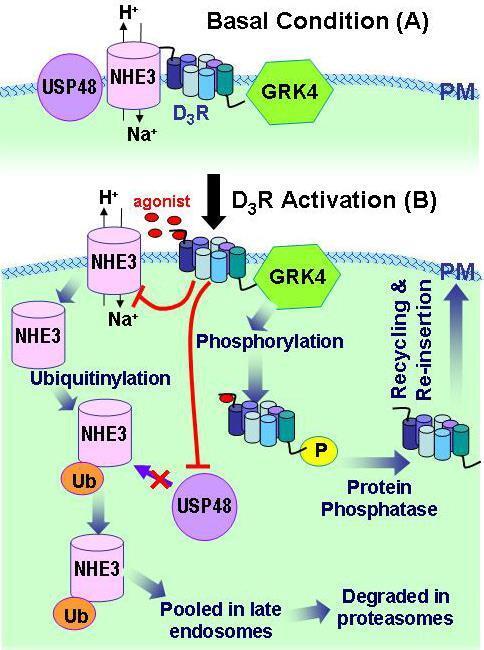
Essential hypertension is caused by the interaction of genetic, behavioral, and environmental factors. Abnormalities in the regulation of renal ion transport cause essential hypertension. The renal dopaminergic system, which inhibits sodium transport in all the nephron segments, is responsible for at least 50% of renal sodium excretion under conditions of moderate sodium excess. Dopaminergic signals are transduced by two families of receptors that belong to the G protein-coupled receptor (GPCR) superfamily. D-like receptors (DR and DR) stimulate, while D2-like receptors (DR, DR, and DR) inhibit adenylyl cyclases. The dopamine receptor subtypes, themselves, or by their interactions, regulate renal sodium transport and blood pressure. We review the role of the DR and DR and their interaction in the natriuresis associated with volume expansion. The DR- and DR-mediated inhibition of renal sodium transport involves PKA and PKC-dependent and -independent mechanisms. The DR also increases the degradation of NHE3 via USP-mediated ubiquitinylation. Although deletion of and in mice causes hypertension, polymorphisms are not always associated with human essential hypertension and polymorphisms in are not associated with human essential hypertension. The impaired DR and DR function in hypertension is related to their hyper-phosphorylation; GRK4γ isoforms, R65L, A142V, and A486V, hyper-phosphorylate and desensitize DR and DR. The locus is linked to and variants are associated with high blood pressure in humans. Thus, , by itself, and by regulating genes related to the control of blood pressure may explain the "apparent" polygenic nature of essential hypertension.
原发性高血压是由遗传、行为和环境因素相互作用引起的。肾脏离子转运调节异常导致原发性高血压。肾脏多巴胺能系统抑制所有肾单位段的钠转运,在中等钠过量的情况下,至少负责 50%的肾脏钠排泄。多巴胺能信号由属于 G 蛋白偶联受体 (GPCR) 超家族的两种受体家族转导。D 样受体 (DR 和 DR) 刺激,而 D2 样受体 (DR、DR 和 DR) 抑制腺苷酸环化酶。多巴胺受体亚型本身或通过其相互作用调节肾脏钠转运和血压。我们综述了 DR 和 DR 及其相互作用在与容量扩张相关的利钠作用中的作用。DR 和 DR 介导的肾脏钠转运抑制涉及 PKA 和 PKC 依赖性和非依赖性机制。DR 还通过 USP 介导的泛素化增加 NHE3 的降解。虽然 和 在小鼠中的缺失导致高血压,但 多态性并不总是与人类原发性高血压相关, 多态性也与人类原发性高血压无关。高血压中 DR 和 DR 功能受损与其过度磷酸化有关;GRK4γ 同工型 R65L、A142V 和 A486V 过度磷酸化并使 DR 和 DR 脱敏。 基因座与 和 变体与人类高血压相关。因此, 本身及其调节与血压控制相关的基因可能解释原发性高血压的“明显”多基因性质。
 Zotero 插件