
肠道和肾脏近端小管中的钠/氢交换体3:定位、生理功能及在血管紧张素II诱导的高血压中的关键作用
The Na/H Exchanger 3 in the Intestines and the Proximal Tubule of the Kidney: Localization, Physiological Function, and Key Roles in Angiotensin II-Induced Hypertension.
作者信息
Nwia Sarah M, Li Xiao Chun, Leite Ana Paula de Oliveira, Hassan Rumana, Zhuo Jia Long
机构信息
Tulane Hypertension and Renal Center of Excellence, Tulane University School of Medicine, New Orleans, LA, United States.
Department of Physiology, Tulane University School of Medicine, New Orleans, LA, United States.
出版信息
Front Physiol. 2022 Apr 19;13:861659. doi: 10.3389/fphys.2022.861659. eCollection 2022.
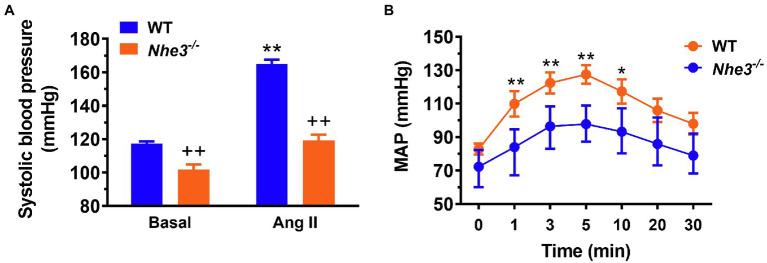
The sodium (Na)/hydrogen (H) exchanger 3 (NHE3) is one of the most important Na/H antiporters in the small intestines of the gastrointestinal tract and the proximal tubules of the kidney. The roles of NHE3 in the regulation of intracellular pH and acid-base balance have been well established in cellular physiology using techniques. Localized primarily on the apical membranes in small intestines and proximal tubules, the key action of NHE3 is to facilitate the entry of luminal Na and the extrusion of intracellular H from intestinal and proximal tubule tubular epithelial cells. NHE3 is, directly and indirectly, responsible for absorbing the majority of ingested Na from small and large intestines and reabsorbing >50% of filtered Na in the proximal tubules of the kidney. However, the roles of NHE3 in the regulation of proximal tubular Na transport in the integrative physiological settings and its contributions to the basal blood pressure regulation and angiotensin II (Ang II)-induced hypertension have not been well studied previously due to the lack of suitable animal models. Recently, novel genetically modified mouse models with whole-body, kidney-specific, or proximal tubule-specific deletion of NHE3 have been generated by us and others to determine the critical roles and underlying mechanisms of NHE3 in maintaining basal body salt and fluid balance, blood pressure homeostasis, and the development of Ang II-induced hypertension at the whole-body, kidney, or proximal tubule levels. The objective of this invited article is to review, update, and discuss recent findings on the critical roles of intestinal and proximal tubule NHE3 in maintaining basal blood pressure homeostasis and their potential therapeutic implications in the development of angiotensin II (Ang II)-dependent hypertension.
钠/氢交换体3(NHE3)是胃肠道小肠和肾脏近端小管中最重要的钠/氢逆向转运体之一。利用相关技术,NHE3在调节细胞内pH值和酸碱平衡方面的作用在细胞生理学中已得到充分证实。NHE3主要定位于小肠和近端小管的顶端膜上,其关键作用是促进肠腔钠的进入以及将细胞内的氢从小肠和近端小管的管状上皮细胞中排出。NHE3直接或间接地负责从小肠和大肠吸收大部分摄入的钠,并在肾脏近端小管中重吸收超过50%的滤过钠。然而,由于缺乏合适的动物模型,NHE3在综合生理环境中对近端小管钠转运的调节作用及其对基础血压调节和血管紧张素II(Ang II)诱导的高血压的贡献此前尚未得到充分研究。最近,我们和其他人已经构建了全身、肾脏特异性或近端小管特异性缺失NHE3的新型转基因小鼠模型,以确定NHE3在全身、肾脏或近端小管水平上维持基础体盐和液体平衡、血压稳态以及Ang II诱导的高血压发展中的关键作用和潜在机制。这篇特邀文章的目的是回顾、更新并讨论关于肠道和近端小管NHE3在维持基础血压稳态中的关键作用及其在血管紧张素II(Ang II)依赖性高血压发展中的潜在治疗意义的最新研究结果。




 Zotero 插件