
长期缺钠可减少钠排泄,但会损害肾功能并增加高草酸钙尿症大鼠的结石形成。
Long-Term Sodium Deficiency Reduces Sodium Excretion but Impairs Renal Function and Increases Stone Formation in Hyperoxaluric Calcium Oxalate Rats.
机构信息
Department of Urology, National Cheng Kung University Hospital, College of Medicine, National Cheng Kung University, Tainan 704302, Taiwan.
出版信息
Int J Mol Sci. 2024 Apr 1;25(7):3942. doi: 10.3390/ijms25073942.
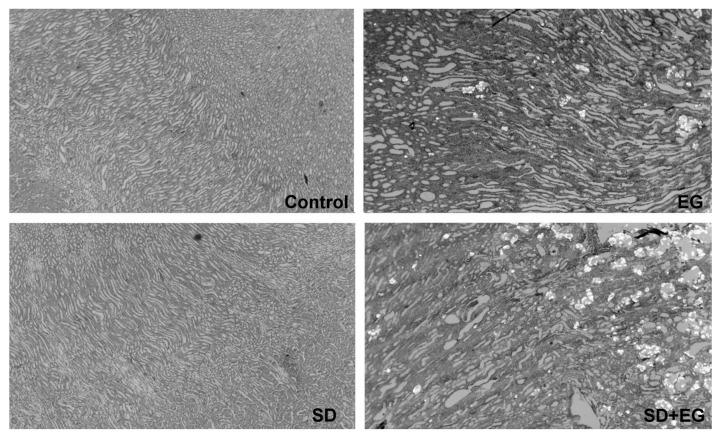
Excessive sodium intake is associated with nephrolithiasis, but the impact of sodium-deficient (SD) diets is unknown. Hence, we investigated the effects of short- and long-term SD diets on the expression of renal aquaporins and sodium transporters, and thus calcium oxalate (CaOx) crystal formation in hyperoxaluria rats. In a short-term sodium balance study, six male rats received drinking water and six received 0.75% ethylene glycol (EG) to induce hyperoxaluria. After a 30-day period of feeding on normal chow, both groups were treated with a normal-sodium diet for 5 days, followed by a sodium-free diet for the next 5 days. In a long-term SD study (42 days), four groups, induced with EG or not, were treated with normal-sodium water and sodium-free drinking water, alternately. Short-term sodium restriction in EG rats reversed the daily positive sodium balance, but progressively caused a negative cumulative water balance. In the long-term study, the abundant levels of of Na/H exchanger, thiazide-sensitive Na-Cl cotransporter, Na-K-ATPase, and aquaporins-1 from SD + EG rats were markedly reduced, corresponding to a decrease in Uosm, as compared to SD rats. Increased urine calcium, AP(CaOx)index, and renal CaOx deposition were also noted in SD + EG rats. Although the SD treatment reduced sodium excretion, it also increased urinary calcium and impaired renal function, ultimately causing the formation of more CaOx crystals.
钠摄入过多与肾结石有关,但目前尚不清楚缺钠(SD)饮食的影响。因此,我们研究了短期和长期 SD 饮食对高草酸尿症大鼠肾水通道蛋白和钠转运体表达的影响,以及由此导致的草酸钙(CaOx)晶体形成。在短期钠平衡研究中,6 只雄性大鼠给予饮用水,6 只给予 0.75%乙二醇(EG)以诱导高草酸尿症。在正常进食 30 天后,两组均给予正常钠饮食 5 天,然后给予无钠饮食 5 天。在长期 SD 研究(42 天)中,用 EG 诱导的 4 组大鼠交替给予正常钠水和无钠饮用水。EG 大鼠短期钠限制逆转了每日正钠平衡,但逐渐导致负的累积水平衡。在长期研究中,与 SD 大鼠相比,SD+EG 大鼠的 Na/H 交换器、噻嗪类敏感的 Na-Cl 共转运蛋白、Na-K-ATP 酶和水通道蛋白-1 的丰富水平明显降低,相应的尿渗透压也降低。SD+EG 大鼠的尿钙、AP(CaOx)指数和肾 CaOx 沉积也增加。虽然 SD 治疗减少了钠的排泄,但也增加了尿钙并损害了肾功能,最终导致更多 CaOx 晶体的形成。



 Zotero 插件