
基于递归神经网络的肽性质无服务器预测。
Serverless Prediction of Peptide Properties with Recurrent Neural Networks.
机构信息
Department of Chemical Engineering, University of Rochester, Rochester, New York 14627, United States.
出版信息
J Chem Inf Model. 2023 Apr 24;63(8):2546-2553. doi: 10.1021/acs.jcim.2c01317. Epub 2023 Apr 3.
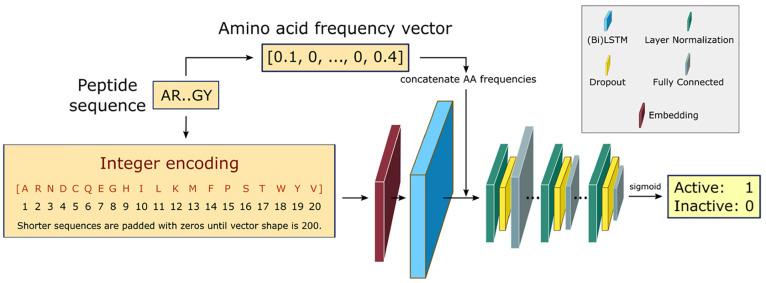
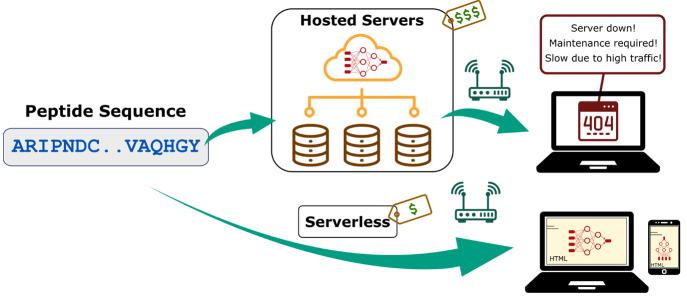
We present three deep learning sequence-based prediction models for peptide properties including hemolysis, solubility, and resistance to nonspecific interactions that achieve comparable results to the state-of-the-art models. Our sequence-based solubility predictor, MahLooL, outperforms the current state-of-the-art methods for short peptides. These models are implemented as a static website without the use of a dedicated server or cloud computing. Web-based models like this allow for accessible and effective reproducibility. Most existing approaches rely on third-party servers that typically require upkeep and maintenance. Our predictive models do not require servers, require no installation of dependencies, and work across a range of devices. The specific architecture is bidirectional recurrent neural networks. This approach is a demonstration of edge machine learning that removes the dependence on cloud providers. The code and models are accessible at https://github.com/ur-whitelab/peptide-dashboard.
我们提出了三个基于深度学习的序列预测模型,用于预测肽的性质,包括溶血、溶解度和抵抗非特异性相互作用,这些模型的结果可与最先进的模型相媲美。我们基于序列的溶解度预测器 MahLooL,在短肽方面优于当前最先进的方法。这些模型被实现为一个静态网站,不使用专用服务器或云计算。像这样的基于网络的模型允许可访问和有效的可重复性。大多数现有的方法依赖于第三方服务器,这些服务器通常需要维护和保养。我们的预测模型不需要服务器,不需要安装任何依赖项,并且可以在各种设备上运行。具体的架构是双向递归神经网络。这种方法展示了边缘机器学习,消除了对云提供商的依赖。代码和模型可在 https://github.com/ur-whitelab/peptide-dashboard 上访问。
 Zotero 插件