
恶性疟原虫配子体在有性分化过程中表现出全染色质重塑。
Plasmodium falciparum gametocytes display global chromatin remodelling during sexual differentiation.
机构信息
Mikrobiologisches Institut - Klinische Mikrobiologie, Immunologie und Hygiene, Universitätsklinikum Erlangen, Friedrich-Alexander-Universität (FAU) Erlangen-Nürnberg, Erlangen, Germany.
Department of Medicine, University of Melbourne, Bio21 Institute, 30 Flemington Road, Parkville, VIC, 3052, Australia.
出版信息
BMC Biol. 2023 Apr 3;21(1):65. doi: 10.1186/s12915-023-01568-4.
BACKGROUND
The protozoan malaria parasite Plasmodium falciparum has a complex life cycle during which it needs to differentiate into multiple morphologically distinct life forms. A key process for transmission of the disease is the development of male and female gametocytes in the human blood, yet the mechanisms determining sexual dimorphism in these haploid, genetically identical sexual precursor cells remain largely unknown. To understand the epigenetic program underlying the differentiation of male and female gametocytes, we separated the two sexual forms by flow cytometry and performed RNAseq as well as comprehensive ChIPseq profiling of several histone variants and modifications.
RESULTS
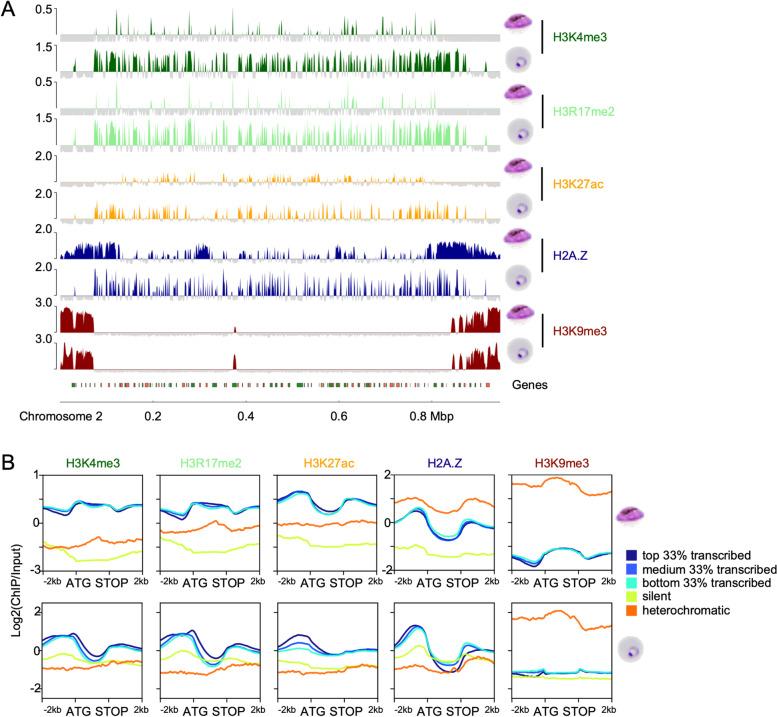
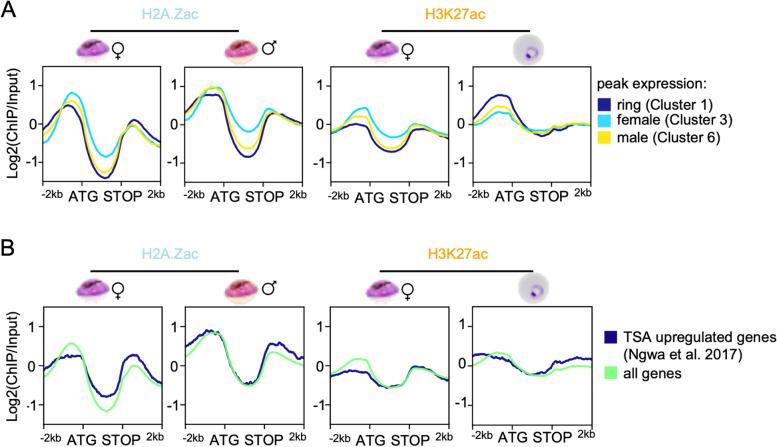
We show that in female gametocytes the chromatin landscape is globally remodelled with respect to genome-wide patterns and combinatorial usage of histone variants and histone modifications. We identified sex specific differences in heterochromatin distribution, implicating exported proteins and ncRNAs in sex determination. Specifically in female gametocytes, the histone variants H2A.Z/H2B.Z were highly enriched in H3K9me3-associated heterochromatin. H3K27ac occupancy correlated with stage-specific gene expression, but in contrast to asexual parasites this was unlinked to H3K4me3 co-occupancy at promoters in female gametocytes.
CONCLUSIONS
Collectively, we defined novel combinatorial chromatin states differentially organising the genome in gametocytes and asexual parasites and unravelled fundamental, sex-specific differences in the epigenetic code. Our chromatin maps represent an important resource for future understanding of the mechanisms driving sexual differentiation in P. falciparum.
背景
原生动物疟原虫恶性疟原虫在其生命周期中有一个复杂的过程,在此过程中需要分化为多种形态上明显不同的生命形式。疾病传播的一个关键过程是在人体血液中发育雄性和雌性配子体,但决定这些单倍体、遗传上相同的性前体细胞性二态性的机制在很大程度上仍然未知。为了了解雄性和雌性配子体分化的表观遗传程序,我们通过流式细胞术分离这两种性形式,并进行 RNAseq 以及几种组蛋白变体和修饰的综合 ChIPseq 分析。
结果
我们表明,在雌性配子体中,染色质景观相对于全基因组模式和组蛋白变体和组蛋白修饰的组合使用进行了全局重塑。我们发现异染色质分布存在性别特异性差异,这表明输出蛋白和 ncRNAs 参与性别决定。特别是在雌性配子体中,H2A.Z/H2B.Z 组蛋白变体高度富集在 H3K9me3 相关异染色质中。H3K27ac 占据与阶段特异性基因表达相关,但与无性寄生虫不同,在雌性配子体中,H3K4me3 共占据与启动子无关。
结论
总的来说,我们定义了新的组合染色质状态,这些状态在配子体和无性寄生虫中差异地组织基因组,并揭示了在表观遗传密码中基本的、性别特异性差异。我们的染色质图谱代表了未来理解恶性疟原虫性分化机制的重要资源。






 Zotero 插件