
亚裔美国人、夏威夷原住民和太平洋岛民的结直肠癌在就诊时的分期和手术时间的差异:一项对细分族裔群体的研究。
Colon Cancer Disparities in Stage at Presentation and Time to Surgery for Asian Americans, Native Hawaiians, and Pacific Islanders: A Study with Disaggregated Ethnic Groups.
机构信息
Massachusetts Institute of Technology, Cambridge, MA, USA.
Harvard University, Cambridge, MA, USA.
出版信息
Ann Surg Oncol. 2023 Sep;30(9):5495-5505. doi: 10.1245/s10434-023-13339-0. Epub 2023 Apr 5.
BACKGROUND
Vast differences in barriers to care exist among Asian American, Native Hawaiian, and Pacific Islander (AANHPI) groups and may manifest as disparities in stage at presentation and access to treatment. Thus, we characterized AANHPI patients with stage 0-IV colon cancer and examined differences in (1) stage at presentation and (2) time to surgery relative to white patients.
PATIENTS AND METHODS
We assessed all patients in the National Cancer Database (NCDB) with stage 0-IV colon cancer from 2004 to 2016 who identified as white, Chinese, Japanese, Filipino, Native Hawaiian, Korean, Vietnamese, Laotian, Hmong, Kampuchean, Thai, Asian Indian or Pakistani, and Pacific Islander. Multivariable ordinal logistic regression defined adjusted odds ratios (AORs), with 95% confidence intervals (CI), of (1) patients presenting with advanced stage colon cancer and (2) patients with stage 0-III colon cancer receiving surgery at ≥ 60 days versus 30-59 days versus < 30 days postdiagnosis, adjusting for sociodemographic/clinical factors.
RESULTS
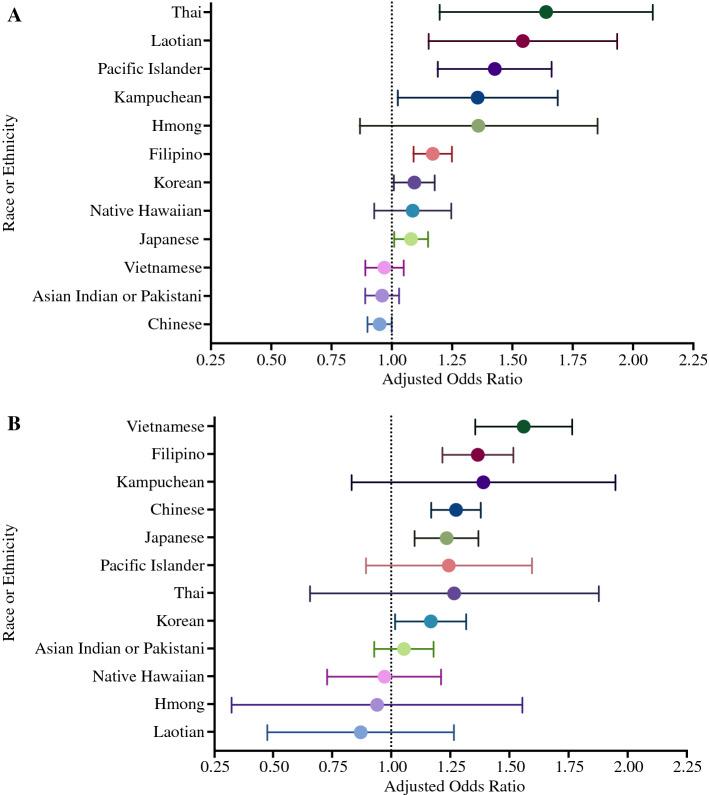
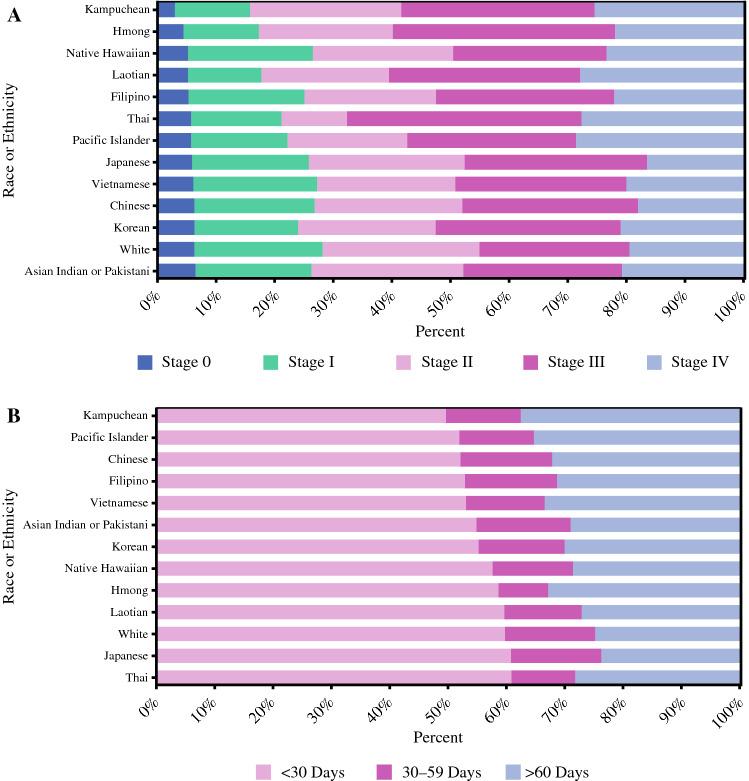
Among 694,876 patients, Japanese [AOR 1.08 (95% CI 1.01-1.15), p < 0.05], Filipino [AOR 1.17 (95% CI 1.09-1.25), p < 0.001], Korean [AOR 1.09 (95% CI 1.01-1.18), p < 0.05], Laotian [AOR 1.51 (95% CI 1.17-1.95), p < 0.01], Kampuchean [AOR 1.33 (95% CI 1.04-1.70), p < 0.01], Thai [AOR 1.60 (95% CI 1.22-2.10), p = 0.001], and Pacific Islander [AOR 1.41 (95% CI 1.20-1.67), p < 0.001] patients were more likely to present with more advanced colon cancer compared with white patients. Chinese [AOR 1.27 (95% CI 1.17-1.38), p < 0.001], Japanese [AOR 1.23 (95% CI 1.10-1.37], p < 0.001], Filipino [AOR 1.36 (95% CI 1.22-1.52), p < 0.001], Korean [AOR 1.16 (95% CI 1.02-1.32), p < 0.05], and Vietnamese [AOR 1.55 (95% CI 1.36-1.77), p < 0.001] patients were more likely to experience greater time to surgery than white patients. Disparities persisted when comparing among AANHPI subgroups.
CONCLUSIONS
Our findings reveal key disparities in stage at presentation and time to surgery by race/ethnicity among AANHPI subgroups. Heterogeneity upon disaggregation underscores the importance of examining and addressing access barriers and clinical disparities.
背景
在亚裔美国人、夏威夷原住民和太平洋岛民(AANHPI)群体中,存在着巨大的护理障碍差异,这些差异可能表现为在就诊时的分期和获得治疗方面的差异。因此,我们对 0-IV 期结肠癌的 AANHPI 患者进行了特征描述,并检查了(1)就诊时的分期和(2)与白人患者相比,手术时间的差异。
方法
我们评估了 2004 年至 2016 年间在国家癌症数据库(NCDB)中患有 0-IV 期结肠癌且自认为是白人、中国、日本、菲律宾、夏威夷原住民、韩国、越南、老挝、苗族、高棉族、泰国、印度裔或巴基斯坦裔以及太平洋岛民的所有患者。多变量有序逻辑回归定义了调整后的优势比(AOR),95%置信区间(CI),(1)患者就诊时患有晚期结肠癌和(2)0-III 期结肠癌患者在诊断后≥60 天、30-59 天和<30 天接受手术的情况,调整了社会人口统计学/临床因素。
结果
在 694876 名患者中,日本患者(AOR 1.08[95%CI 1.01-1.15],p<0.05)、菲律宾患者(AOR 1.17[95%CI 1.09-1.25],p<0.001)、韩国患者(AOR 1.09[95%CI 1.01-1.18],p<0.05)、老挝患者(AOR 1.51[95%CI 1.17-1.95],p<0.01)、高棉族患者(AOR 1.33[95%CI 1.04-1.70],p<0.01)、泰国患者(AOR 1.60[95%CI 1.22-2.10],p=0.001)和太平洋岛民患者(AOR 1.41[95%CI 1.20-1.67],p<0.001)更有可能患有更晚期的结肠癌。与白人患者相比,中国患者(AOR 1.27[95%CI 1.17-1.38],p<0.001)、日本患者(AOR 1.23[95%CI 1.10-1.37],p<0.001)、菲律宾患者(AOR 1.36[95%CI 1.22-1.52],p<0.001)、韩国患者(AOR 1.16[95%CI 1.02-1.32],p<0.05)和越南患者(AOR 1.55[95%CI 1.36-1.77],p<0.001)更有可能经历更长的手术时间。在 AANHPI 亚组之间进行比较时,差异仍然存在。
结论
我们的研究结果揭示了 AANHPI 亚组之间在种族/族裔方面在就诊时的分期和手术时间方面的关键差异。在分解时的异质性强调了检查和解决获得途径障碍和临床差异的重要性。
 Zotero 插件