
排除致糖尿病 HLA-DR3 和 HLA-DR4 的 HLA-DR 配型可预测胰岛移植后的胰岛素独立性。
Matching for HLA-DR excluding diabetogenic HLA-DR3 and HLA-DR4 predicts insulin independence after pancreatic islet transplantation.
机构信息
Collaborative Islet Transplant Registry Coordinating Center, The EMMES Company, LLC, Rockville, MD, United States.
Division of Transplantation, Department of Surgery, Geneva University Hospitals, Geneva, Switzerland.
出版信息
Front Immunol. 2023 Mar 21;14:1110544. doi: 10.3389/fimmu.2023.1110544. eCollection 2023.
INTRODUCTION
In pancreatic islet transplantation, the exact contribution of human leukocyte antigen (HLA) matching to graft survival remains unclear. Islets may be exposed to allogenic rejection but also the recurrence of type 1 diabetes (T1D). We evaluated the HLA-DR matching, including the impact of diabetogenic HLA-DR3 or HLA-DR4 matches.
METHODS
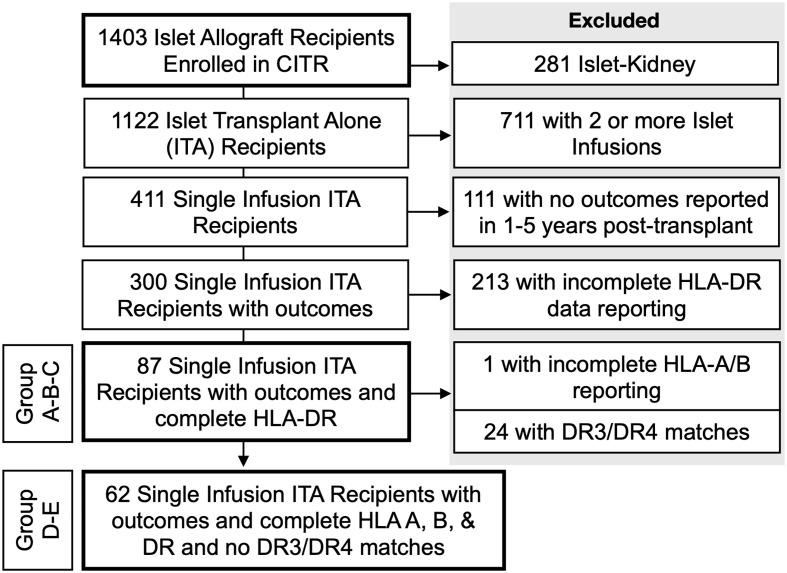
We retrospectively examined the HLA profile in 965 transplant recipients and 2327 islet donors. The study population was obtained from patients enrolled in the Collaborative Islet Transplant Registry. We then identified 87 recipients who received a single-islet infusion. Islet-kidney recipients, 2nd islet infusion, and patients with missing data were excluded from the analysis (n=878).
RESULTS
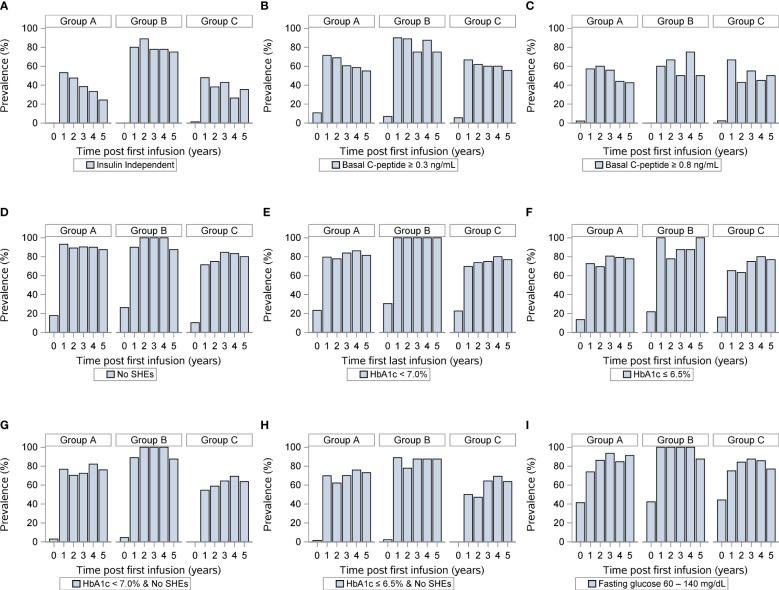
HLA-DR3 and HLA-DR4 were present in 29.7% and 32.6% of T1D recipients and 11.6% and 15.8% of the donors, respectively. We identified 52 T1D islet recipients mismatched for HLA-DR (group A), 11 with 1 or 2 HLA-DR-matches but excluding HLA-DR3 and HLA- DR4 (group B), and 24 matched for HLA-DR3 or HLA-DR4 (group C). Insulin-independence was maintained in a significantly higher percentage of group B recipients from year one through five post-transplantation (p<0.01). At five-year post-transplantation, 78% of group B was insulin-independent compared to 24% (group A) and 35% (group C). Insulin-independence correlated with significantly better glycemic control (HbA1c <7%), fasting blood glucose, and reduced severe hypoglycemic events. Matching HLA-A-B-DR (≥3) independently of HLA- DR3 or HLA-DR4 matching did not improve graft survival.
CONCLUSION
This study suggests that matching HLA-DR but excluding the diabetogenic HLA-DR3 and/or 4 is a significant predictor for long-term islet survival.
介绍
在胰岛移植中,人类白细胞抗原(HLA)配型对移植物存活的确切贡献仍不清楚。胰岛可能会受到同种异体排斥反应的影响,也可能会复发 1 型糖尿病(T1D)。我们评估了 HLA-DR 配型,包括对致糖尿病 HLA-DR3 或 HLA-DR4 配型的影响。
方法
我们回顾性分析了 965 名移植受者和 2327 名胰岛供者的 HLA 谱。研究人群来自于协作胰岛移植登记处登记的患者。然后,我们确定了 87 名接受单次胰岛输注的受者。我们排除了胰岛-肾移植受者、第 2 次胰岛输注以及数据缺失的患者(n=878)。
结果
T1D 受者中 HLA-DR3 和 HLA-DR4 的存在率分别为 29.7%和 32.6%,供者中分别为 11.6%和 15.8%。我们发现 52 名 T1D 胰岛受者 HLA-DR 错配(A 组),11 名受者 HLA-DR 有 1 或 2 个匹配,但不包括 HLA-DR3 和 HLA-DR4(B 组),24 名受者 HLA-DR3 或 HLA-DR4 匹配(C 组)。从移植后第 1 年到第 5 年,B 组胰岛素依赖的受者比例显著更高(p<0.01)。移植后 5 年,B 组胰岛素不依赖的比例为 78%,而 A 组为 24%,C 组为 35%。胰岛素不依赖与更好的血糖控制(HbA1c<7%)、空腹血糖和减少严重低血糖事件相关。独立于 HLA-DR3 或 HLA-DR4 配型匹配 HLA-A-B-DR(≥3)并不能改善移植物存活。
结论
本研究表明,匹配 HLA-DR 但排除致糖尿病 HLA-DR3 和/或 4 是长期胰岛存活的重要预测因素。

 Zotero 插件