
脊髓背角神经元中的电压门控钙通道亚基αδ-1在外周神经损伤后促成异常兴奋性突触传递和机械性超敏反应。
Voltage-gated calcium channel subunit αδ-1 in spinal dorsal horn neurons contributes to aberrant excitatory synaptic transmission and mechanical hypersensitivity after peripheral nerve injury.
作者信息
Koga Keisuke, Kobayashi Kenta, Tsuda Makoto, Kubota Kazufumi, Kitano Yutaka, Furue Hidemasa
机构信息
Department of Neurophysiology, Hyogo Medical University, Nishinomiya, Japan.
Section of Viral Vector Development, National Institute for Physiological Sciences, Okazaki, Japan.
出版信息
Front Mol Neurosci. 2023 Mar 23;16:1099925. doi: 10.3389/fnmol.2023.1099925. eCollection 2023.
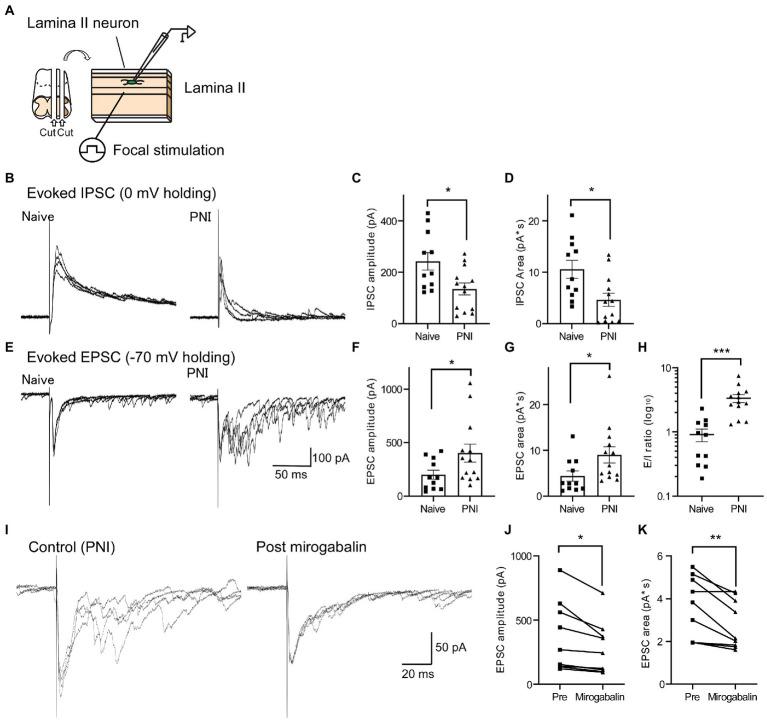
Neuropathic pain, an intractable pain symptom that occurs after nerve damage, is caused by the aberrant excitability of spinal dorsal horn (SDH) neurons. Gabapentinoids, the most commonly used drugs for neuropathic pain, inhibit spinal calcium-mediated neurotransmitter release by binding to αδ-1, a subunit of voltage-gated calcium channels, and alleviate neuropathic pain. However, the exact contribution of αδ-1 expressed in SDH neurons to the altered synaptic transmission and mechanical hypersensitivity following nerve injury is not fully understood. In this study, we investigated which types of SDH neurons express αδ-1 and how αδ-1 in SDH neurons contributes to the mechanical hypersensitivity and altered spinal synaptic transmission after nerve injury. Using hybridization technique, we found that mRNA coding αδ-1, was mainly colocalized with , an excitatory neuronal marker, but not with , an inhibitory neuronal marker in the SDH. To investigate the role of αδ-1 in SDH neurons, we used clustered regularly interspaced short palindromic repeats (CRISPR)-Cas9 system and showed that SDH neuron-specific ablation of alleviated mechanical hypersensitivity following nerve injury. We further found that excitatory post-synaptic responses evoked by electrical stimulation applied to the SDH were significantly enhanced after nerve injury, and that these enhanced responses were significantly decreased by application of mirogabalin, a potent αδ-1 inhibitor, and by SDH neuron-specific ablation of . These results suggest that αδ-1 expressed in SDH excitatory neurons facilitates spinal nociceptive synaptic transmission and contributes to the development of mechanical hypersensitivity after nerve injury.
神经性疼痛是一种在神经损伤后出现的顽固性疼痛症状,由脊髓背角(SDH)神经元的异常兴奋性引起。加巴喷丁类药物是治疗神经性疼痛最常用的药物,它通过与电压门控钙通道的一个亚基αδ-1结合,抑制脊髓钙介导的神经递质释放,从而减轻神经性疼痛。然而,SDH神经元中表达的αδ-1对神经损伤后突触传递改变和机械性超敏反应的确切作用尚未完全明确。在本研究中,我们调查了哪些类型的SDH神经元表达αδ-1,以及SDH神经元中的αδ-1如何导致神经损伤后的机械性超敏反应和脊髓突触传递改变。使用杂交技术,我们发现编码αδ-1的mRNA主要与兴奋性神经元标记物共定位,但在SDH中不与抑制性神经元标记物共定位。为了研究αδ-1在SDH神经元中的作用,我们使用了成簇规律间隔短回文重复序列(CRISPR)-Cas9系统,结果表明,SDH神经元特异性敲除αδ-1可减轻神经损伤后的机械性超敏反应。我们进一步发现,电刺激SDH诱发的兴奋性突触后反应在神经损伤后显著增强,而强效αδ-1抑制剂米罗加巴林的应用以及SDH神经元特异性敲除αδ-1可显著降低这些增强的反应。这些结果表明,SDH兴奋性神经元中表达的αδ-1促进脊髓伤害性突触传递,并导致神经损伤后机械性超敏反应的发生。

 Zotero 插件