
不同种族中特应性皮炎概述
Overview of Atopic Dermatitis in Different Ethnic Groups.
作者信息
Chiricozzi Andrea, Maurelli Martina, Calabrese Laura, Peris Ketty, Girolomoni Giampiero
机构信息
UOC di Dermatologia, Dipartimento di Scienze Mediche e Chirurgiche, Fondazione Policlinico Universitario A. Gemelli-IRCCS, 00168 Rome, Italy.
Dermatologia, Dipartimento di Medicina e Chirurgia Traslazionale, Università Cattolica del Sacro Cuore, 00168 Rome, Italy.
出版信息
J Clin Med. 2023 Apr 4;12(7):2701. doi: 10.3390/jcm12072701.
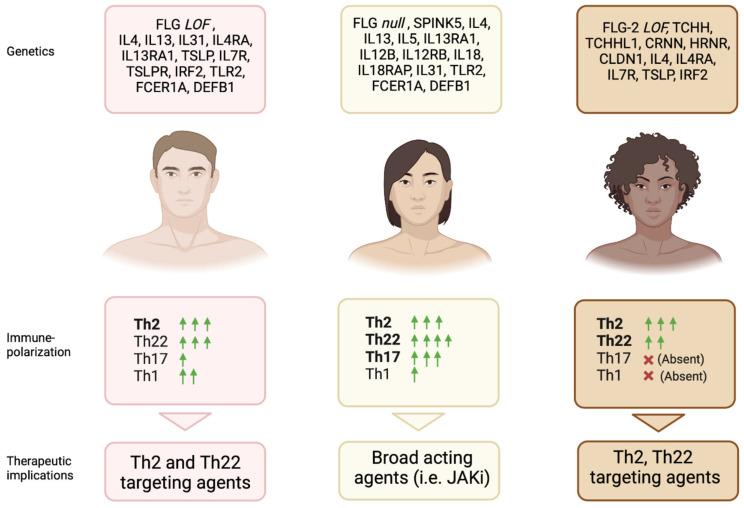
Atopic dermatitis (AD) is a common chronic inflammatory skin disease with a high prevalence worldwide, including countries from Asia, Africa, and Latin America, and in different ethnic groups. In recent years, more attention has been placed on the heterogeneity of AD associated with multiple factors, including a patient's ethnic background, resulting in an increasing body of clinical, genetic, epidemiologic, and immune-phenotypic evidence that delineates differences in AD among racial groups. Filaggrin (FLG) mutations, the strongest genetic risk factor for the development of AD, are detected in up to 50% of European and 27% of Asian AD patients, but very rarely in Africans. Th2 hyperactivation is a common attribute of all ethnic groups, though the Asian endotype of AD is also characterized by an increased Th17-mediated signal, whereas African Americans show a strong Th2/Th22 signature and an absence of Th1/Th17 skewing. In addition, the ethnic heterogeneity of AD may hold important therapeutic implications as a patient's genetic predisposition may affect treatment response and, thereby, a tailored strategy that better targets the dominant immunologic pathways in each ethnic subgroup may be envisaged. Nevertheless, white patients with AD represent the largest ethnicity enrolled and tested in clinical trials and the most treated in a real-world setting, limiting investigations about safety and efficacy across different ethnicities. The purpose of this review is to describe the heterogeneity in the pathophysiology of AD across ethnicities and its potential therapeutic implications.
特应性皮炎(AD)是一种常见的慢性炎症性皮肤病,在全球范围内具有较高的患病率,包括亚洲、非洲和拉丁美洲的国家以及不同种族群体。近年来,人们越来越关注与多种因素相关的AD异质性,包括患者的种族背景,这导致越来越多的临床、遗传、流行病学和免疫表型证据表明不同种族群体的AD存在差异。丝聚合蛋白(FLG)突变是AD发病最强的遗传风险因素,在高达50%的欧洲AD患者和27%的亚洲AD患者中被检测到,但在非洲人中很少见。Th2过度激活是所有种族群体的共同特征,尽管AD的亚洲亚型还具有Th17介导信号增加的特点,而非洲裔美国人则表现出强烈的Th2/Th22特征且不存在Th1/Th17偏移。此外,AD的种族异质性可能具有重要的治疗意义,因为患者的遗传易感性可能影响治疗反应,因此可以设想一种更有针对性地针对每个种族亚组主要免疫途径的定制策略。然而,患有AD的白人患者是临床试验中登记和测试人数最多的种族,也是现实环境中接受治疗最多的种族,这限制了对不同种族安全性和有效性的研究。本综述的目的是描述不同种族AD病理生理学的异质性及其潜在的治疗意义。
 Zotero 插件