
法国里昂,2021 年 12 月至 2022 年 3 月,第三剂疫苗使异源或同源 COVID-19 疫苗方案的有效性和免疫原性达到平衡。
A third vaccine dose equalises the levels of effectiveness and immunogenicity of heterologous or homologous COVID-19 vaccine regimens, Lyon, France, December 2021 to March 2022.
机构信息
Occupational Health and Medicine Department, Hospices Civils de Lyon, Université Claude Bernard Lyon1, Université Gustave Eiffel-IFSTTAR, UMRESTTE, UMR T_9405, Lyon University, Lyon, France.
CIRI - Centre International de Recherche en Infectiologie, Université de Lyon, Université Claude Bernard Lyon 1, Inserm, U1111, CNRS, UMR5308, ENS Lyon, Université Jean Monnet de Saint-Etienne, Lyon, France.
出版信息
Euro Surveill. 2023 Apr;28(15). doi: 10.2807/1560-7917.ES.2023.28.15.2200746.
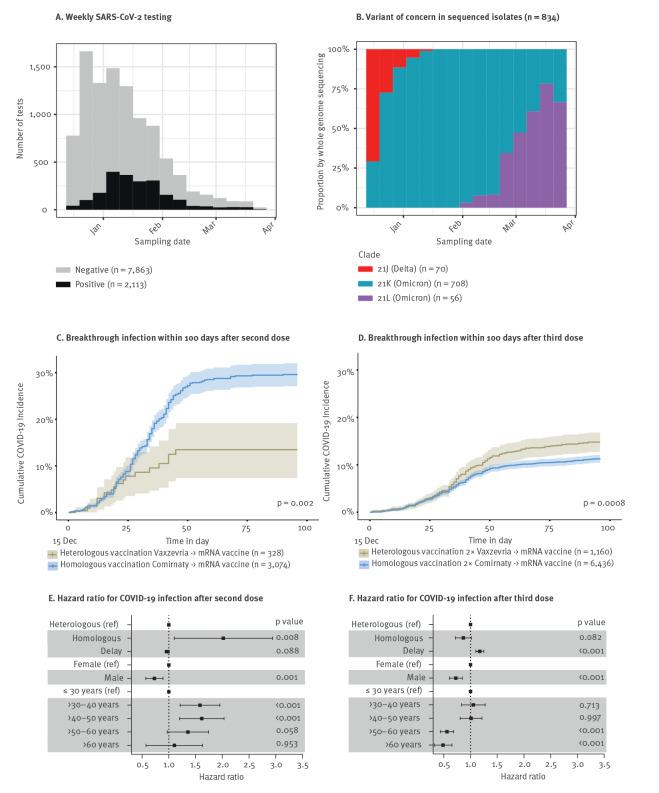
BackgroundTo cope with the persistence of the COVID-19 epidemic and the decrease in antibody levels following vaccination, a third dose of vaccine has been recommended in the general population. However, several vaccine regimens had been used initially for the primary vaccination course, and the heterologous Vaxzevria/Comirnaty regimen had shown better efficacy and immunogenicity than the homologous Comirnaty/Comirnaty regimen.AimWe wanted to determine if this benefit was retained after a third dose of an mRNA vaccine.MethodsWe combined an observational epidemiological study of SARS-CoV-2 infections among vaccinated healthcare workers at the University Hospital of Lyon, France, with a prospective cohort study to analyse immunological parameters before and after the third mRNA vaccine dose.ResultsFollowing the second vaccine dose, heterologous vaccination regimens were more protective against infection than homologous regimens (adjusted hazard ratio (HR) = 1.88; 95% confidence interval (CI): 1.18-3.00; p = 0.008), but this was no longer the case after the third dose (adjusted HR = 0.86; 95% CI: 0.72-1.02; p = 0.082). Receptor-binding domain-specific IgG levels and serum neutralisation capacity against different SARS-CoV-2 variants were higher after the third dose than after the second dose in the homologous regimen group, but not in the heterologous group.ConclusionThe advantage conferred by heterologous vaccination was lost after the third dose in terms of both protection and immunogenicity. Immunological measurements 1 month after vaccination suggest that heterologous vaccination induces maximal immunity after the second dose, whereas the third dose is required to reach the same level in individuals with a homologous regimen.
背景
为应对 COVID-19 疫情的持续存在以及接种疫苗后抗体水平下降,建议在普通人群中接种第三剂疫苗。然而,最初用于初级疫苗接种的疫苗方案有几种,与同源 Comirnaty/Comirnaty 方案相比,异源 Vaxzevria/Comirnaty 方案显示出更好的疗效和免疫原性。
目的
我们想确定在接种 mRNA 疫苗的第三剂后,这种益处是否仍然存在。
方法
我们将法国里昂大学医院接种疫苗的医护人员中 SARS-CoV-2 感染的观察性流行病学研究与前瞻性队列研究相结合,分析第三剂 mRNA 疫苗前后的免疫参数。
结果
在接种第二剂疫苗后,异源疫苗接种方案比同源疫苗接种方案更能预防感染(调整后的危险比 (HR) = 1.88;95%置信区间 (CI):1.18-3.00;p = 0.008),但在接种第三剂后则不再如此(调整后的 HR = 0.86;95% CI:0.72-1.02;p = 0.082)。同源方案组中,第三剂后受体结合域特异性 IgG 水平和针对不同 SARS-CoV-2 变体的血清中和能力均高于第二剂,但异源组则不然。
结论
就保护和免疫原性而言,在接种第三剂后,异源疫苗接种的优势丧失。接种后 1 个月的免疫测量结果表明,异源疫苗接种在第二剂后诱导出最大的免疫力,而对于同源方案的个体,需要接种第三剂才能达到相同水平。



 Zotero 插件