
欧洲莱姆病螺旋体病的血清流行率:系统文献回顾(2005-2020 年)的结果。
Seroprevalence of Lyme Borreliosis in Europe: Results from a Systematic Literature Review (2005-2020).
机构信息
P95 Pharmacovigilance & Epidemiology, Princeton, New Jersey, USA.
Pfizer Global Medical Affairs, Vaccines, Vienna, Austria.
出版信息
Vector Borne Zoonotic Dis. 2023 Apr;23(4):195-220. doi: 10.1089/vbz.2022.0069.
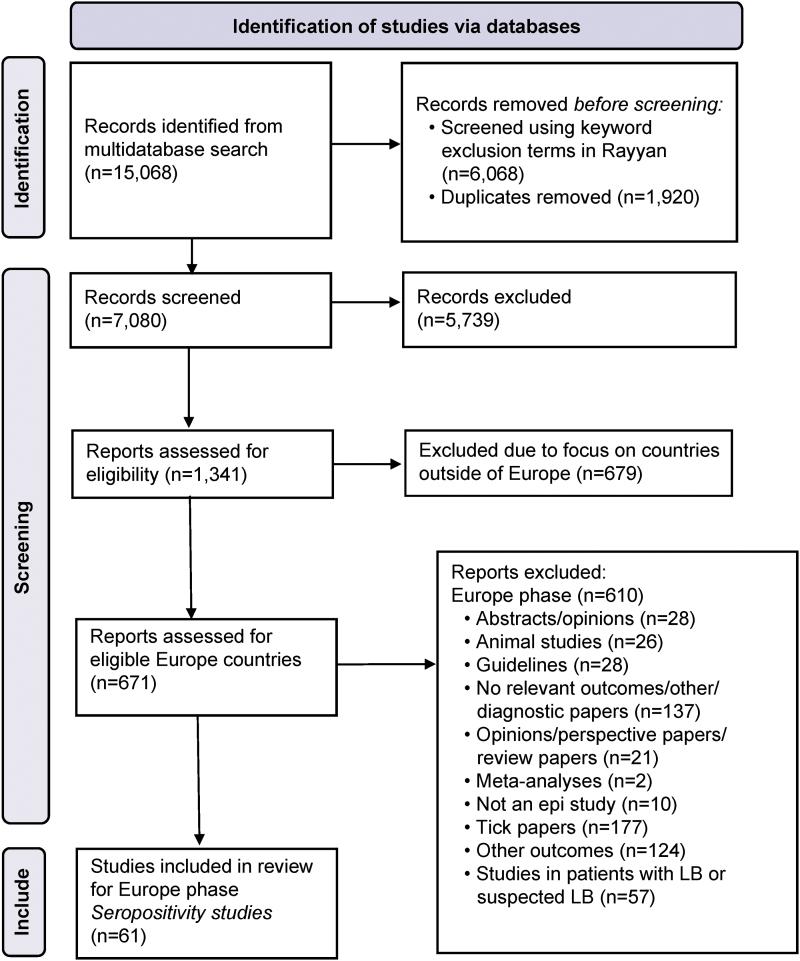
Lyme borreliosis (LB), a tick bite-transmitted infection caused by () complex spirochetes, is the most common tickborne disease in Europe. Studies in European countries have reported LB seroprevalence (prevalence of antibodies to infection) and diagnostic strategies used for testing. We conducted a systematic literature review to summarize contemporary LB seroprevalence in Europe. PubMed, Embase, and CABI Direct (Global Health) databases were searched from 2005 to 2020 to identify studies reporting LB seroprevalence in European countries. Reported single-tier and two-tier test results were summarized; algorithms (standard or modified) were used to interpret final test results from studies that used two-tier testing. The search yielded 61 articles from 22 European countries. Studies used a range of diagnostic testing methods and strategies (48% single-tier, 46% standard two-tier, and 6% modified two-tier). In 39 population-based studies, of which 14 were nationally representative, seroprevalence estimates ranged from 2.7% (Norway) to 20% (Finland). There was substantial heterogeneity among studies in terms of design, cohort types, periods sampled, sample sizes, and diagnostics, which limited cross-study comparisons. Nevertheless, among studies that reported seroprevalence in persons with greater exposure to ticks, LB seroprevalence was higher among these groups than in the general population (40.6% vs. 3.9%). Furthermore, among studies that used two-tier testing, general population LB seroprevalence was higher in Western Europe (13.6%) and Eastern Europe (11.1%) than in Northern Europe (4.2%) and Southern Europe (3.9%). Despite variations in LB seroprevalence between and within European subregions and countries, high seroprevalence was observed in certain geographic regions and particular risk groups, suggesting significant disease burden and supporting the need for improved, targeted public health interventions such as vaccination. Harmonized approaches to serologic testing and more nationally representative seroprevalence studies are needed to better understand the prevalence of infection in Europe.
莱姆病(LB)是一种由()复杂螺旋体引起的蜱虫叮咬传播感染,是欧洲最常见的蜱传疾病。欧洲国家的研究报告了 LB 血清流行率(针对感染的抗体流行率)和用于检测的诊断策略。我们进行了系统的文献综述,以总结欧洲当代 LB 血清流行率。从 2005 年到 2020 年,我们在 PubMed、Embase 和 CABI Direct(全球健康)数据库中搜索了报告欧洲国家 LB 血清流行率的研究。总结了报告的单级和两级检测结果;对于使用两级检测的研究,使用算法(标准或修改)来解释最终检测结果。搜索结果来自 22 个欧洲国家的 61 篇文章。研究使用了一系列诊断检测方法和策略(48%的单级,46%的标准两级,6%的修改两级)。在 39 项基于人群的研究中,其中 14 项具有全国代表性,血清流行率估计值范围从 2.7%(挪威)到 20%(芬兰)。研究在设计、队列类型、采样时段、样本量和诊断方面存在很大的异质性,这限制了跨研究的比较。然而,在报告与蜱虫接触较多的人群中 LB 血清流行率的研究中,这些人群的 LB 血清流行率高于一般人群(40.6%比 3.9%)。此外,在使用两级检测的研究中,西欧(13.6%)和东欧(11.1%)的普通人群 LB 血清流行率高于北欧(4.2%)和南欧(3.9%)。尽管欧洲各地区和国家之间的 LB 血清流行率存在差异,但在某些地理区域和特定风险群体中观察到高流行率,这表明疾病负担重大,支持需要改进有针对性的公共卫生干预措施,如疫苗接种。需要采用协调一致的血清学检测方法和更具全国代表性的血清流行率研究,以更好地了解欧洲的感染流行情况。


 Zotero 插件