
欧洲莱姆病的发病率:系统评价(2005-2020 年)。
Incidence of Lyme Borreliosis in Europe: A Systematic Review (2005-2020).
机构信息
P95 Pharmacovigilance and Epidemiology, Princeton, New Jersey, USA.
Pfizer Vaccines Medical, Walton Oaks, United Kingdom.
出版信息
Vector Borne Zoonotic Dis. 2023 Apr;23(4):172-194. doi: 10.1089/vbz.2022.0070.
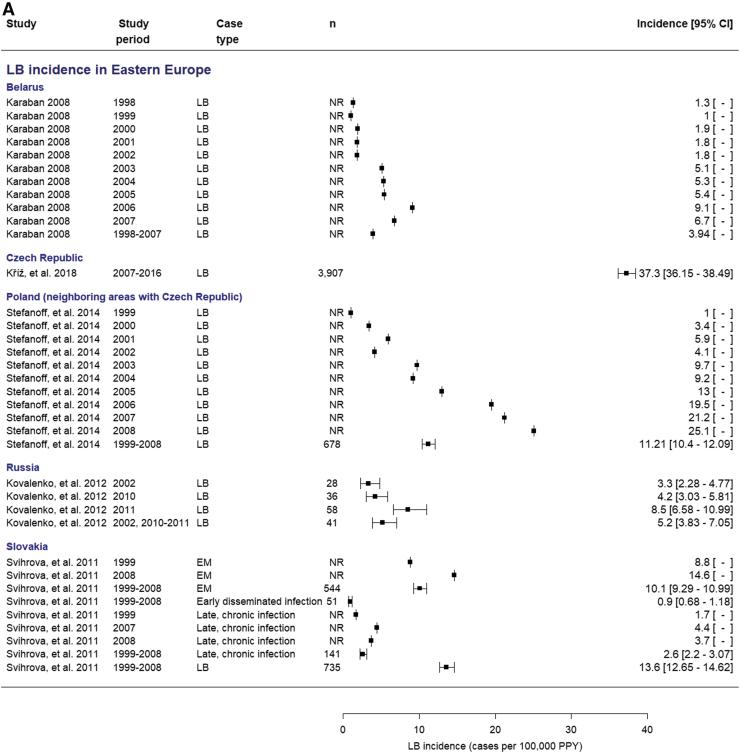
Lyme borreliosis (LB) is the most common tick-borne disease in Europe, but the burden of disease is incompletely described. We conducted a systematic review across PubMed, EMBASE, and CABI Direct (Global Health) databases, from January 1, 2005, to November 20, 2020, of epidemiological studies reporting incidence of LB in Europe (PROSPERO, CRD42021236906). The systematic review yielded 61 unique articles describing LB incidence (national or subnational) in 25 European countries. Substantial heterogeneity in study designs, populations sampled, and case definitions restricted data comparability. The European Union Concerted Action on Lyme Borreliosis (EUCALB)-published standardized LB case definitions were used by only 13 (21%) of the 61 articles. There were 33 studies that provided national-level LB incidence estimates for 20 countries. Subnational LB incidence was available from an additional four countries (Italy, Lithuania, Norway, and Spain). The highest LB incidences (>100 cases per 100,000 population per year [PPY]) were reported in Belgium, Finland, the Netherlands, and Switzerland. Incidences were 20-40/100,000 PPY in the Czech Republic, Germany, Poland, and Scotland and <20/100,000 PPY in Belarus, Croatia, Denmark, France, Ireland, Portugal, Russia, Slovakia, Sweden, and the United Kingdom (England, Northern Ireland, and Wales); markedly higher incidences were observed at the subnational level (up to 464/100,000 PPY in specific local areas). Although countries in Northern (Finland) and Western (Belgium, the Netherlands, and Switzerland) Europe reported the highest LB incidences, high incidences also were reported in some Eastern European countries. There was substantial subnational variation in incidence, including high incidences in some areas of countries with low overall incidence. This review, complemented by the incidence surveillance article, provides a comprehensive view into LB disease burden across Europe that may guide future preventive and therapeutic strategies-including new strategies on the horizon.
莱姆病(LB)是欧洲最常见的蜱传疾病,但疾病负担的描述并不完整。我们在 2005 年 1 月 1 日至 2020 年 11 月 20 日期间对 Pubmed、Embase 和 CABI Direct(全球健康)数据库进行了系统检索,以获取欧洲莱姆病发病率的流行病学研究报告(PROSPERO、CRD42021236906)。系统检索共产生了 61 篇描述 25 个欧洲国家(国家或次国家级)莱姆病发病率的独特文章。研究设计、抽样人群和病例定义的巨大异质性限制了数据的可比性。只有 13 篇(21%)61 篇文章使用了欧盟莱姆病协调行动(EUCALB)发表的标准化莱姆病病例定义。有 33 项研究提供了 20 个国家的国家级莱姆病发病率估计值。另外还有 4 个国家(意大利、立陶宛、挪威和西班牙)提供了次国家级莱姆病发病率数据。比利时、芬兰、荷兰和瑞士报告的莱姆病发病率最高(>100 例/每 10 万人口/年[PPY])。捷克共和国、德国、波兰和苏格兰的发病率为 20-40/100,000 PPY,白俄罗斯、克罗地亚、丹麦、法国、爱尔兰、葡萄牙、俄罗斯、斯洛伐克、瑞典和联合王国(英格兰、北爱尔兰和威尔士)的发病率<20/100,000 PPY;在次国家级水平上观察到更高的发病率(某些特定地区高达 464/100,000 PPY)。尽管北欧(芬兰)和西欧(比利时、荷兰和瑞士)的国家报告的莱姆病发病率最高,但一些东欧国家的发病率也很高。发病率存在很大的次国家级差异,包括一些总体发病率较低的国家的某些地区发病率较高。本综述与发病率监测文章相结合,全面了解了欧洲莱姆病的疾病负担,可能为未来的预防和治疗策略提供指导,包括新的策略。

 Zotero 插件