Zhen Fangyuan, Zou Tongdan, Wang Ting, Zhou Yongwei, Dong Shuqian, Zhang Houbin
Department of Ophthalmology, The First Affiliated Hospital of Zhengzhou University, Henan Provincial Ophthalmic Hospital, Zhengzhou, China.
The Key Laboratory for Human Disease Gene Study of Sichuan Province and Institute of Laboratory Medicine, Sichuan Provincial People's Hospital, University of Electronic Science and Technology of China, Chengdu, Sichuan, China.
Front Neurosci. 2023 Apr 3;17:1132179. doi: 10.3389/fnins.2023.1132179. eCollection 2023.
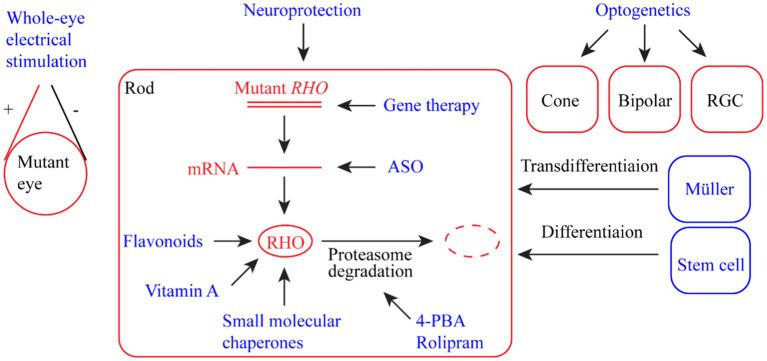
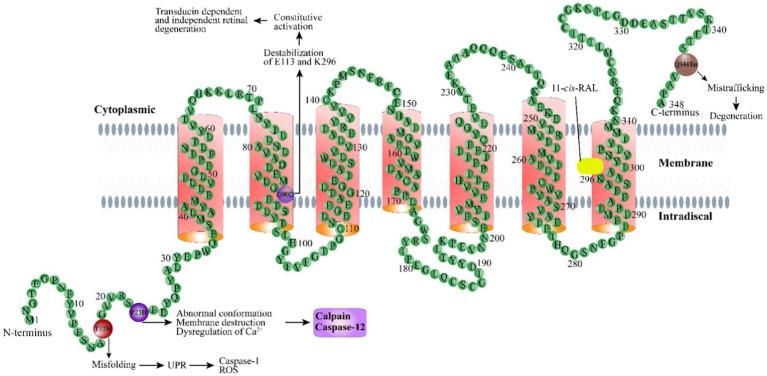
Rhodopsin is a light-sensitive G protein-coupled receptor that initiates the phototransduction cascade in rod photoreceptors. Mutations in the rhodopsin-encoding gene are the leading cause of autosomal dominant retinitis pigmentosa (ADRP). To date, more than 200 mutations have been identified in . The high allelic heterogeneity of mutations suggests complicated pathogenic mechanisms. Here, we discuss representative mutations as examples to briefly summarize the mechanisms underlying rhodopsin-related retinal dystrophy, which include but are not limited to endoplasmic reticulum stress and calcium ion dysregulation resulting from protein misfolding, mistrafficking, and malfunction. Based on recent advances in our understanding of disease mechanisms, various treatment methods, including adaptation, whole-eye electrical stimulation, and small molecular compounds, have been developed. Additionally, innovative therapeutic treatment strategies, such as antisense oligonucleotide therapy, gene therapy, optogenetic therapy, and stem cell therapy, have achieved promising outcomes in preclinical disease models of rhodopsin mutations. Successful translation of these treatment strategies may effectively ameliorate, prevent or rescue vision loss related to rhodopsin mutations.
视紫红质是一种光敏感的G蛋白偶联受体,它在视杆光感受器中启动光转导级联反应。视紫红质编码基因突变是常染色体显性视网膜色素变性(ADRP)的主要原因。迄今为止,已在该基因中鉴定出200多种突变。该基因突变的高等位基因异质性表明其致病机制复杂。在这里,我们以代表性的视紫红质基因突变为例,简要总结视紫红质相关视网膜营养不良的潜在机制,这些机制包括但不限于蛋白质错误折叠、运输错误和功能异常导致的内质网应激和钙离子失调。基于我们对疾病机制理解的最新进展,已经开发出了各种治疗方法,包括适应性治疗、全眼电刺激和小分子化合物。此外,创新的治疗策略,如反义寡核苷酸疗法、基因疗法、光遗传学疗法和干细胞疗法,在视紫红质突变的临床前疾病模型中取得了有前景的结果。这些治疗策略的成功转化可能有效改善、预防或挽救与视紫红质突变相关的视力丧失。

 Zotero 插件