
发现 KRAS 突变的男性结直肠癌患者的铁死亡减少。
Discovery of decreased ferroptosis in male colorectal cancer patients with KRAS mutations.
机构信息
Department of Environmental Health Sciences, Yale School of Public Health, Yale University, USA.
Department of Pathology, Yale School of Medicine, USA.
出版信息
Redox Biol. 2023 Jun;62:102699. doi: 10.1016/j.redox.2023.102699. Epub 2023 Apr 14.
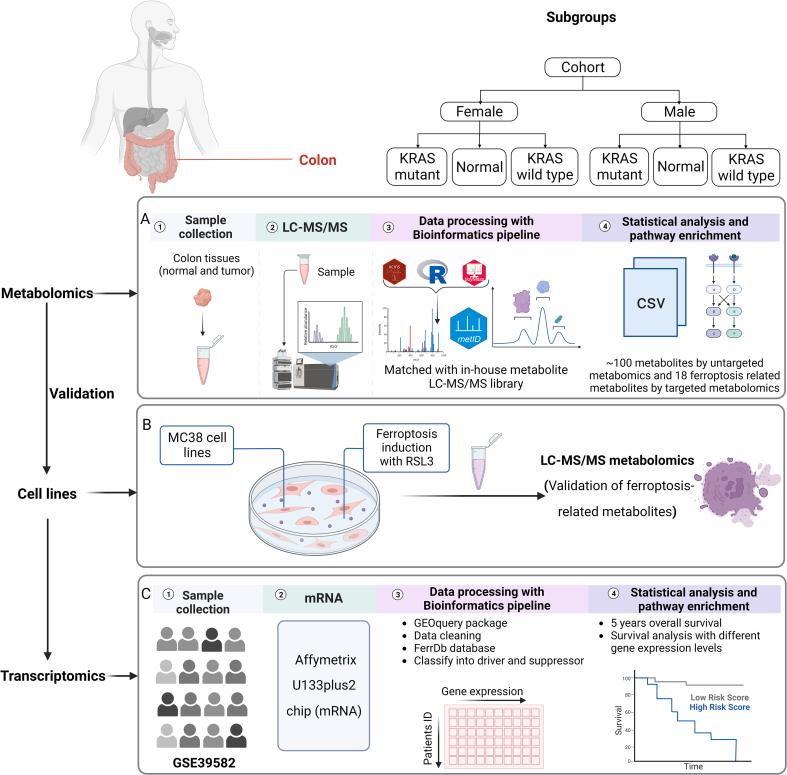
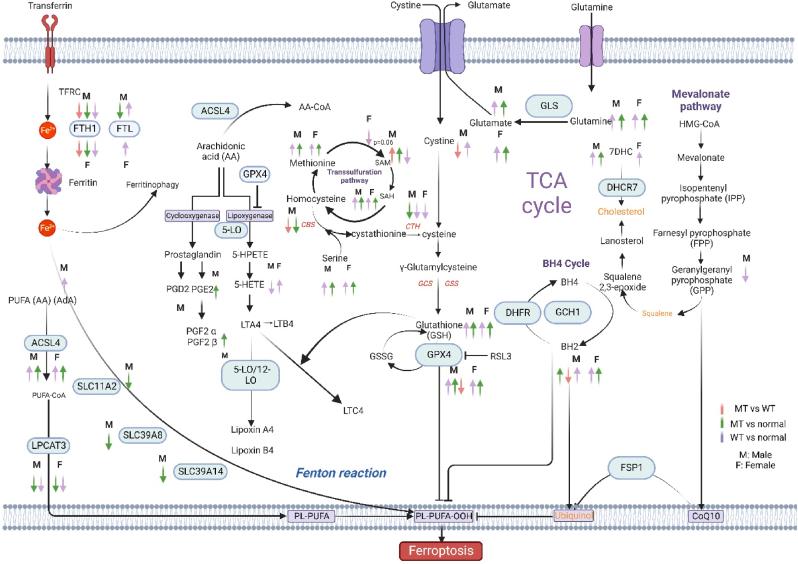
Aberrant tumor metabolism is a hallmark of cancer in which metabolic rewiring can support tumor growth under nutrient deficient conditions. KRAS mutations occur in 35-45% of all colorectal cancer (CRC) cases and are difficult to treat. The relationship between mutant KRAS and aberrant metabolism in CRCs has not been fully explored and could be a target for intervention. We previously acquired non-targeted metabolomics data from 161 tumor tissues and 39 normal colon tissues from stage I-III chemotherapy naïve CRC patients. In this study, we revealed that only in male patients, tumors with KRAS mutations had several altered pathways that suppress ferroptosis, including glutathione biosynthesis, transsulfuration activity, and methionine metabolism. To validate this phenotype, MC38 CRC cells (KRAS) were treated with a ferroptosis inducer; RAS-selected lethal (RSL3). RSL3 altered metabolic pathways in the opposite direction to that seen in KRAS mutant tumors from male patients confirming a suppressed ferroptosis metabolic phenotype in these patients. We further validated gene expression data from an additional CRC patient cohort (Gene Expression Omnibus (GEO)), and similarly observed differences in ferroptosis-related genes by sex and KRAS status. Further examination of the relationship between these genes and overall survival (OS) in the GEO cohort showed that KRAS mutant tumors are associated with poorer 5-year OS compared to KRAS wild type tumors, and only in male patients. Additionally, high compared to low expression of GPX4, FTH1, FTL, which suppress ferroptosis, were associated with poorer 5-year OS only in KRAS mutant tumors from male CRC patients. Additionally, low compared to high expression of ACSL4 was associated with poorer OS for this group. Our results show that KRAS mutant tumors from male CRC patients have suppressed ferroptosis, and gene expression changes that suppress ferroptosis associate with adverse outcomes for these patients, revealing a novel potential avenue for therapeutic approaches.
肿瘤代谢异常是癌症的一个标志,在营养缺乏的情况下,代谢重编程可以支持肿瘤生长。KRAS 突变发生在所有结直肠癌(CRC)病例的 35-45%中,并且难以治疗。KRAS 突变与 CRC 中异常代谢之间的关系尚未得到充分探索,可能成为干预的目标。我们之前从 161 个肿瘤组织和 39 个 I-III 期化疗初治 CRC 患者的正常结肠组织中获得了非靶向代谢组学数据。在这项研究中,我们揭示了只有在男性患者中,KRAS 突变的肿瘤具有几种抑制铁死亡的改变途径,包括谷胱甘肽生物合成、转硫活性和蛋氨酸代谢。为了验证这种表型,我们用铁死亡诱导剂处理了 MC38 CRC 细胞(KRAS);RAS 选择致死(RSL3)。RSL3 改变了代谢途径,与来自男性患者的 KRAS 突变肿瘤中观察到的相反,证实了这些患者存在抑制性铁死亡代谢表型。我们进一步验证了来自另一个 CRC 患者队列(基因表达综合数据库(GEO))的基因表达数据,并且同样观察到性别和 KRAS 状态对铁死亡相关基因的差异。进一步研究这些基因与 GEO 队列中总生存(OS)之间的关系表明,与 KRAS 野生型肿瘤相比,KRAS 突变肿瘤与较差的 5 年 OS 相关,并且仅在男性患者中。此外,与低表达相比,高表达抑制铁死亡的 GPX4、FTH1 和 FTL 仅在男性 CRC 患者的 KRAS 突变肿瘤中与较差的 5 年 OS 相关。此外,与高表达相比,低表达 ACSL4 与该组患者的预后不良相关。我们的结果表明,来自男性 CRC 患者的 KRAS 突变肿瘤具有抑制性铁死亡,并且抑制性铁死亡的基因表达变化与这些患者的不良结局相关,揭示了一种新的潜在治疗方法。





 Zotero 插件