
2013-2017 年人群烟草和健康评估(PATH)研究中成年人的多种烟草使用模式:多状态马尔可夫转移分析。
Patterns of poly tobacco use among adults in the Population Assessment of Tobacco and Health (PATH) study, 2013-2017: a multistate Markov transition analysis.
机构信息
Biostatistics, University of Michigan School of Public Health, Ann Arbor, Michigan, USA
Epidemiology, University of Michigan School of Public Health, Ann Arbor, Michigan, USA.
出版信息
Tob Control. 2024 Sep 25;33(5):603-610. doi: 10.1136/tc-2022-057822.
BACKGROUND
A better understanding of sociodemographic transition patterns between single, dual and poly tobacco product use may help improve tobacco control policy interventions.
METHODS
HRs of transition between never, non-current (no past 30-day use), cigarette, e-cigarette, other combustible, smokeless tobacco (SLT), dual and poly tobacco use states in adults were estimated for age, sex, race/ethnicity, education and income using a multistate model for waves 1-4 of the Population Assessment of Tobacco and Health study (2013-2017), a US-based cohort study, accounting for complex survey design.
RESULTS
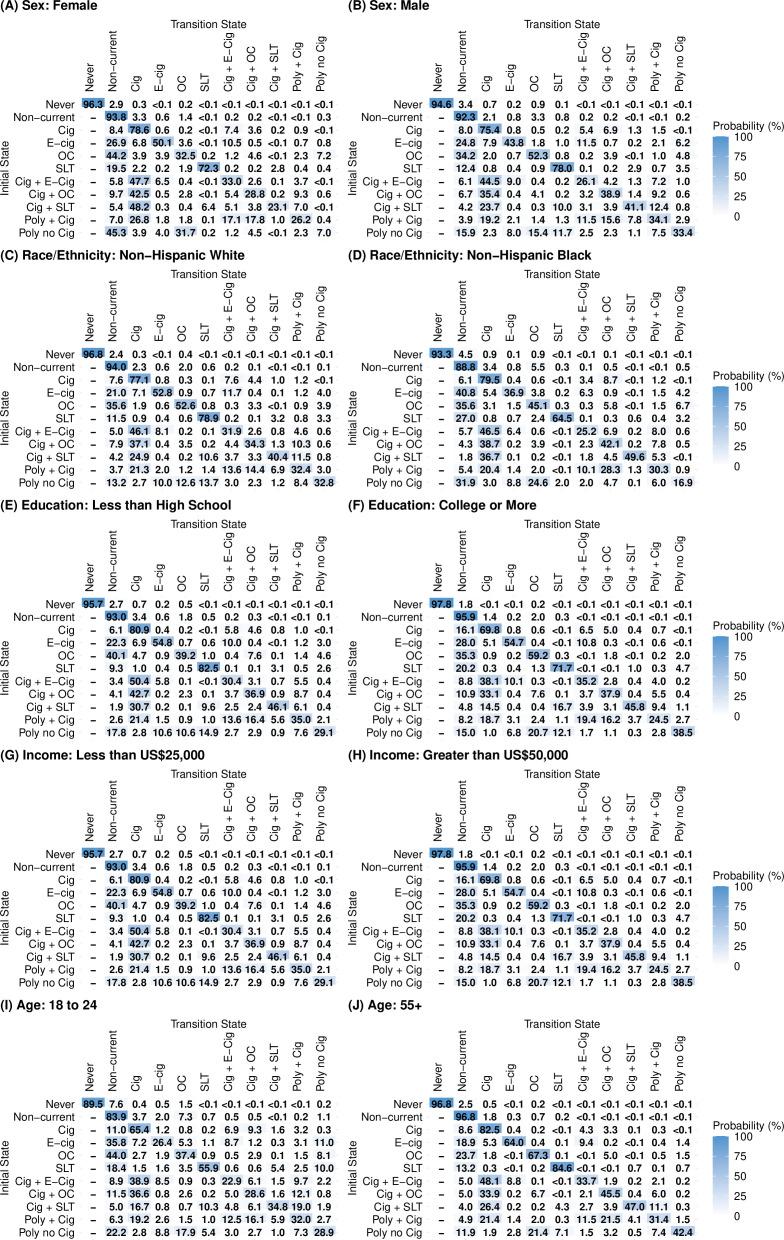
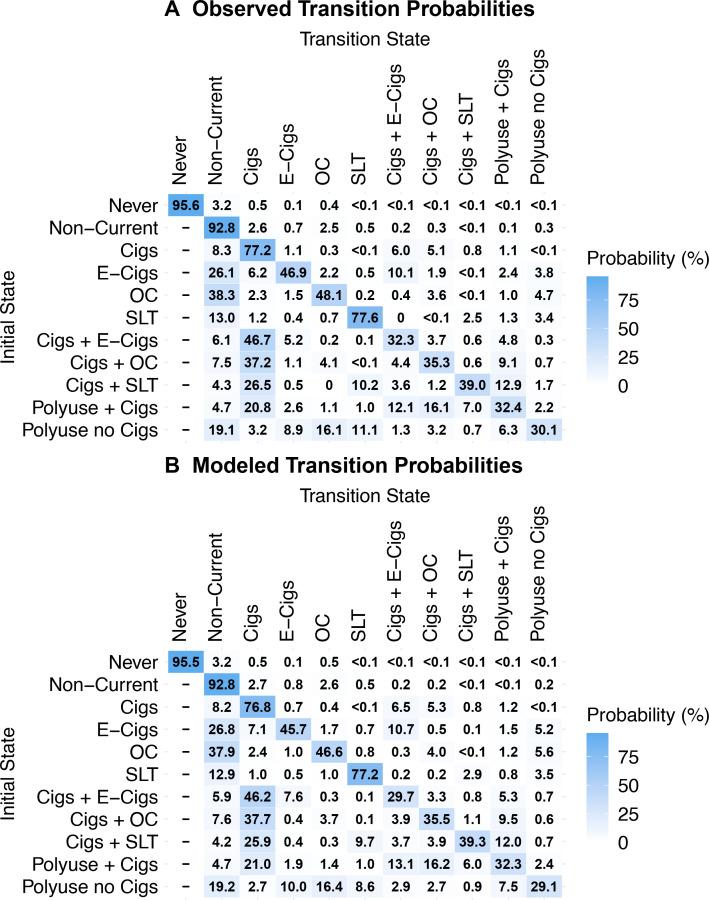
Sole cigarette and SLT use were persistent, with 77% and 78% of adults continuing use after one wave. Other use states were more transient, with 29%-48% of adults reporting the same pattern after one wave. If single-product users transitioned, it was most likely to non-current use while dual or poly cigarette users were most likely to transition to exclusive cigarette use. Males were more likely than females to initiate combustible product use after a history of no use, and after a period of tobacco use cessation. Hispanic and non-Hispanic black participants initiated cigarette use at higher rates than non-Hispanic white participants, and had higher rates of experimentation with tobacco products between study waves. Lower socioeconomic status was associated with higher rates of transition into combustible tobacco use.
CONCLUSIONS
Dual and poly tobacco use is largely transient, while single-use patterns are more stable over time. Transitions differ by age, sex, race/ethnicity, education and income, which may influence the impact of current and future tobacco control efforts.
背景
更好地了解单一、双重和多种烟草制品使用之间的社会人口学转变模式,可能有助于改进烟草控制政策干预措施。
方法
利用多状态模型,对美国基于人群的队列研究(2013-2017 年)“人口烟草与健康评估研究”第 1-4 波数据,估计了从不、非当前(过去 30 天无使用)、香烟、电子烟、其他可燃、无烟烟草(SLT)、双重和多种烟草制品使用状态之间转变的年龄、性别、种族/民族、教育和收入的 HRs,该研究考虑了复杂的调查设计。
结果
单一香烟和 SLT 的使用具有持续性,在一个波次后,有 77%和 78%的成年人继续使用。其他使用状态更具瞬时性,在一个波次后,有 29%-48%的成年人报告了同样的模式。如果单一产品使用者发生转变,最有可能转变为非当前使用,而双重或多重香烟使用者最有可能转变为单纯使用香烟。与女性相比,男性在没有使用史或停止吸烟一段时间后,更有可能开始使用可燃产品。西班牙裔和非西班牙裔黑人参与者比非西班牙裔白人参与者更有可能开始吸烟,并且在研究波次之间更有可能尝试使用烟草制品。较低的社会经济地位与更高的进入可燃烟草制品使用的转变率相关。
结论
双重和多种烟草制品的使用主要是瞬时的,而单一使用模式随着时间的推移更加稳定。不同的年龄、性别、种族/民族、教育和收入会导致转变不同,这可能会影响当前和未来烟草控制工作的效果。
 Zotero 插件