
新冠疫情期间主宠关系、压力和孤独的时间模式,以及宠物拥有对心理健康的影响:一项纵向调查。
Temporal patterns of owner-pet relationship, stress, and loneliness during the COVID-19 pandemic, and the effect of pet ownership on mental health: A longitudinal survey.
机构信息
Department of Veterinary Clinical Sciences, College of Veterinary Medicine, Purdue University, West Lafayette, Indiana, United States of America.
Department of Comparative Pathobiology, College of Veterinary Medicine, Purdue University, West Lafayette, Indiana, United States of America.
出版信息
PLoS One. 2023 Apr 26;18(4):e0284101. doi: 10.1371/journal.pone.0284101. eCollection 2023.
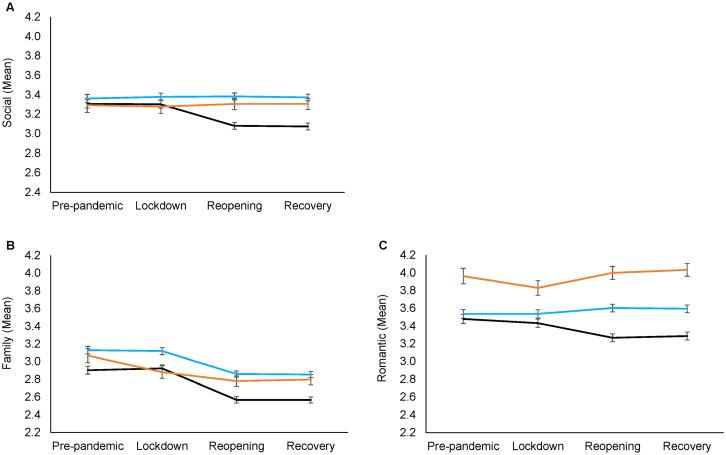
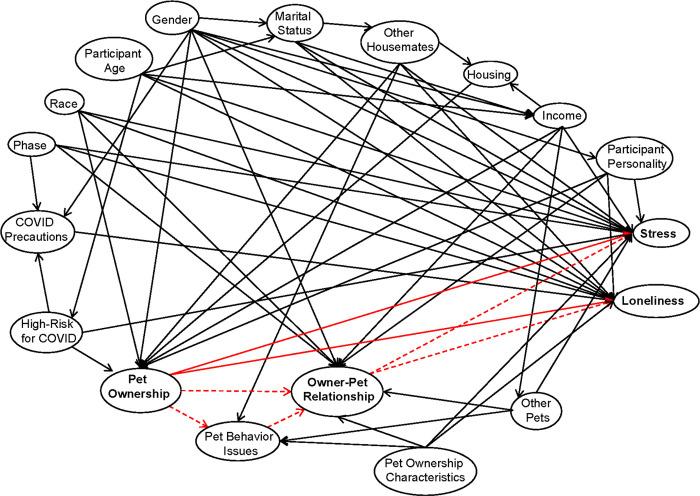
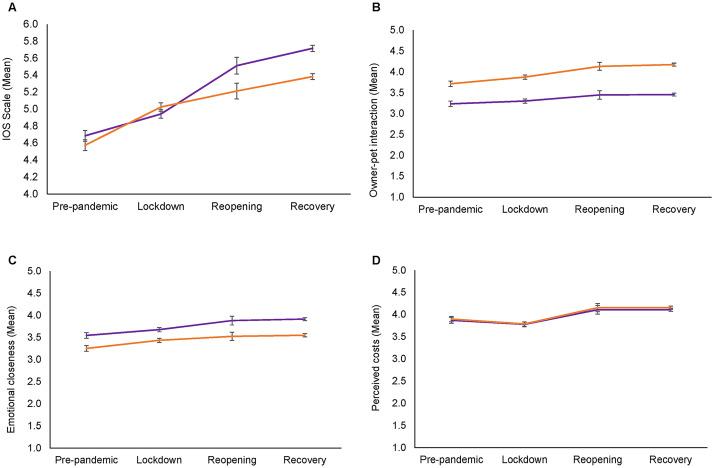
The COVID-19 pandemic has affected us in numerous ways and may consequently impact our relationships with pet dogs and cats. We conducted a longitudinal survey to examine the temporal patterns of owner-pet relationship, stress, and loneliness during four phases of the pandemic: 1) pre-pandemic (February 2020), 2) lockdown (April to June 2020), 3) reopening (September to December 2020), and 4) recovery (January 2021 to December 2021). We also investigated the effect of pet ownership on stress and loneliness, by considering a set of a priori causal assumptions. In addition, we hypothesized that the differences in the levels of stress and loneliness between dog and cat ownerships were mediated by the owner-pet relationship. A total of 4,237 participants (657 non-pet owners, 1,761 dog owners, and 1,819 cat owners) completed between one and six surveys. Overall, the closeness in the relationship between owners and their pets increased with time during the study period. We also observed that dog owners consistently showed larger decreases in the levels of stress and loneliness than cat and non-pet owners. However, after adjusting for confounders, the findings did not support a mitigating effect of pet ownership. Pet ownership did not alleviate stress, social loneliness resulting from a lack of friendships or workplace relationships, or emotional loneliness due to deficiencies in family relationships. Pet owners, however, reported a lower degree of emotional loneliness caused by deficits in romantic relationships than non-pet owners. Our results also indicated that the differences in stress and loneliness levels between dog and cat ownerships were partially explained by the owner-pet relationship, and once this was accounted for, the differences between them reduced. In summary, this study highlights the dynamic effects of COVID-19 on owner-pet relationship and mental health. It also shows the complexity of the association between pet ownership and mental health, partially mediated by owner-pet relationships.
新冠疫情以多种方式影响着我们,可能会继而影响我们与宠物狗和猫的关系。我们进行了一项纵向调查,以研究在疫情的四个阶段(1)大流行前(2020 年 2 月),2)封锁(2020 年 4 月至 6 月),3)重新开放(2020 年 9 月至 12 月)和 4)恢复(2021 年 1 月至 2021 年 12 月)期间,主人与宠物关系、压力和孤独感的时间模式。我们还通过考虑一套先验因果假设,研究了宠物拥有对压力和孤独感的影响。此外,我们假设狗和猫的主人在压力和孤独感水平上的差异是由主人与宠物的关系介导的。共有 4237 名参与者(657 名非宠物主人、1761 名狗主人和 1819 名猫主人)完成了一到六次调查。总体而言,在研究期间,主人与宠物之间的关系亲密程度随着时间的推移而增加。我们还观察到,与猫和非宠物主人相比,狗主人的压力和孤独感水平持续下降幅度更大。然而,在调整了混杂因素后,研究结果并不支持宠物拥有的缓解作用。宠物拥有并不能减轻压力、因缺乏友谊或职场关系而导致的社交孤独感,或因家庭关系缺陷而导致的情感孤独感。然而,宠物主人报告的因恋爱关系不足而导致的情感孤独感程度低于非宠物主人。我们的研究结果还表明,狗和猫的主人在压力和孤独感水平上的差异部分由主人与宠物的关系解释,一旦考虑到这一点,它们之间的差异就会减少。总之,这项研究强调了新冠疫情对主宠关系和心理健康的动态影响。它还显示了宠物拥有与心理健康之间关联的复杂性,部分由主宠关系介导。

 Zotero 插件