
磷脂酰肌醇蛋白聚糖-3靶向正电子发射断层扫描在肝细胞癌异种移植模型中检测出亚厘米级肿瘤。
Glypican-3 targeted positron emission tomography detects sub-centimeter tumors in a xenograft model of hepatocellular carcinoma.
作者信息
Labadie Kevin P, Lehnert Adrienne L, Kenoyer Aimee L, Hamlin Donald K, Ludwig Andrew D, Utria Alan F, Daniel Sara K, Mihailovic Tara N, Prossnitz Alexander, Orozco Johnnie J, Li Yawen, Wilbur D Scott, Miyaoka Robert S, Park James O
机构信息
Department of Surgery, University of Washington School of Medicine, 1959 NE Pacific Street, Health Sciences Bldg. Room BB-442, Box 356410, Seattle, WA, 98195-6410, USA.
Department of Radiology, University of Washington School of Medicine, 1959 NE Pacific Street, Seattle, WA, 98195, USA.
出版信息
EJNMMI Res. 2023 Apr 27;13(1):35. doi: 10.1186/s13550-023-00980-9.
BACKGROUND
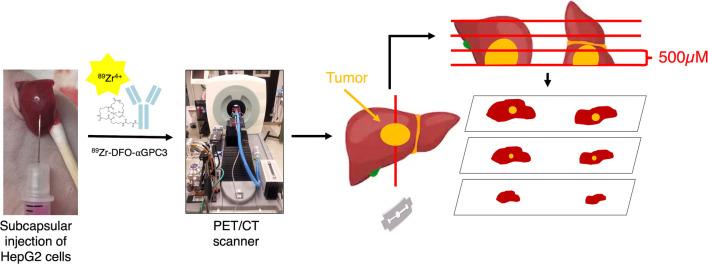
Early intrahepatic recurrence is common after surgical resection of hepatocellular carcinoma (HCC) and leads to increased morbidity and mortality. Insensitive and nonspecific diagnostic imaging contributes to EIR and results in missed treatment opportunities. In addition, novel modalities are needed to identify targets amenable for targeted molecular therapy. In this study, we evaluated a zirconium-89 radiolabeled glypican-3 (GPC3) targeting antibody conjugate (Zr-αGPC3) for use in positron emission tomography (PET) for detection of small, GPC3 HCC in an orthotopic murine model. Athymic nu/J mice received hepG2, a GPC3 human HCC cell line, into the hepatic subcapsular space. Tumor-bearing mice were imaged by PET/computerized tomography (CT) 4 days after tail vein injection of Zr-αGPC3. Livers were then excised for the tumors to be identified, measured, bisected, and then serially sectioned at 500 μm increments. Sensitivity and specificity of PET/CT for Zr-αGPC3-avid tumors were assessed using tumor confirmation on histologic sections as the gold standard.
RESULTS
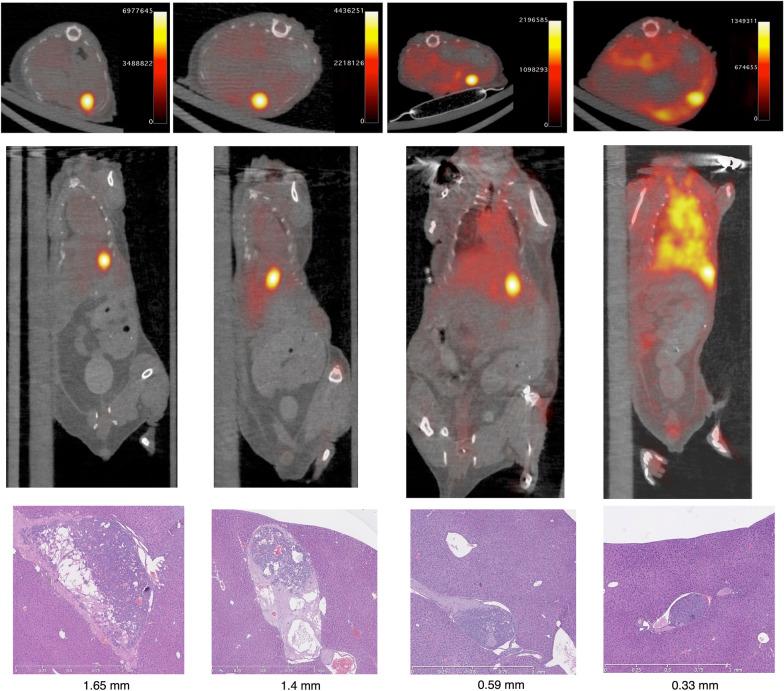
In tumor-bearing mice, Zr-αGPC3 avidly accumulated in the tumor within four hours of injection with ongoing accumulation over time. There was minimal off-target deposition and rapid bloodstream clearance. Thirty-eight of 43 animals had an identifiable tumor on histologic analysis. Zr-αGPC3 immuno-PET detected all 38 histologically confirmed tumors with a sensitivity of 100%, with the smallest tumor detected measuring 330 μm in diameter. Tumor-to-liver ratios of Zr-αGPC3 uptake were high, creating excellent spatial resolution for ease of tumor detection on PET/CT. Two of five tumors that were observed on PET/CT were not identified on histologic analysis, yielding a specificity of 60%.
CONCLUSIONS
Zr-αGPC3 avidly accumulated in GPC3 tumors with minimal off-target sequestration. Zr-αGPC3 immuno-PET yielded a sensitivity of 100% and detected sub-millimeter tumors. This technology may improve diagnostic sensitivity of small HCC and select GPC3 tumors for targeted therapy. Human trials are warranted to assess its impact.
背景
肝细胞癌(HCC)手术切除后早期肝内复发很常见,会导致发病率和死亡率增加。不敏感且非特异性的诊断成像导致早期肝内复发,并造成治疗机会的错失。此外,需要新的方法来识别适合靶向分子治疗的靶点。在本研究中,我们评估了一种锆 - 89放射性标记的磷脂酰肌醇蛋白聚糖 - 3(GPC3)靶向抗体偶联物(Zr-αGPC3)在正电子发射断层扫描(PET)中用于检测原位小鼠模型中微小的、表达GPC3的HCC的情况。无胸腺裸鼠/J小鼠在肝包膜下间隙接种人HCC细胞系hepG2。在尾静脉注射Zr-αGPC3后4天,对荷瘤小鼠进行PET/计算机断层扫描(CT)成像。然后切除肝脏以识别肿瘤、测量肿瘤大小、将肿瘤对半切开,接着以500μm的增量进行连续切片。以组织学切片上的肿瘤确认作为金标准,评估PET/CT对Zr-αGPC3摄取阳性肿瘤的敏感性和特异性。
结果
在荷瘤小鼠中,Zr-αGPC3在注射后4小时内即大量积聚在肿瘤中,且随着时间持续积聚。非靶向沉积极少,血液清除迅速。43只动物中有38只在组织学分析中可识别出肿瘤。Zr-αGPC3免疫PET检测到所有38个经组织学证实的肿瘤,敏感性为100%,检测到的最小肿瘤直径为330μm。Zr-αGPC3摄取的肿瘤与肝脏比值很高,在PET/CT上产生了出色的空间分辨率,便于检测肿瘤。在PET/CT上观察到的5个肿瘤中有2个在组织学分析中未被识别,特异性为60%。
结论
Zr-αGPC3大量积聚在GPC3肿瘤中,非靶向滞留极少。Zr-αGPC3免疫PET的敏感性为100%,可检测到亚毫米级肿瘤。该技术可能提高小HCC的诊断敏感性,并为靶向治疗选择GPC3肿瘤。有必要进行人体试验以评估其影响。

 Zotero 插件