
俄罗斯南部生物修复后石油污染土壤状况的酶学评估
Enzymatic Assessment of the State of Oil-Contaminated Soils in the South of Russia after Bioremediation.
作者信息
Minnikova Tatyana, Kolesnikov Sergey, Revina Sofia, Ruseva Anna, Gaivoronsky Vladimir
机构信息
Department of Ecology and Nature Management, Academy of Biology and Biotechnology by D.I. Ivanovsky, Southern Federal University, Stachki Ave., 194/1, Rostov Region, 344090 Rostov-on-Don, Russia.
Academy of Physical Culture and Sports, Department of Theoretical Foundations of Physical Education, Southern Federal University, St. Zorge, 5, Rostov Region, 344015 Rostov-on-Don, Russia.
出版信息
Toxics. 2023 Apr 8;11(4):355. doi: 10.3390/toxics11040355.
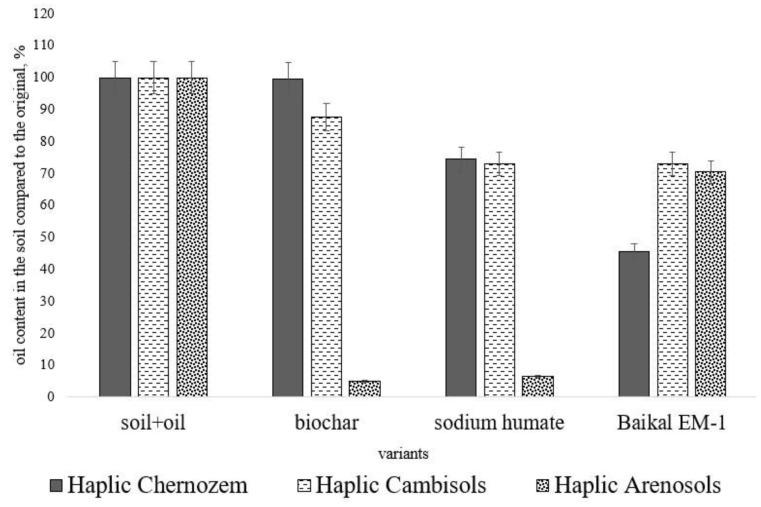
Soil pollution with oil as a result of accidents at oil pipelines and oil refineries is a frequent occurrence in the south of Russia. To restore such polluted lands, it is necessary to carry out soil remediation measures. This work aimed to evaluate the use of ameliorants of various natures (biochar, sodium humate, and microbial preparation Baikal EM-1) to restore the ecological state of oil-contaminated soils with different properties (Haplic Chernozem, Haplic Arenosols, Haplic Cambisols). To assess the ecological state of soils, the following physicochemical and biological indicators were studied: residual oil content, redox potential, and medium reaction (pH). Changes in enzymatic activity were also studied, including catalase, dehydrogenases, invertase, urease, and phosphatase. The greatest decomposition of oil in Haplic Chernozem and Haplic Cambisols was provided by Baikal EM-1 (56 and 26%), and in Haplic Arenosols, this was provided by biochar (94%) and sodium humate (93%). In oil-contaminated Haplic Cambisols, the content of easily soluble salts with the addition of biochar and Baikal EM-1 increased by 83 and 58%, respectively. The introduction of biochar caused an increase in pH from 5.3 (Haplic Cambisols) to 8.2 (Haplic Arenosols). The introduction of oil-contaminated Haplic Arenosols of biochar, humate, and Baikal stimulated the activity of catalase and dehydrogenases by 52-245%. The activity of invertase was stimulated in the Haplic Chernozem after the introduction of ameliorants by 15-50%. The activity of urease was stimulated after the introduction of ameliorants into borax and Arenosol by 15-250%. The most effective ameliorant for restoring the ecological state of Haplic Cambisols after oil pollution was biochar. For Haplic Arenosols, this was sodium humate, and for Haplic Chernozem, the effectiveness of biochar and sodium humate did not differ. The most informative indicator for the remediation of Haplic Chernozem and Haplic Cambisols was the activity of dehydrogenases, and for Haplic Arenosols, this was the activity of phosphatase. The results of the study should be used to biomonitor the ecological state of oil-contaminated soils after bioremediation.
由于石油管道和炼油厂事故导致的土壤油污污染在俄罗斯南部屡见不鲜。为了恢复此类污染土地,有必要采取土壤修复措施。这项工作旨在评估使用各种性质的改良剂(生物炭、腐殖酸钠和微生物制剂贝加尔EM - 1)来恢复具有不同性质(黑钙土、砂质新成土、雏形土)的石油污染土壤的生态状态。为了评估土壤的生态状态,研究了以下物理化学和生物学指标:残留油含量、氧化还原电位和介质反应(pH值)。还研究了酶活性的变化,包括过氧化氢酶、脱氢酶、转化酶、脲酶和磷酸酶。在黑钙土和雏形土中,贝加尔EM - 1对石油的分解作用最大(分别为56%和26%),而在砂质新成土中,生物炭(94%)和腐殖酸钠(93%)对石油的分解作用最大。在受石油污染的雏形土中,添加生物炭和贝加尔EM - 1后,易溶性盐的含量分别增加了83%和58%。生物炭的引入使pH值从5.3(雏形土)升高到8.2(砂质新成土)。向受石油污染的砂质新成土中引入生物炭、腐殖酸盐和贝加尔制剂后,过氧化氢酶和脱氢酶的活性提高了52% - 245%。在黑钙土中引入改良剂后,转化酶的活性提高了15% - 50%。在硼砂和砂质新成土中引入改良剂后,脲酶的活性提高了15% - 250%。对石油污染后恢复雏形土生态状态最有效的改良剂是生物炭。对于砂质新成土,是腐殖酸钠,对于黑钙土,生物炭和腐殖酸钠的效果没有差异。对黑钙土和雏形土修复最具信息量的指标是脱氢酶的活性,而对于砂质新成土,是磷酸酶的活性。该研究结果应用于生物修复后对石油污染土壤的生态状态进行生物监测。




 Zotero 插件