
加拿大安大略省家庭医生的 COVID-19 大流行期间的虚拟护理和急诊科使用情况。
Virtual Care and Emergency Department Use During the COVID-19 Pandemic Among Patients of Family Physicians in Ontario, Canada.
机构信息
Department of Family and Community Medicine, St Michael's Hospital, University of Toronto, Toronto, Ontario, Canada.
MAP Centre for Urban Health Solutions, Li Ka Shing Knowledge Institute, St Michael's Hospital, Toronto, Ontario, Canada.
出版信息
JAMA Netw Open. 2023 Apr 3;6(4):e239602. doi: 10.1001/jamanetworkopen.2023.9602.
IMPORTANCE
The COVID-19 pandemic has played a role in increased use of virtual care in primary care. However, few studies have examined the association between virtual primary care visits and other health care use.
OBJECTIVE
To evaluate the association between the percentage of virtual visits in primary care and the rate of emergency department (ED) visits.
DESIGN, SETTING, AND PARTICIPANTS: This cross-sectional study used routinely collected administrative data and was conducted in Ontario, Canada. The sample comprised family physicians with at least 1 primary care visit claim between February 1 and October 31, 2021, and permanent Ontario residents who were alive as of March 31, 2021. All residents were assigned to physicians according to enrollment and billing data.
EXPOSURE
Family physicians' virtual visit rate was the exposure. Physicians were stratified by the percentage of total visits that they delivered virtually (via telephone or video) during the study period (0% [100% in person], >0%-20%, >20%-40%, >40%-60%, >60%-80%, >80% to <100%, or 100%).
MAIN OUTCOMES AND MEASURES
Population-level ED visit rate was calculated for each stratum of virtual care use. Multivariable regression models were used to understand the relative rate of patient ED use after adjusting for rurality of practice, patient characteristics, and 2019 ED visit rates.
RESULTS
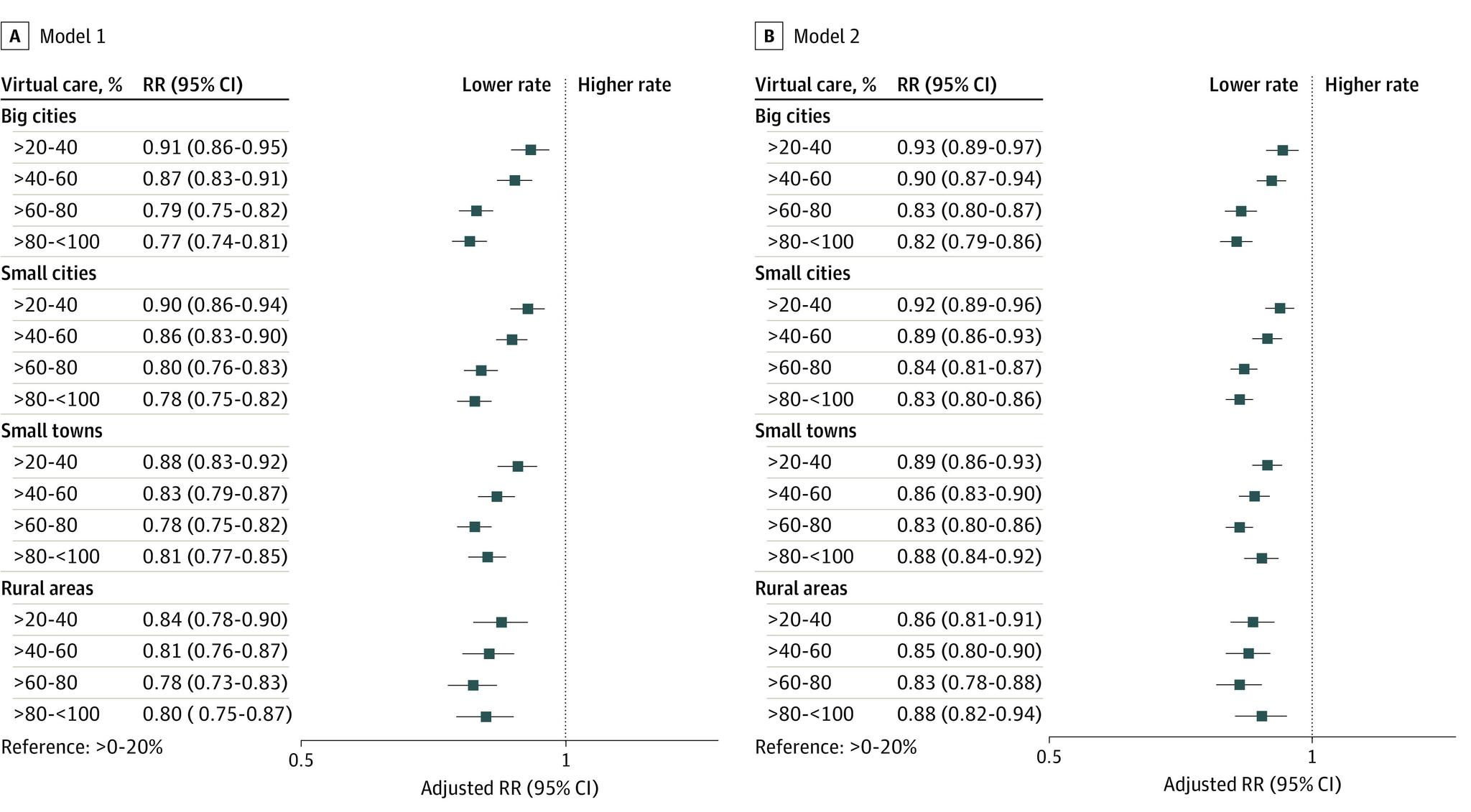
Data were analyzed for a total of 13 820 family physicians (7114 males [51.5%]; mean [SD] age, 50 [13.1] years) with 12 951 063 patients (6 714 150 females [51.8%]; mean [SD] age, 42.6 [22.9] years) who were attached to these physicians. Most physicians provided between 40% and 80% of care virtually. A higher percentage of the physicians who provided more than 80% of care virtually were 65 years or older, female individuals, and practiced in big cities. Patient comorbidity and morbidity were similar across strata of virtual care use. The mean (SD) number of ED visits was highest among patients whose physicians provided only in-person care (470.3 [1918.8] per 1000 patients) and was lowest among patients of physicians who provided more than 80% to less than 100% of care virtually (242.0 [800.3] per 1000 patients). After adjustment for patient characteristics, patients of physicians with more than 20% of visits delivered virtually had lower rates of ED visits compared with patients of physicians who provided more than 0% to 20% of care virtually (eg, >80% to <100% vs >0%-20% virtual visits in big cities: relative rate, 0.77%; 95% CI, 0.74%-0.81%). This pattern was unchanged across all rurality of practice strata and after adjustment for 2019 ED visit rates. In urban areas, there was a gradient whereby patients of physicians providing the highest level of virtual care had the lowest ED visit rates.
CONCLUSIONS AND RELEVANCE
Findings of this study show that patients of physicians who provided a higher percentage of virtual care did not have higher ED visit rates compared with patients of physicians who provided the lowest levels of virtual care. The findings refute the hypothesis that family physicians providing more care virtually during the pandemic resulted in higher ED use.
重要性
COVID-19 大流行导致初级保健中虚拟护理的使用增加。然而,很少有研究调查虚拟初级保健访问与其他医疗保健使用之间的关联。
目的
评估初级保健中虚拟访问的百分比与急诊部 (ED) 就诊率之间的关联。
设计、设置和参与者:这是一项使用常规收集的行政数据进行的横断面研究,在加拿大安大略省进行。样本包括在 2021 年 2 月 1 日至 10 月 31 日期间有至少一次初级保健就诊记录的家庭医生,以及截至 2021 年 3 月 31 日仍在世的安大略省永久居民。根据注册和计费数据,为所有居民分配医生。
暴露
家庭医生的虚拟访问率是暴露因素。医生根据他们在研究期间通过电话或视频提供的总访问量的百分比进行分层(0%[100%面对面]、>0%-20%、>20%-40%、>40%-60%、>60%-80%、>80%-<100%或 100%)。
主要结果和措施
为每个虚拟护理使用阶层计算了人群层面的 ED 就诊率。使用多变量回归模型来理解在调整实践的农村性、患者特征和 2019 年 ED 就诊率后患者 ED 使用的相对率。
结果
共分析了 13820 名家庭医生(51.5%为男性[51.5%];平均[SD]年龄为 50[13.1]岁)和 12951063 名患者(6714150 名女性[51.8%];平均[SD]年龄为 42.6[22.9]岁)的数据,这些患者隶属于这些医生。大多数医生提供 40%至 80%的虚拟护理。提供超过 80%虚拟护理的医生中,65 岁或以上的医生、女性医生和在大城市执业的医生比例更高。在虚拟护理使用的各个阶层中,患者的合并症和发病率相似。在仅接受面对面护理的患者中,平均(SD)ED 就诊次数最高(每 1000 名患者 470.3[1918.8]次),而在接受虚拟护理比例超过 80%至不到 100%的患者中,平均(SD)ED 就诊次数最低(每 1000 名患者 242.0[800.3]次)。在调整患者特征后,与接受 0%至 20%虚拟护理的患者相比,接受超过 20%虚拟护理的患者的 ED 就诊率较低(例如,>80%至<100%与>0%-20%虚拟就诊于大城市:相对率,0.77%;95%CI,0.74%-0.81%)。这种模式在所有农村实践阶层中都没有改变,并且在调整 2019 年 ED 就诊率后也没有改变。在城市地区,存在一个梯度,即接受虚拟护理最高水平的医生的患者 ED 就诊率最低。
结论和相关性
这项研究的结果表明,与接受最低水平虚拟护理的患者相比,接受虚拟护理比例较高的医生的患者 ED 就诊率没有更高。这些发现反驳了家庭医生在大流行期间提供更多虚拟护理会导致 ED 使用增加的假设。


 Zotero 插件